


Visual content plays a key role in how users understand and evaluate real estate offers. In this article, we explain why 3D content outperforms traditional visuals, how spatial awareness influences decision-making, and why interactive 3D solutions have become an effective marketing tool in the real estate industry.
The best ads of recent years share one trait: visual refinement. Psychological studies back this up - people need to experience visual content to engage with a presentation or advertisement and remember what matters.
We go a step further than static graphics. Consider 3D content, which anyone can experience on any device, anytime and anywhere. But accessibility is only part of it - what matters more is the impact such content has on perception and decision-making. So why does it perform so well?
Drawing on our real estate technology, Vinode, we explain how advanced visual solutions support marketing and drive sales effectiveness.
Spatial awareness: its value in visual real estate marketing
No matter how precisely a project is described in words, it strikes the imagination differently than a visual presentation does. Between 50% and 80% of the human brain processes visual content - shapes, color, texture, patterns, and spatial awareness. It's that last one we want to focus on. What does spatial awareness mean in visual marketing?
It's the ability to perceive our environment in relation to ourselves. Two processes drive it: one builds representations of the surrounding space through our senses, the other models our own body - its position and orientation. Space is an integral part of our thinking that connects all our experiences.
It also covers how we read the relationship between two objects set apart, or how their positions shift within a space - letting us think in both two and three dimensions. But in marketing presentations, plain 2D visuals often can't convey three-dimensional space to a potential buyer. In real estate especially, where layout and proportions must read accurately, experiencing space in 3D becomes essential to grasp both the place and its location.

This is why we built 3D web apps for real estate developers. Our service pairs state-of-the-art rendering with web technology so agents can present all the necessary information at once, saving time and effort. Property visuals render in real time, letting clients explore them instantly without delays or loading times. We deliver original content for every unit, so you can target your visuals precisely.
3D web app as a powerful marketing tool
Visualizing products - or, in real estate, offers - is now the way to help buyers understand functionality and unique features.
3D web apps carry emotional weight and help customers decide. The more someone sees and understands before buying, the less likely they are to regret the purchase. With 3D visualizations, there's no need to imagine layouts or proportions before meeting an agent - the space is no longer abstract. Even the best interior photos only partly convey what it feels like to move through a room. 3D sites address these limits with a more realistic, immersive sense of space.
How will your sales factors change with such a solution?
Better brand recognition and visibility
Standing out is one of the key challenges in real estate today. More companies are experimenting with 3D, but many still rely on standard presentations. A dedicated 3D site attracts more attention than a traditional website built on static photos alone. Visibility rises, and buyers find the brand easier to recognize and remember.
Time-saving
Photorealistic 3D visualizations cut the time required from both customers and agents. Many buyers can't attend multiple on-site viewings. When they explore the property in detail beforehand and access key information remotely, they arrive better informed and more confident. Agents can then focus on final details instead of explaining basic layout and functionality - a substantial time saving.
Lead generation
Take Vinode as an example: this kind of solution generates highly qualified leads. Users explore entire investments - buildings, apartments, surrounding areas, and points of interest - all within one 3D environment. That transparency raises engagement and encourages users who already know the offer to take the next step and become customers.
Improved data management
Our platform combines CMS (content management system) and CRM (customer relationship management) functionality. Administrators manage and update the web app, while sales reps get immediate access to new leads and the data behind them. Efficient data management smooths internal communication and helps sales teams prepare for meetings, improving the chances of closing deals.
User journey is simple and enjoyable
A key element of our 3D visualizations is highlighting building segments as users make a selection, so apartments can be chosen from multiple angles.
Exploring 3D visualizations anywhere, anytime, on any connected device is convenient. But we also account for showroom presentations: we can build interactive kiosks that run 3D presentations on 4k resolution screens on site. Those digital kiosks can also gather data and essential information about customers.
Conclusions
3D visual marketing connects with people better than anything else. Buyers want information as fast and clearly as possible, so investing in 3D web apps is a step toward your future.
No other solution is so compact. We remember about 20% of what we read and 80% of what we see - and when visuals are interactive, that impression sticks even harder.
If our solution interests you, visit our page and sign up on the Vinode wishlist. We'd love to work with you!
FAQ
Why is visual content so important in real estate marketing? Because buyers rely heavily on visual perception to understand space, proportions and layout, which directly influences their confidence and purchase decisions.
What makes 3D content more effective than traditional photos? 3D content allows users to explore space interactively, offering a more realistic sense of scale, movement and spatial relationships than static images.
How does spatial awareness influence buying decisions? When users clearly understand how a space is organized and how it relates to their own movement, they feel more confident and engaged, which supports faster decision-making.
Can 3D visualizations reduce post-purchase dissatisfaction? Yes. By presenting space accurately before purchase, buyers know what to expect, which lowers the risk of unmet expectations.
Is 3D content accessible on different devices? Modern 3D web solutions are designed to work smoothly across desktops, tablets and mobile devices without additional software.

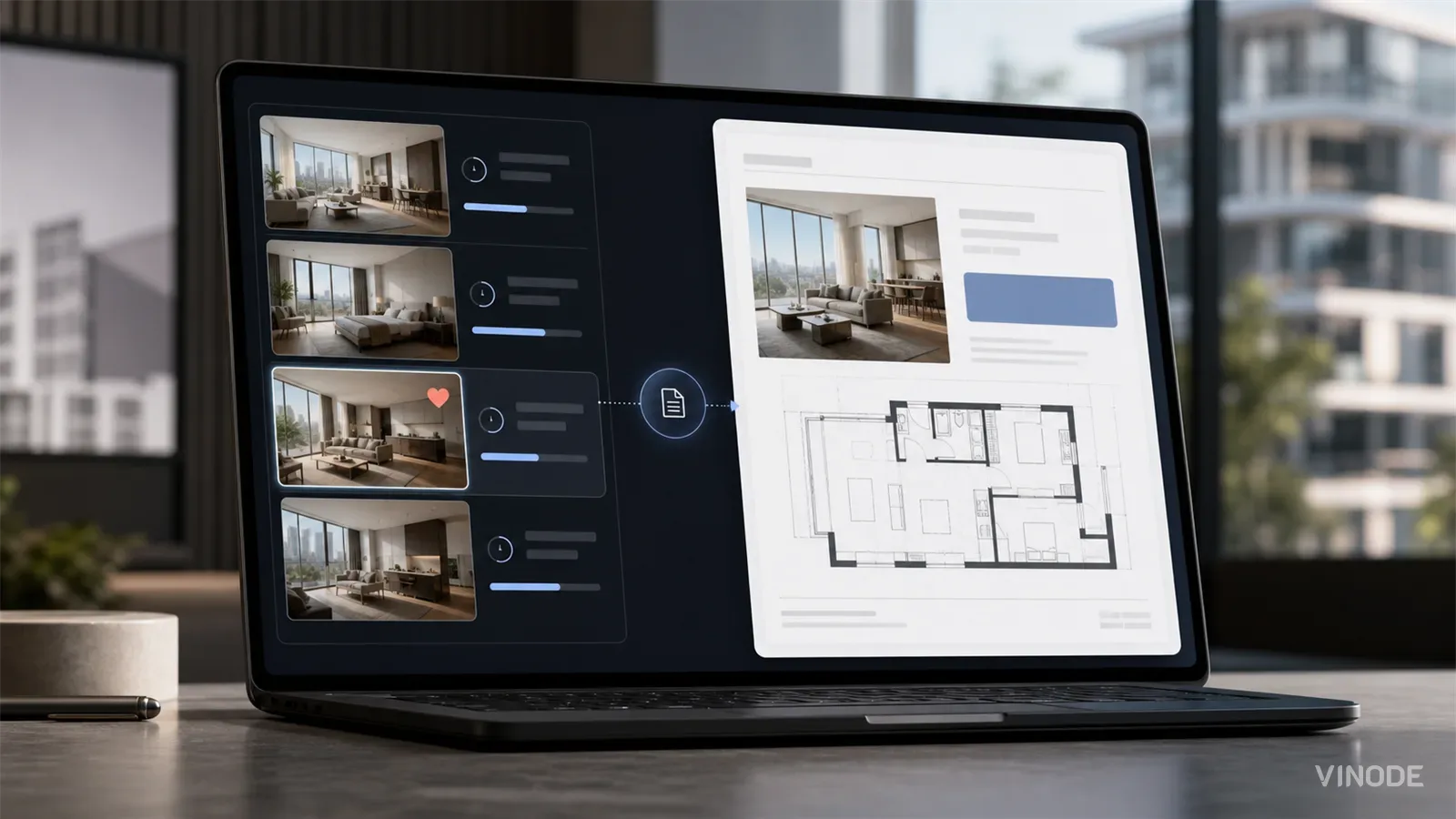
The Unit-Specific PDF a Buyer Actually Asked For
A buyer spends nineteen minutes on one two-bed, saves it, and gets the forty-one-page development brochure the next morning. Once a sales platform records the unit a buyer chose, the generic brochure becomes a decision to ignore that choice.

Expression of interest before release day: capture unit demand
640 names and no idea which side of the building they want. An expression of interest campaign pays off when the form is joined to the units each buyer explored, and each of these checks has a pass, a fail and a cost.

We measured when a pipeline crosses the presale line, not just whether it will
When GTHA opening-quarter absorption averaged 66%, the sold percentage was enough to forecast a presale crossing date. Then absorption fell to 17%. Three pipeline inputs produce the crossing date your lender asks for: stage-conversion rates, a cancellation haircut, and remaining inventory.