
Why do buyers abandon house and land configurators?

Key Takeaways
- A house-and-land configurator can deliver instant pricing, accurate pricing or full self-service, and only two at once.
- Site costs depend on an assessment of real ground, so no configurator can bind a final price the moment a buyer picks a lot.
- The gap between base price and signed contract is the cost of site work nobody has done yet, and the buyer finds it in the contract.
- Pricing the known choices instantly and capturing the rest as a qualified lead keeps the buyer moving without publishing a number the contract will contradict.
A sales agent at a house and land client showed me a screenshot on his phone that a buyer had sent him at seven in the morning. She had configured a four-bed on a corner lot the night before, around midnight going by the timestamp, and the configurator had given her a number. The contract he emailed her the following week was a good deal higher, because the lot slopes and needs a retaining wall and a longer service run, and none of that was in the tool. Her message under the screenshot was one line: which one is the real price? He had had this conversation before. The ones who ask, he said, are the polite ones. Most just stop replying.
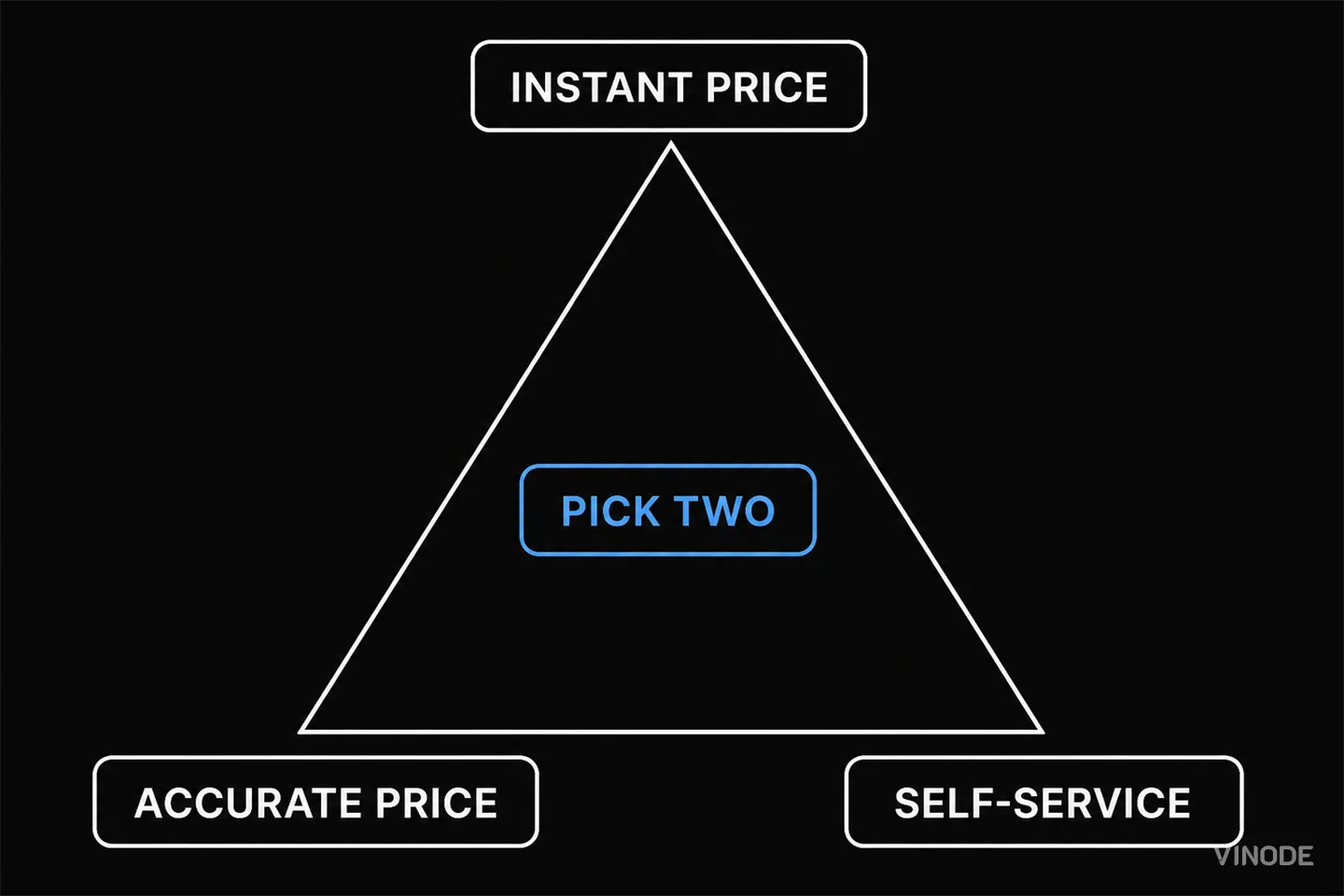
A configurator gets asked for three things: an instant price, an accurate price, and self-service with no agent in the loop. It can give you two. The third corner is where buyers leave, and the way out is to price what the tool can know and capture the rest as a lead, instead of showing a number it cannot stand behind.
The configurator triangle
Instant: the buyer picks a design and a lot and a number appears. Accurate: the number is what they will actually pay, site costs included. Self-service: no phone call, no agent, works at midnight. We call this the configurator triangle, and you get two sides of it.
The reason is in the ground. Site costs, slope, soil, retaining walls, service connections, need a person standing on the lot with a level and a soil report. A CMS field cannot hold what nobody has measured yet. We can price house designs and standard inclusions instantly, because someone typed those numbers in. We cannot price the ground under one particular lot, because an engineer has to look at it first.
Instant and self-service, and the price is wrong
Most builders take this pair without deciding to. The buyer picks a design, picks a lot, the configurator adds up the base prices from the CMS, and a number appears. Fast, self-serve, and wrong. It leaves out site costs, lot premiums, the driveway, fencing, retaining walls, landscaping, everything that depends on what this piece of land looks like. The gap between the advertised base price and the signed contract is the cost of work nobody has done yet: a site assessment, a soil test, a surveyor measuring the slope. A buyer who configured a home at one figure and recieved a contract well above it knows exactly why she left. The tool showed her a price it could not hold. A from price is the same choice in a smaller font.
Secondary source, aggregating e-commerce research broadly (not house-and-land-specific). The pattern still holds: a price that surprises at checkout kills the session.
Source: Magebit (secondary) - as of
Accurate and self-service, and the quote takes a week
Some developers refuse to publish a number they cannot hold. The configurator captures the whole selection, design, lot, upgrades, and tells the buyer a real price will follow once the site has been assessed. The number that arrives days later by phone is right. But the buyer's peak moment was at midnight, choosing the kitchen and the premium facade, and by the time the quote lands that moment has gone. She has moved on, or started to wonder what else takes a week. Right and slow loses to fast and wrong more often than it should. I do not think that is fair, but it is what the abandonment numbers say.
Instant and accurate, and it lives in one head
The third pair is a sales agent who already knows every lot's site costs and quotes in real time. Right number, right then. It needs a person who has walked the estate with the engineer, and that person is not available at midnight. It also puts the whole pricing model in one head. When that agent takes leave or resigns, the knowledge walks out with them, and on a launch weekend with thirty buyers browsing at once and one person who can quote, you have built a sales channel around someone's memory. This works on a boutique estate of twenty premium lots where one agent handles every conversation. It does not scale to two hundred lots in a land release, and it definately does not survive staff turnover.
Price what you know, capture the rest
The triangle assumes the configurator has to return one final all-in number. Drop that assumption and there is a fourth option, which we call the hybrid: price what the configurator knows, capture what it does not.
The tool prices the house design, the standard inclusions and the lot base price instantly and self-service, because those are discrete choices typed into a CMS and adding them up is what software is good at. The parts it does not know get handled diffrent. Everything the buyer configured is saved as a qualified lead, routed to the deal pipeline, and the site cost is quoted by callback within a stated time. The buyer stays in the configurator through the part that works, sees a number she can trust, and leaves with a personalised PDF that shows the bound part of the price and a clear label on what is still to be quoted.
Does this just move the abandonment to the callback? Some buyers will still leave when the site cost arrives. But a buyer who was told to expect that call handles it very differently from one opening a contract far above her midnight screenshot, and the developer has a qualified lead with the whole configuration attached instead of an anonymous abandoned session.
Which two to build around
Most house and land projects should take the hybrid. The exception is a small premium estate where one agent knows every lot's conditions, and there the person is faster than any pipeline. That is twenty lots, though, and it stops being true at two hundred. Whatever you build, decide which two sides of the triangle it delivers and say so on the screen. A gap the buyer discovers in the contract costs you the buyer. A gap the configurator names up front costs you a phone call.
Turn configurator sessions into qualified leads
See how a pre-rendered experience works on your own phone.