
Cost per lead vs. cost per reserved unit: the two numbers that defend a marketing budget
Key Takeaways
- A lead-to-reservation rate of about 2% is the threshold: above it cost-per-reservation arithmetic works, below it no lead price is cheap enough to produce a number a board will fund.
- Two channels with the same CPL can produce cost-per-reservation figures that differ by 5x, because the conversion rate through to reservation sets the number rather than the lead price.
- No published benchmark for cost per reserved unit exists in new-build development, so the only figure you can defend in a board meeting is your own measured one.
A marketing manager at a client showed me the slide that had lost her a third of her budget. Two channels side by side, cost per lead on each, one at a fraction of the other. The board had read it the obvious way and cut the expensive one. What the slide did not show was that the expensive channel's leads were reserving units at three times the rate, so the cheap channel was the one costing more per reserved unit. She had the reservation data in the CRM. It had never made it onto a slide.
Report cost per reserved unit alongside cost per lead, for every active channel, in the next board deck. Most developer marketing teams report CPL because it is the number their ad tools hand them, and the board cuts the budget anyway, because CPL does not connect to what a reservation cost.
One system, first click to deposit
You need a system that follows a lead from first click through to deposit, with spend attached per channel. Most setups hand the lead to a separate CRM and the connection breaks.
We track both in Vinode's back panel, per campaign, with attribution through to the deposit. The trade-off is real: it only works when every lead flows through one system. A developer with an established CRM is adding a pipeline or migrating one.
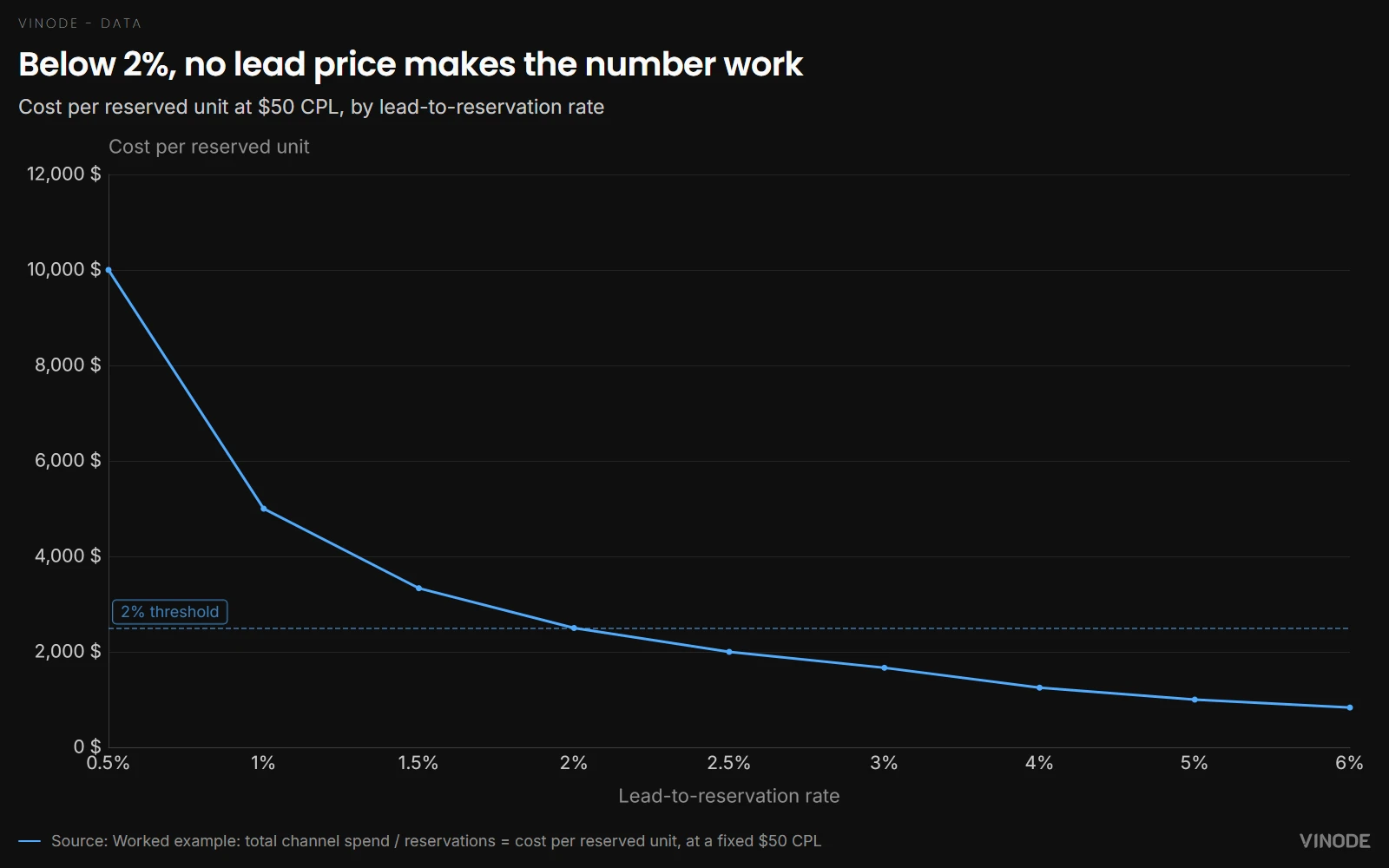
Below 2%, no lead price is cheap enough
Cost per reserved unit is total channel spend divided by reservations from that channel. Not cost per sale in the brokerage sense. A reservation is a deposit commitment, the point where a buyer puts money down on a specific unit.
At a 2% lead-to-reservation rate, a $30 lead costs $1,500 per reserved unit. Drop that rate to 1% and same lead costs $3,000. Cut your CPL in half to $15, still $1,500 per reservation. Below 2%, no reduction in lead price produces a cost per reservation that survives a board meeting.
Run two channels. Channel A: $30 per lead, 2% conversion to reservation, $1,500 per reserved unit. Channel B: $75 per lead, 6% conversion, $1,250 per reserved unit. Cheaper lead, more expensive reservation. Hold CPL constant at $50 and vary only the conversion rate: 1% gives you $5,000 per reservation, 5% gives you $1,000. Five times the difference from a number that never appears on the ad platform.
These are worked examples. No published cost-per-reserved-unit benchmark exists for new-build developers.
The second risk is time. Off-plan sales relationships run 6 to 18 months. A campaign measured on CPL at month one and cost-per-reservation at month six tells two diffrent stories about the same spend. Finance that judges ROI on immediate closings kills campaigns still working through the funnel. This does not apply to spec homes that close in 30 days, where CPL tracks directly to the sale.
Digital lead or walk-in: same price, different reservation
Lead type changes cost per reservation seperate from lead price. Digital leads in new-build development convert at roughly 1-in-25 (Bokka Group, 2016-17 Home Buyer Conversion Report). Walk-in leads convert at 20-40% (Builder Lead Converter). The Bokka figure is nine years old and remains the only published conversion rate specific to new-build digital leads. Same CPL, wildly different cost per reservation depending on whether the lead walked through a door or clicked an ad.
The most cited budget convention in residential development, '2% of GDV on marketing', is itself unsourced. DS.Emotion and others reference it. No primary source backs it. No survey, no industry body, no government dataset.
Same metric, different audience
Cost per lead
An operating metric. Tells marketing how efficiently a channel generates interest. Useful for optimizing spend week to week. Tells the board nothing about what a reservation cost.
Cost per reserved unit
A business metric. Tells the board what each deposit commitment costs from each channel. This is the number that defends a marketing budget.
0.8% to 2.2% on one project
One of our clients switched their project's sales presentation and lead capture to Vinode in Q2 2025. Same area, same price bracket, before and after on the same project. Lead-to-sale moved from 0.8% to 2.2%. Visitor-to-sale moved from 0.01% to 0.06%. One client, one project, client-reported.
The absolute numbers are small. But 0.8% is deep below the threshold where cost-per-reservation arithmetic works. At 2.2% it crosses into the range where the number you put in front of a board holds. A few points of conversion rate move cost per reservation by multiples.

What happens if you report only CPL
The budget gets cut. The board sees $30 per lead on one channel and $75 on another. Clear winner. But Channel B at $1,250 per reservation is cheaper than Channel A at $1,500. Without the conversion rate, the slide tells the opposite story.
You optimize a metric the board does not use. You lose the conversation about the one they do.
Sixteen generate_lead events on vinode.io in Jul-Aug 2026, every one under 'Unassigned' channel in GA4. Our system tracks 14 custom dimensions including first-touch attribution. Channel data was not connecting to conversions. The measurement blind spot this post describes sat in our own analytics.
Both numbers in the next board deck
Calculate cost per reserved unit for every active channel and put both numbers in front of the board before the next meeting. The marketing manager with the slide did, the following quarter, and got the channel back.

The Unit-Specific PDF a Buyer Actually Asked For
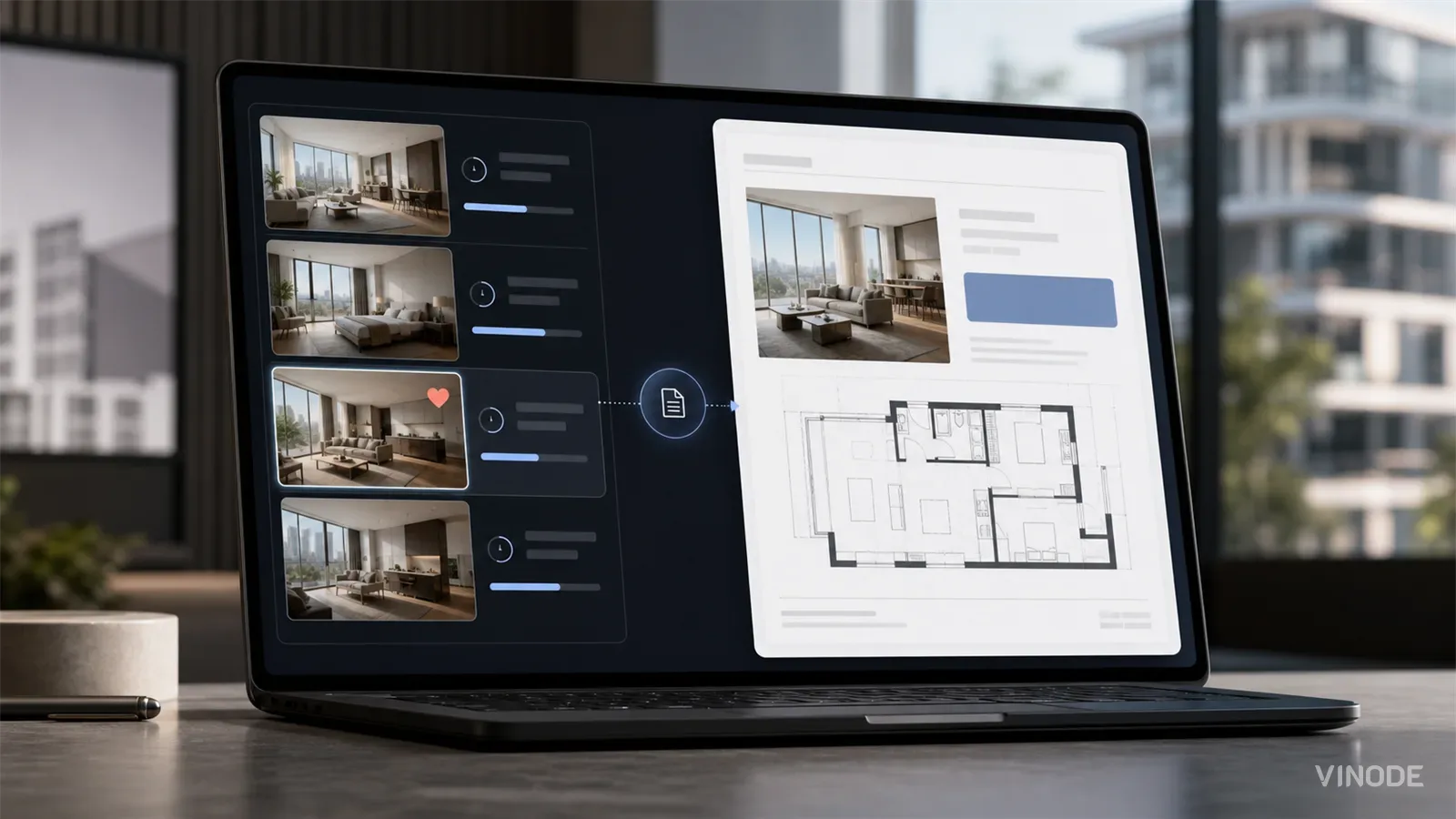
A buyer spends nineteen minutes on one two-bed, saves it, and gets the forty-one-page development brochure the next morning. Once a sales platform records the unit a buyer chose, the generic brochure becomes a decision to ignore that choice.

Expression of interest before release day: capture unit demand
640 names and no idea which side of the building they want. An expression of interest campaign pays off when the form is joined to the units each buyer explored, and each of these checks has a pass, a fail and a cost.

We measured when a pipeline crosses the presale line, not just whether it will
When GTHA opening-quarter absorption averaged 66%, the sold percentage was enough to forecast a presale crossing date. Then absorption fell to 17%. Three pipeline inputs produce the crossing date your lender asks for: stage-conversion rates, a cancellation haircut, and remaining inventory.