
EU AI Act Article 50: do property renders need an AI label?

Key Takeaways
- A property visual owes an AI Act disclosure only if it is AI-generated and resembles something that already exists.
- A conventional path-traced frame simulates light over an authored model; it is not generative AI output.
- Article 50(5) requires a legible mark at first exposure, not a prominent banner.
- The EU's free labelling icons are optional artwork, and equivalent designs remain valid.
A marketing lead opens the sales site on Sunday morning, 2 August, with an AI Act headline in one tab and a gallery of apartment renders in the other. The immediate fear is practical: every image, flythrough and interactive 3D view may now need a warning.
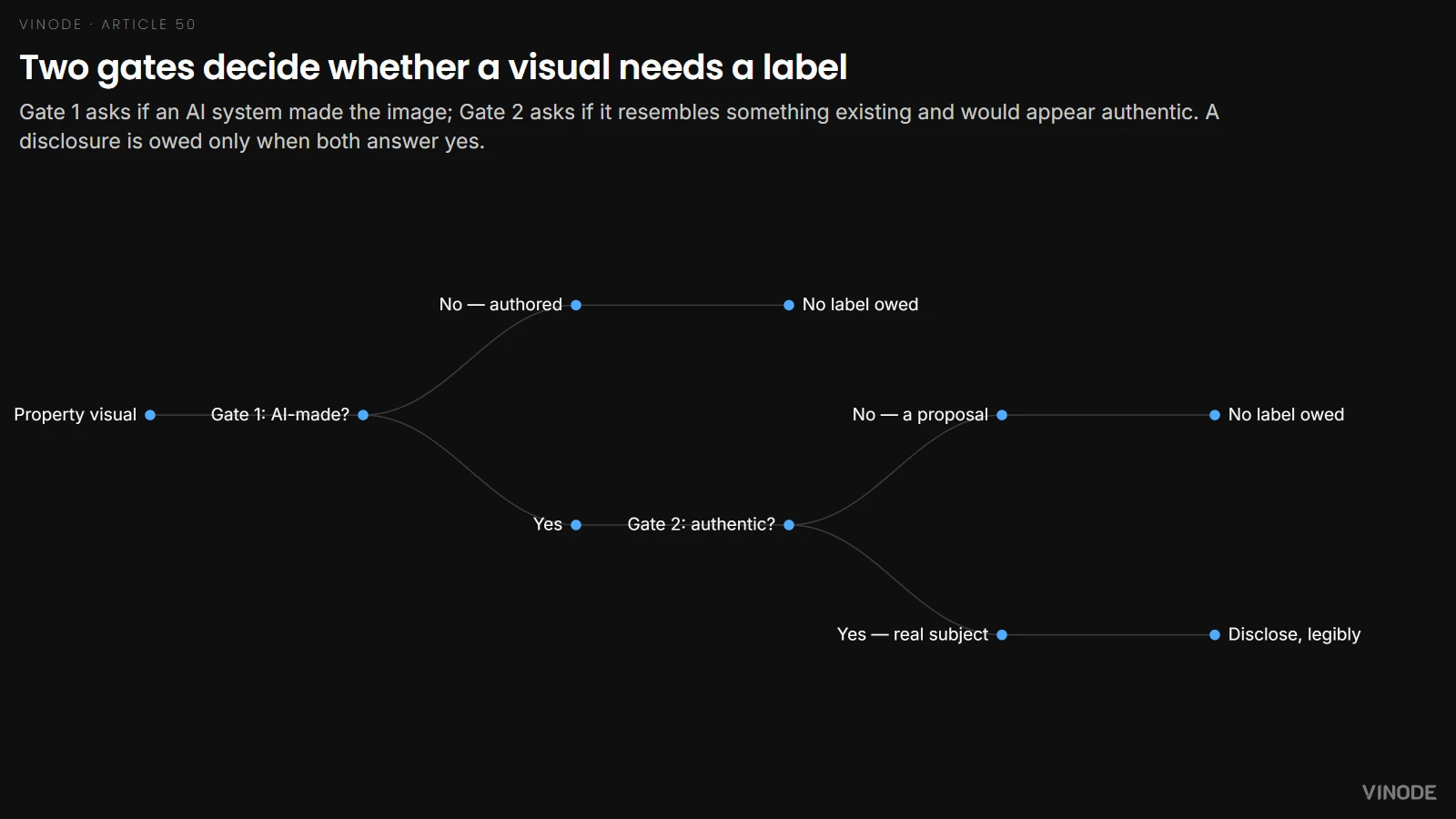
No. A render of an unbuilt building is not automatically a deep fake, and a conventional 3D render is not AI-generated merely because it is photorealistic. Article 50(4) reaches a property visual only when two conditions are both true: an AI system generated or manipulated it, and the result resembles an existing person, object, place, entity or event in a way that would falsely appear authentic. Miss either gate and that disclosure duty does not attach.
This is narrower than many deadline headlines suggest, but it is not a free pass for every image on a property page. A generated person in a lobby, a synthesised photograph of the real street outside, or imagery of a completed development can cross both gates. The response is an asset audit focused on those edge cases.
What actually applies on 2 August 2026
Article 50 is a transparency rule. It requires disclosure of deep fakes; it does not ban them. The AI Act's prohibited practices sit in Article 5 of Regulation (EU) 2024/1689 and have applied since 2 February 2025. They cover matters such as social scoring and untargeted scraping of facial images. Architectural visualisation sits outside that list.
The timing has also been muddled by the Digital Omnibus. As we write in late July, negotiators have provisionally agreed to move the high-risk deadlines: stand-alone uses listed in Annex III, such as specified systems used for employment or access to essential services, to 2 December 2027; AI embedded in products covered by the safety legislation listed in Annex I, to 2 August 2028. Formal adoption and publication are expected before 2 August. That change does not move the core Article 50 transparency date. It also adds a four-month grace period, until 2 December 2026, for providers of generating systems already on the market to implement Article 50(2)'s machine-readable marking. The Commission's Article 50 FAQ sets out the transparency timetable and the division of duties.
That machine-readable duty belongs to the provider of the generating system: the model vendor. A property developer publishing qualifying generated content is the deployer, and Article 50(4) gives that deployer the human-readable disclosure duty. Provenance embedded by a provider does not replace the label a person sees.
Gate 1: establish whether an AI system was involved
We need to separate rendering from generation. In a conventional architectural pipeline, an artist builds geometry, assigns materials, places lights and defines cameras. Unreal Engine then solves how light travels through that scene. Path tracing samples light paths to estimate each pixel's colour. It is a numerical simulation, not machine learning.
The renderer does not infer a new facade from training data or improvise the next frame from a prompt. It evaluates an authored model. Camera, geometry, materials and lighting are invariants: properties that must not change between equivalent views. With those inputs fixed, the engine evaluates the same decisions. Article 50 stops at Gate 1.
A package can contain AI-assisted features without making every output AI-generated. Follow the asset's production path. Did a model generate people, rebuild a real sky, extend a photograph or replace an existing object? Record that step. If artists modelled the scene and a renderer calculated its light, the engine's sophistication does not turn simulation into generation.
Path tracing calculates an authored decision. Generative AI proposes a new one. Treating those as the same process makes the audit useless.
Gate 2: test resemblance and authenticity
Suppose an AI system did touch the image. That still does not finish the test. Article 3(60) asks whether the result resembles something that exists and falsely appears authentic.
An off-plan tower is a proposal. The building shown in the render does not yet exist, and a buyer meets it in the established visual grammar of property marketing: plans, renders, material samples and completion dates describe what is intended to be built. A photorealistic style does not convert that proposal into a photograph of a completed object. Put directly: an AI-generated render of a building that has not been built is not a deep fake merely because it looks photographic. The Commission's draft Article 50 guidelines treat context and audience expectations as part of the authenticity assessment; the guidance also places clearly fantastical or physically impossible content outside the definition. The guidance was still in progress as the deadline approached and was not binding legal text.
"Label every realistic image" is therefore a poor operational rule. It collapses origin, referent and authenticity into a judgement about style. The boundary is not a quality score. A mediocre generated image can qualify if it presents something existing convincingly enough to mislead. A flawless image can fall outside Article 50 because no AI system generated it, or because it plainly depicts a proposal.
Where the property-visual test changes
The subject and setting can produce different answers inside one frame. The proposed tower may not exist, while the neighbouring street, skyline and park do. If an AI system synthesised that context and it reads as a photograph of the actual place, Gate 2 is no longer an automatic no. Audit a composite at element level, because one origin field for the whole file can hide the part that qualifies.
Synthetic people are the likeliest property-page element to clear both gates. A generated person relaxing in a lobby is intended to read as a photographic human, even if that person has no name. A generated replacement or manipulated face requires the same assessment.
A completed development also changes the referent. Once the building exists, it is an existing object. Generated or heavily manipulated post-completion imagery needs a different assessment from an off-plan proposal. When a real photograph is extended, cleaned or recomposed with generative tools, record the exact intervention alongside the filename.
One boundary sits outside Article 50 altogether. This test isn't for approving what a render promises. Adding a park, removing an inconvenient road or overstating the approved materials can mislead buyers even when the image is entirely artist-authored. Consumer-protection and advertising duties survive independently. At Vinode, this is our operational reading of Article 50, not legal advice.
Where we use generative AI, and where we do not
Vinode's standard production pipeline does not use generative AI to produce the 3D work we deliver. Geometry, materials, lighting and cameras are authored, and frames are pre-rendered in Unreal Engine, with Maya, Cinema 4D and Blender also used in production.
We hold that line for a practical reason. An off-plan experience has to preserve continuity across hundreds of frames, angles and unit variants. The invariant is the development itself: balcony rails, window divisions, stone textures and lighting conditions must remain identical whenever a buyer returns to the same state. A generated frame can look convincing alone and still change one of those facts in the next view. A pair of individually convincing frames fails as one deliverable when the balcony rail moves between them. The technology is not yet reliable enough for the continuity problem we are selling.
We do use generative tools around the render, in studio work and in our own tooling, wherever they improve the process without changing the fidelity of the delivered property. We use every tool that earns its place. Variation belongs in an internal exploration or a coding task where a person can inspect the result. It cannot quietly edit the building a buyer is considering.

Image co-authored with help of AI for illustrative purposes
The ✦ on our own site
We already make this decision in public. Some illustrative images on this blog carry a small ✦ mark and the line "Image co-authored with help of AI for illustrative purposes." A footer legend explains it. We apply the mark to photorealistic illustrative imagery that could read as a real photograph.
Diagrams, charts, wireframes and renders of unbuilt buildings do not carry it because they fail the Article 3(60) test. Applying the two gates to our own work keeps the mark meaningful.
The design is deliberately quiet. The glyph sits on the image, a plain-language line accompanies the full-size view, and assistive technology can read machine-readable meaning from the mark. We chose this treatment so the disclosure remains present and legible from the person's first exposure without becoming the subject of the image.
Requirement versus recommendation
Article 50(5) says the disclosure must reach a person in a "clear and distinguishable manner at the latest at the time of the first interaction or exposure." That is a legibility and timing test. It does not prescribe a large banner or require a marketing team to cover the subject of an image.
On 10 June 2026, the Commission published the voluntary Code of Practice on marking and labelling of AI-generated content and a free set of three labels: a basic icon, "Fully AI-Generated," and "Partially AI-Modified." Each comes in four variants across black, white and 50%-transparency treatments, in SVG and PNG, with no attribution required.
The Commission's EU icons page states the limit plainly. The icons are optional, and using one does not establish legal compliance by itself. An organisation may use an equivalent design. The statutory object is the disclosure; the icon is artwork that can support it. Our disclosure design remains exactly as it is.
The voluntary Code adds placement specifications for its signatories. A mark should be perceivable at first exposure, free from an intervening overlay and embedded in the content so that it survives resharing or download. For published text covered by the Code, it belongs at the top, near the byline or before the headline; a footer-only notice arrives too late. That point concerns the initial disclosure on text. It does not prohibit a supplementary legend elsewhere on the page.
The Commission tested the designs in France and Romania, including how much explanation readers trusted.
Source: European Commission, EU icons for labelling AI-generated content - as of
The "AI" acronym paired with a short label such as "AI MODIFIED" performed better than icon-only designs on comprehension, trust and reliability. Longer notices naming tools and explaining oversight workflows performed worse on reader trust than brief labels did.
That gives marketing teams a calibration rule. A bare glyph asks the reader to decode too much; a paragraph asks them to stop and inspect the production workflow. The useful middle names the intervention in a short label that remains legible on a mobile image.
The research does not prove one design best in every layout. It gives us a practical QA target: the reader should understand the intervention at first exposure. Test the implementation at its real display size, with the crop, overlays and contrast a visitor actually sees. A mark that disappears on a phone or vanishes after download has failed. Once a short label remains visible and explains the intervention, adding a legal paragraph over the photograph contributes no useful information.
The asset record to hand your team
Asset and production path
List the page, file and responsible producer. Record the render, compositing, generation and manipulation steps from the production history.
Gate 1 evidence
Name the AI system and the part it generated or changed. If there was no AI step, record the authored pipeline and stop the test.
Gate 2 decision
Identify the real-world referent. Note why the result would or would not appear authentic in its published context.
Action and owner
Assign the disclosure, mobile and download checks, approval and review date. Preserve the record when a source asset or production method changes.
Article 50 breaches sit in the penalty tier of up to €15 million or 3% of total worldwide annual turnover, whichever is higher, with reduced ceilings for SMEs. A traceable asset decision is the useful control.
The same supervision line applies to UI and code
Generative AI is excellent at executing a decided design and dangerous at making one. Give a model fixed tokens, named components, enumerated states and a spacing scale, and it fills a known shape. It can write the fortieth card variant, connect validation states and port a pattern across twelve screens. The human made the design decision; the model does the typing.
Remove that system and the output converges on the median of its training material. Each screen invents spacing again. Components that should share behaviour drift. The page looks finished at first review but has no governing decision beneath it. Code fails in the same place: the happy path looks plausible, while errors, empty states and concurrent updates expose assumptions nobody specified.
A model multiplies the definition we give it. Named tokens, components and states keep repeated output inside the same grammar. Without them, the model samples familiar patterns and each new screen can drift. Our authored render pipeline and our supervised coding practice therefore share one control: later output must preserve decisions established earlier.
The one-afternoon audit
Article 50 is live today; the agreed high-risk delay does not change that transparency duty. Export the sales site's image and video inventory, then ask the production owner how each asset was made. Appearance alone cannot establish origin. Record any AI generation or manipulation. For assets that pass Gate 1, identify the existing referent and decide whether the published result would appear authentic.
Only assets that answer yes twice move to disclosure. Put a small, legible mark on the content where someone first encounters it, then test the mobile crop and downloaded file. A team without its own design can use the Commission's optional SVG or PNG artwork immediately, free of charge and without attribution.
Do not label every render to feel safe. That trains visitors to ignore the mark and obscures the decisions that matter. Run the two gates, retain the asset record, and mark what survives. Two words and an icon, on the image, where someone will see it. The job is done.
Review the production path behind your property visuals
Bring the two-gate test to a Vinode walkthrough and ask how every delivered frame is made.


We measured when a pipeline crosses the presale line, not just whether it will
When GTHA opening-quarter absorption averaged 66%, the sold percentage was enough to forecast a presale crossing date. Then absorption fell to 17%. Three pipeline inputs produce the crossing date your lender asks for: stage-conversion rates, a cancellation haircut, and remaining inventory.

Digital Sales Gallery: What to Test Before the Display Suite Opens
The afternoon before opening, the sales lead sends herself a test enquiry and the sales desk cannot find it. Four things go wrong most often in a digital sales gallery, and each has a test you can run on the real devices and a fallback if it fails.

How to Move a Live Property Launch Off a Spreadsheet
Three weeks from launch, new enquiries were going into a spreadsheet tab called new leads 2. Move new leads and current unit data first, let old deals finish where they started, and leave the historical import until later.