
Expression of interest before release day: capture unit demand

Image co-authored with help of AI for illustrative purposes
Key Takeaways
- A name-only EOI list cannot show which units have demand before prices and release order are fixed.
- Unit views and time spent can guide pricing checks and sales calls, and they should not decide who gets a home.
- Every field in the EOI flow needs a named release-day decision, or it should not be collected.
A marketing lead at a client rang me the week before a release with a spreadsheet of 640 names and a question from her sales director: which units are people actually interested in? The expression of interest form had been live for six weeks. Name, email, phone, a tick box for keep me informed. She could tell him when each person had registered, and that was all she could tell him. Prices and the release order were being signed off that Friday. She had the biggest list the company had ever collected and it said nothing about which side of the building people wanted.
An EOI campaign earns its keep when the form is joined to the units each buyer opened and how long they stayed there. That trail is the only demand measurement you get before prices and release order are fixed. It has to be wired up before the campaign starts, becuase six weeks of anonymous page views cannot be joined to names afterwards.
Pull the ten most engaged people and name their units
This is the first check, and it passes or fails in a minute. Take the ten most active people on the list and name the three units each of them looked at most. If you cannot, you collected names, and the bill for that arrives after prices and release order are fixed.
Our Back Panel is the CRM and CMS behind a project. A contact record there carries the buyer's unit trail, while lead scoring and nudges flag fresh activity. We would use that to decide call order even when the formal allocation rule stays first come, first served, because a list that only sorts by submission time rewards whoever typed fastest, and the serious buyer is often halfway down the sheet. Who gets a call first and who gets a home are seperate questions, and mixing them up is the mistake to avoid.
The first three checks
Unit trail
Name each registrant's most-viewed units.
Call order
Rank people by recorded activity alongside form time.
Demand map
Map demand before prices and unit sequence are approved.
A demand table by unit type, floor and orientation
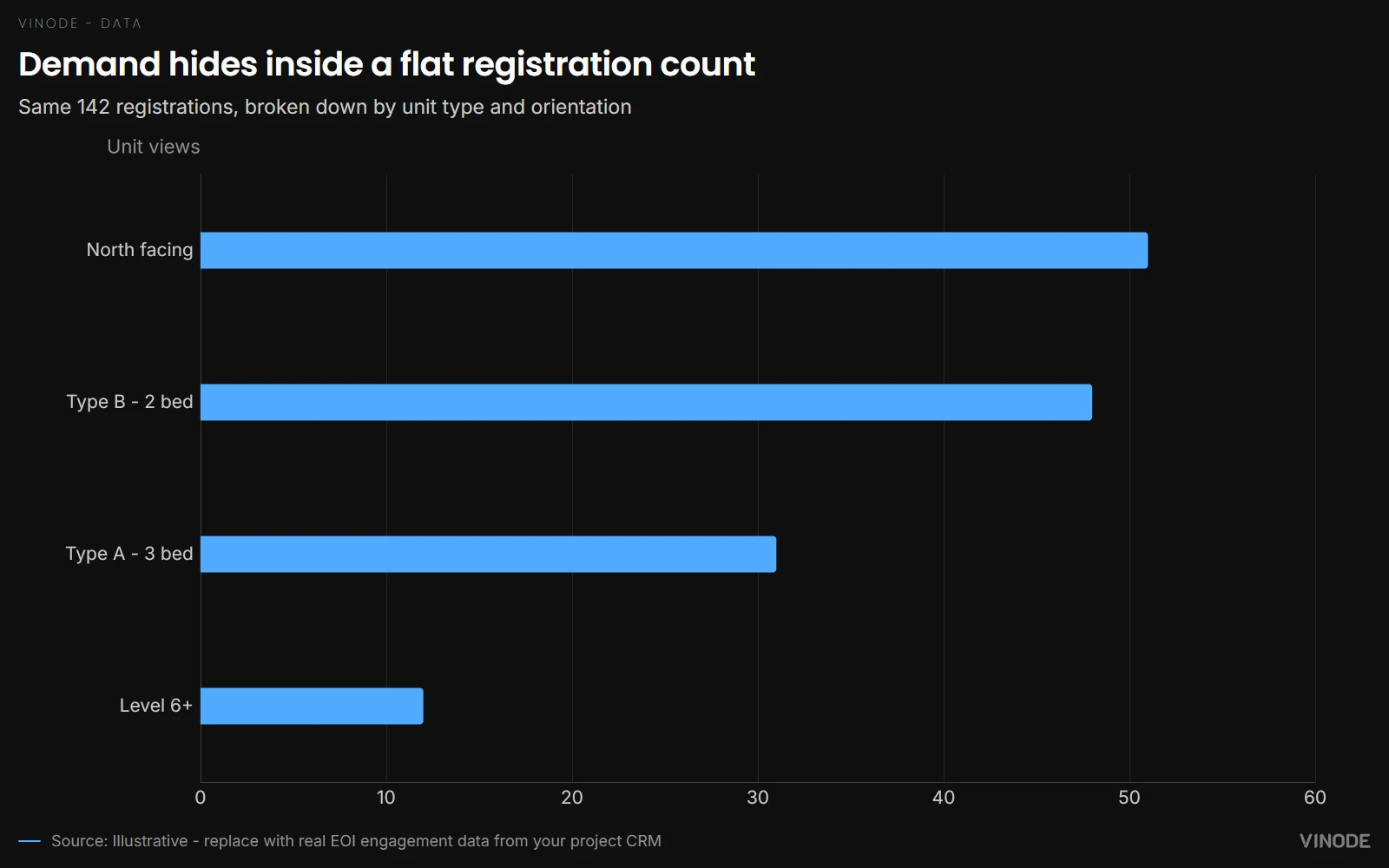
Now build a table of interest by unit type, floor, orientation and price band. It passes if every total can be opened back to the units and the visits behind it. A long registration list can hide the fact that one side of the building has no interest at all, and a total count is a weak pricing input.
This check closes before prices are signed. Unit views, time spent, favourites and saved configurations show where attention gathers. They do not tell you the right price. They tell you which assumptions need pressure. Skip it and the team learns about a weak unit mix from live reservations, where every correction is public and expensive.
The demand check
Pass
You can group interest by unit, floor, type, and orientation, then open the visits behind each total.
Fail
You have a registration count and a spreadsheet of contact details, with no unit trail.
Cost
Prices and release order are based on a total count. Low-interest units appear only after reservations open.
Two browsers, one unit, release morning
Release-day availability needs its own test. Open the project in two browsers. Mark one unit reserved in the Back Panel. If the second browser still offers it, stop, because two buyers can recieve the same promise. A private release breaks as easily as a public one, since stock has to stay in sync even when the buyer list is short.
We can bind a unit list to project data such as price and availability so the listing stays in step with the CMS. Still test the real release flow, with your CRM, your permissions and your devices. A feature existing is not proof that the handoff works.
Second-tranche stock after first-release demand
After the first tranche, rank the unreleased units by interest from the buyers who missed out. If all you have is a remaining EOI count, the second tranche is another guess. Per-unit history shows whether demand moved to similar homes or stopped.
When browsing is not a demand signal
Do not use browsing as a demand signal when buyers could not explore real units before launch. A small project with interchangeable stock may need only a clear form and a fair timestamp order. The signal also fails when the page hides key facts, loads the wrong inventory, or pushes everyone through the same featured unit, because then you are measuring your own interface. Fix the browsing path before you let its clicks guide a release.

Vinode has no dedicated EOI entity, waitlist manager, or ballot tool. ComingSoon status, forms, unit tracking, contact scoring, pipelines, and live availability are building blocks. Your team still owns the campaign rules and legal review.
Find the warm buyers before release day
Compare the people who kept coming back to the units with the people who submitted once and vanished. If the CRM cannot seperate those two groups, sales starts release week with one queue and no idea where interest is still alive. We link form leads to contacts, so a return visit gives sales a reason to reopen a contact instead of treating every old registration as warm. It makes the next call less blind.
Allocation and sales priority are two decisions
Ask marketing, sales and legal to show you one written allocation rule and the record of who received it. Pass means the method, the owner and the message to buyers are agreed before any unit goes Available. Fail means no document exists and sales decides on release morning, and the cost is delay, mixed answers and buyers who suspect favouritism.
Timestamp order rewards speed. A ballot gives equal chances. Engagement can rank the sales follow-up. These are diffrent choices. I would not let browsing engagement alone decide who gets a home, because it can be gamed and it favours people with more free time, and local rules may require another method anyway. Use engagement to plan calls, test pricing assumptions and shape tranches, unless legal and sales agree to give it a wider role.
Give every EOI field one job
A team can collect unit demand for a month and then ignore it because nobody decided what the data was allowed to change. Before the campaign opens, map each field and each tracked event to one decision: a pricing check, the release order, a sales call, or the allocation rule. Delete fields with no job. Add a signal wherever an important decision is still blind.
Do it on one page, with sales, marketing and legal able to point at each line and agree who uses it. If the mapping waits until release morning, you will have a full dashboard and the same old timestamp queue.
Test your EOI flow before release day
Bring the unit list, form, allocation rule, and sales handoff. We will show where Vinode's building blocks fit and where your process still needs work.


We measured when a pipeline crosses the presale line, not just whether it will
When GTHA opening-quarter absorption averaged 66%, the sold percentage was enough to forecast a presale crossing date. Then absorption fell to 17%. Three pipeline inputs produce the crossing date your lender asks for: stage-conversion rates, a cancellation haircut, and remaining inventory.

Digital Sales Gallery: What to Test Before the Display Suite Opens
The afternoon before opening, the sales lead sends herself a test enquiry and the sales desk cannot find it. Four things go wrong most often in a digital sales gallery, and each has a test you can run on the real devices and a fallback if it fails.

How to Move a Live Property Launch Off a Spreadsheet
Three weeks from launch, new enquiries were going into a spreadsheet tab called new leads 2. Move new leads and current unit data first, let old deals finish where they started, and leave the historical import until later.