
Marketing Before Planning Consent: What You Can Say
Key Takeaways
- Photorealistic renders raise the disclosure bar because viewers treat finished-looking images as decided facts, while a concept sketch signals uncertainty by its medium.
- A CGI, indicative only caption does not fix a photorealistic image whose overall impression misleads.
- Before reserved-matters approval, market that development is approved here, and hold facades, layouts, landscaping and unit counts until the approval confirms them.
- Changes at reserved-matters stage invalidate finished renders, so budget the re-render or wait for approval, and decide which on purpose.
A developer's marketing manager sent us a set of elevations in March, a brick facade with deep window reveals, and asked for the full exterior walkthrough before the reserved-matters application had gone in, because the sales launch was pencilled for June. We delivered in April. The reserved-matters approval came through in July with a condition on the facade: the planning officer wanted a lighter brick and different window proportions on the street elevation. By then the April renders had been on the landing page for eleven weeks, in a printed brochure, and on a hoarding along the site boundary. The re-render was a line item nobody had budgeted. The harder part was the twenty-three people who had registered interest in a building that now had a different face, and the email she had to write to each of them.
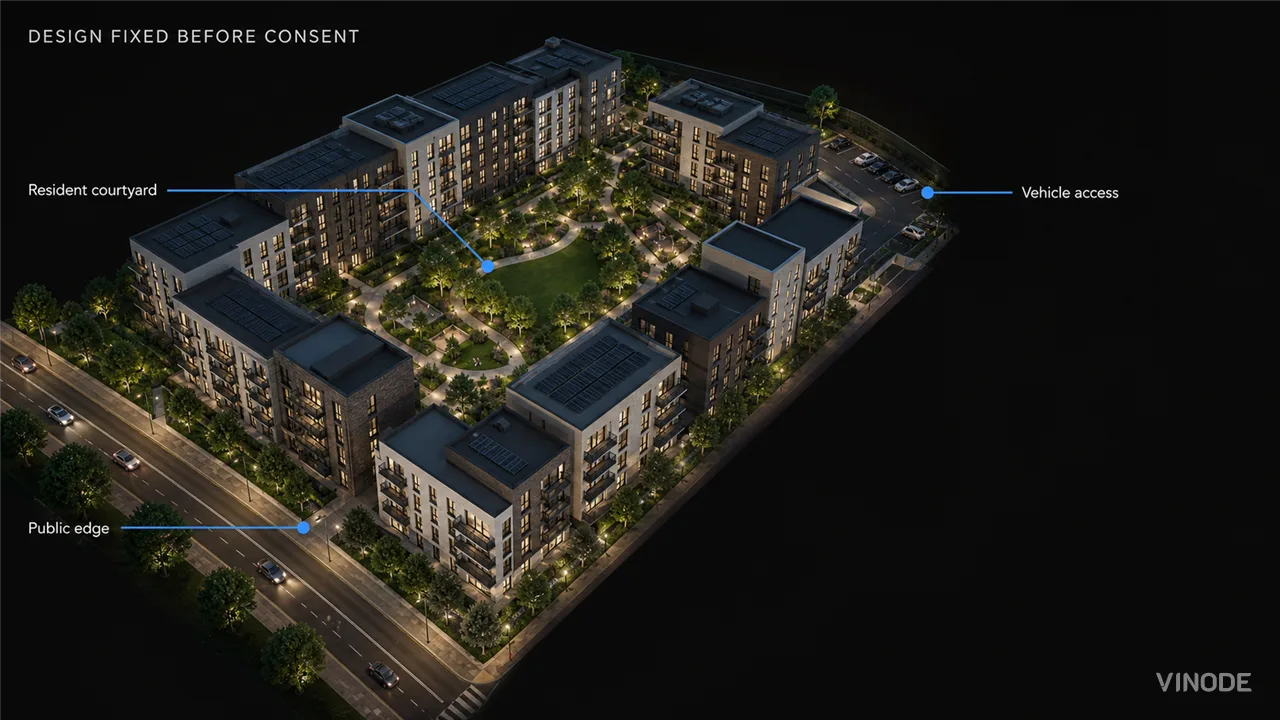
Before reserved matters are approved, you can market two things about a consented site: that development will happen here, and roughly at what scale. Appearance, access, landscaping, layout and final scale are legally open until the approval, and every photorealistic image released before it is a claim about at least one of them.
What outline consent actually locks
Outline planning consent in England settles one question: yes, this site can be developed, at roughly this scale. It defers the five things that define what a buyer gets to a separate reserved-matters application, filed within three years of the outline grant (gov.uk). Even after reserved matters are approved, two clocks run. Full permission expires either two years from the last reserved-matters approval or three years from the outline grant, whichever is later (gov.uk). Track both, because a marketing calendar built on one of them will be wrong.
Every photorealistic image released before those matters are approved is a visual claim about at least one of them. A rendered facade is a claim about appearance. A site plan with unit positions is a claim about layout. An aerial with mature planting is a claim about landscaping. The higher the fidelity, the wider the gap between what a viewer reads as settled and what the permission has locked.
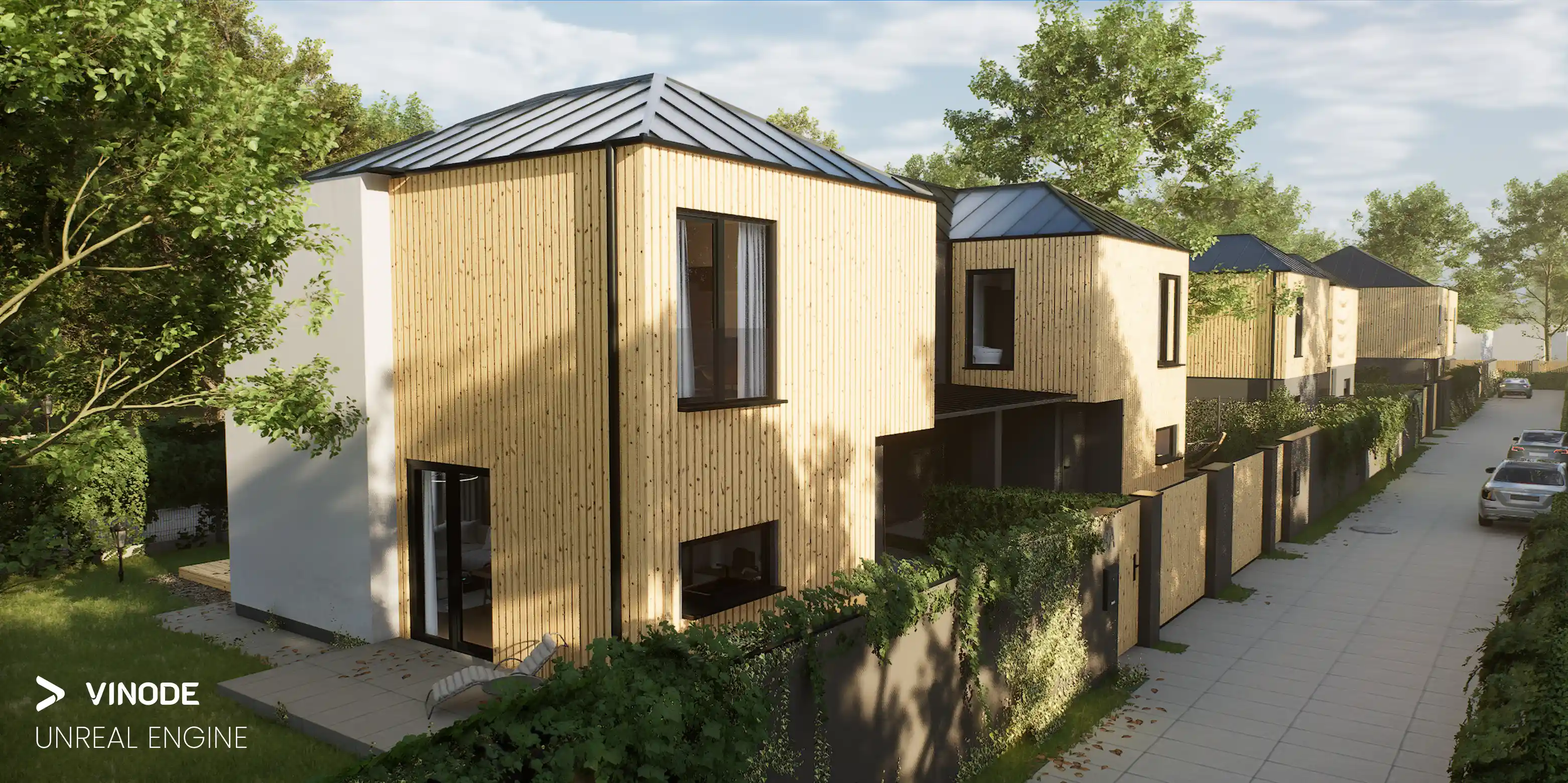
We build these images, so the constraint lands on our clients first. Pre-rendered photorealistic 3D, about two seconds to interactive on a mid-range phone across the projects we have delivered, is what Vinode does, and that fidelity makes the constraint sharper for our clients than for anyone working with sketches. A hand-drawn concept reads as indicative by its own medium. A photorealistic walkthrough does not. Viewers treat what looks finished as decided, and under UK advertising standards the test is whether the overall impression misleads. If a render tells the viewer that facades and finishes are settled, a caption saying CGI, indicative only does not undo that impression.
Why the risk is revision rather than rejection
The obvious worry is outright rejection: the council says no and every marketing asset is wasted. That happens, and it is the rare case. The more common outcome is that reserved matters are approved with changes. Appearance shifts. Layout adjusts. Landscaping gets conditions. Every render that showed the old version is now wrong, and every buyer who saw it carries an impression that no longer matches what will be built. The marketing manager with the brick facade was in the common case, and it still cost her a re-render and twenty-three awkward emails.
That changes the budget conversation. The real cost is re-rendering, and the scope of the change sets the price. A facade revision is a different job from a full site-plan rebuild, and both can be scoped and quoted before you commit to marketing early.
It also rules out CGI, indicative only as blanket cover. The image is judged on its overall impression. A render showing specific facades, window treatments and a finished streetscape tells the viewer those are decided, whatever the small print says. CMA enforcement against major housebuilders in 2025 and 2026 brought developers themselves under scrutiny for sales-process representations, and the Competition and Markets Authority rejected pleas for sector-specific guidance and began acting against individual businesses (Propertymark).
One related thing, since we are on the subject of what the council knows: pre-application discussions are less confidential than developers assume. Pre-app submissions can be requested under the Freedom of Information Act, and commercial sensitivity gets a public-interest test rather than automatic protection. Case law has weakened the old assumption that pre-app advice stays in the room (gov.uk). If your early marketing timeline depends on nobody outside the council knowing what was discussed, check that assumption. Regardless, back to what your renders claim and when.
What to put live before reserved matters
The practical step is a landing page and a lead-capture form, live, with units, pricing, floor plans and the full 3D experience left unpublished. It matches the marketing to the permission rather than shrinking it. A page that confirms residential development is approved for this site and invites early interest is accurate. A page that shows specific facades or interior finishes is making claims about reserved matters that have not been decided.
Actually, even the phrase approximate scale overstates what outline consent locks, and I used it myself at the top of this post. Scale is one of the five reserved matters. What outline really settles is closer to buildings of roughly this size will go here than to any number a buyer could act on. The safe claims are broad, and the landing page should be as broad as they are.
Before reserved-matters approval
Safe to market
Brand and project name. Confirmation that residential development is approved here. General scale from the outline permission (no unit counts or sizes). Interest-registration form with re-consent language.
Claims about undecided matters
Specific facades or exterior appearance. Unit layouts or floor plans. Landscaping detail. Interior finishes. Exact unit counts or sizes.
How consent and S106 terms catch you off guard
The pre-registration list needs consent that survives a material change. If reserved matters alter the product between sign-up and launch, the people on that list registered for something that no longer exists. Re-consent is the safe position: tell them what changed and give them the choice to stay. GDPR erasure is the floor, and I would treat it as the floor.
Section 106 obligations are standard (gov.uk), but their specific terms often arrive after marketing has set expectations. If a S106 commits 30% of units to affordable housing and the pre-launch material implied a different mix, the marketing is out of step with the consent. Know the S106 terms before you set the story.
Reservation deposits are a separate question with no clean answer. Whether a planning refusal triggers a refund depends on the contract, and I could not find a primary source that establishes a standard practice. Get the terms into the contract with a solicitor before taking any deposit.
The Levelling-up and Regeneration Act 2023 creates the framework for an Infrastructure Levy intended to replace the Community Infrastructure Levy and much of Section 106 in England. The change still depends on regulations and local rollout. Until then, current S106 terms still govern the project in front of you.
Commission early, or lean on the disclaimer
The first workaround developers try is commissioning the full photorealistic experience early and betting that reserved matters will not move much. The logic is reasonable. First-mover advantage is real, and our production timelines are short, two to four weeks for productised packages based on deliveries to date, so planning is the bottleneck and the developer does not control that clock. But if reserved matters alter appearance, layout or landscaping after we have delivered the asset, the asset is wrong and redoing it is a line item. Some developers decide the early advantage justifies that risk. Some wait. Both are defensible when the re-rendering cost is budgeted and the choice is made on purpose. The marketing manager in March had made the bet without knowing she was making it, which is the version to avoid.
The second workaround is leaning on CGI, indicative only as a universal shield, and it fails for the reason above: the disclaimer does not change what the image communicates.
The strongest visual you can produce for a pre-launch is also the one that needs the most careful timing. Design the launch to fit that constraint rather than the render.
Short enough that commissioning early is tempting, as long as the brief stays stable through approval.
After approval, commission the full experience
Once reserved matters are approved, appearance, access, landscaping, layout and scale are decided, and the claims a photorealistic render makes about them become safe. Commissioning the full interactive 3D experience stops being a bet and becomes an ordinary production decision. Brief the approved site plan, elevations, materials, landscaping, floor plans and sales data, and use the two-to-four-week delivery window to set the launch date. The facade in the render is then the facade on the street, which is the only version of early marketing that never needs an apology.
See how Vinode scopes a phased launch
From landing page to full interactive experience, on your planning timeline.


Why Do Brokers Stop Showing Your Development?
Because they cannot verify stock. A stock list emailed on Monday is wrong by Thursday, and an agent who shows a reserved unit once does not bring you another buyer for a while. The fix is a boundary: live status on a link they can forward, pricing and commission behind a login.
Brand Kits for Development Sites: Questions Vendors Should Answer
Four projects, four slightly different blues, and an agency quote for another page-by-page pass. These vendor questions show whether a platform's brand kit enforces the brand or just displays settings.

What presale evidence will a lender accept?
The Monday sales meeting said 60% sold. The bank said 35%. Both came from the same CRM. Lenders count qualifying contracts, and reservations, waitlists and page views show demand without proving an enforceable sale.