
Where Off-Plan Leads Get Lost: A Handoff-by-Handoff Checklist

Key Takeaways
- Off-plan leads can die in the unmeasured gap between funnel stages, even when the lead was qualified.
- A CRM can record every event, but it does not chase a stalled handoff on its own.
- Audit each stage transition by next owner, maximum delay and escalation, then check the oldest gaps daily.
- Separate teams and inboxes make buyer context easy to lose between inquiry, viewing, offer and reservation.
"Marketing sends us junk leads." Sales says it after another month of weak conversions. Marketing answers that sales ignores good inquiries. Lead quality does vary, but off-plan leads also get lost in the gaps between inquiry, first contact, viewing, offer and reservation.
The useful response is to measure those gaps. Give every handoff a next owner, a maximum delay and an escalation. Then check the oldest gaps every day before buying more leads. Without time recieved, time assigned, first contact, outcome and next action, both teams are arguing from memory.
The off-plan handoff checklist starts at inquiry
The checklist uses the same three fields at every seam. Name who owns the next move. Set the longest acceptable delay with the people doing the work. Name who gets the alert when that limit passes.
Audit each off-plan sales seam
Inquiry -> first contact
Owner: the named person who makes first contact. Delay: your agreed response window. Escalation: the sales lead when the record stays unassigned.
First contact -> qualification
Keep the buyer's unit interest and timing. Record a dated next action rather than a contact status.
Qualification -> viewing
Give one person the booking, confirmation and recovery of a missed appointment.
Viewing -> offer
Set the follow-up date before closing the viewing record. Keep objections and preferred units.
Offer -> reservation
Track approvals, documents and expiry dates. An offer waiting without an owner is still leakage.
Reservation -> close
Make the legal and payment handoff visible. Reservation is not the end of sales work.
Start with the missing timestamp. A weak stage is hard to fix when nobody knows how long the lead sat between owners.
Follow-up timestamps separate weak leads from late action
A team may say it follows every lead. The CRM should prove it. Pull one month of inquiries and count records with an owner, first-contact time, second action and dated next step. Count unanswered attempts as work. Do not count "Contacted" when no activity sits behind it.
The point is not to punish agents. It is to seperate a lead problem from a handoff problem. A poor-fit buyer contacted on time is a quality issue. A good-fit buyer left unassigned is an operating issue. Those need diffrent fixes.
An off-plan CRM cannot own a stalled handoff
"We already track every lead in the CRM, so the process is visible." The CRM may hold a complete record. Vinode's Back Panel keeps contacts, units viewed, time spent, lead capture, deal stages, tasks and reminders in one place. It also supports lead scoring and nudges. That context matters.
But a CRM can record every event and stay silent when nobody acts. It does not replace the person who checks teh oldest gap and calls its owner. Our view is blunt. A dashboard that depends on spare attention is a report, not a control. The control is a named check with authority behind it.
Separate off-plan teams lose buyer context at each transfer
An off-plan inquiry may pass from a marketing team to the developer, an on-site agent, a broker and a solicitor. When those people work in seperate companies or inboxes, each transfer can lose context.
A buyer may view two units, return to one floor plan and ask for a viewing. If the next person gets only a name and phone number, the conversation starts again from zero. Preserve the unit interest, timing, objections and last action with the contact. More seams mean more places to lose time and context.
One client result shows why each funnel seam needs its own rate
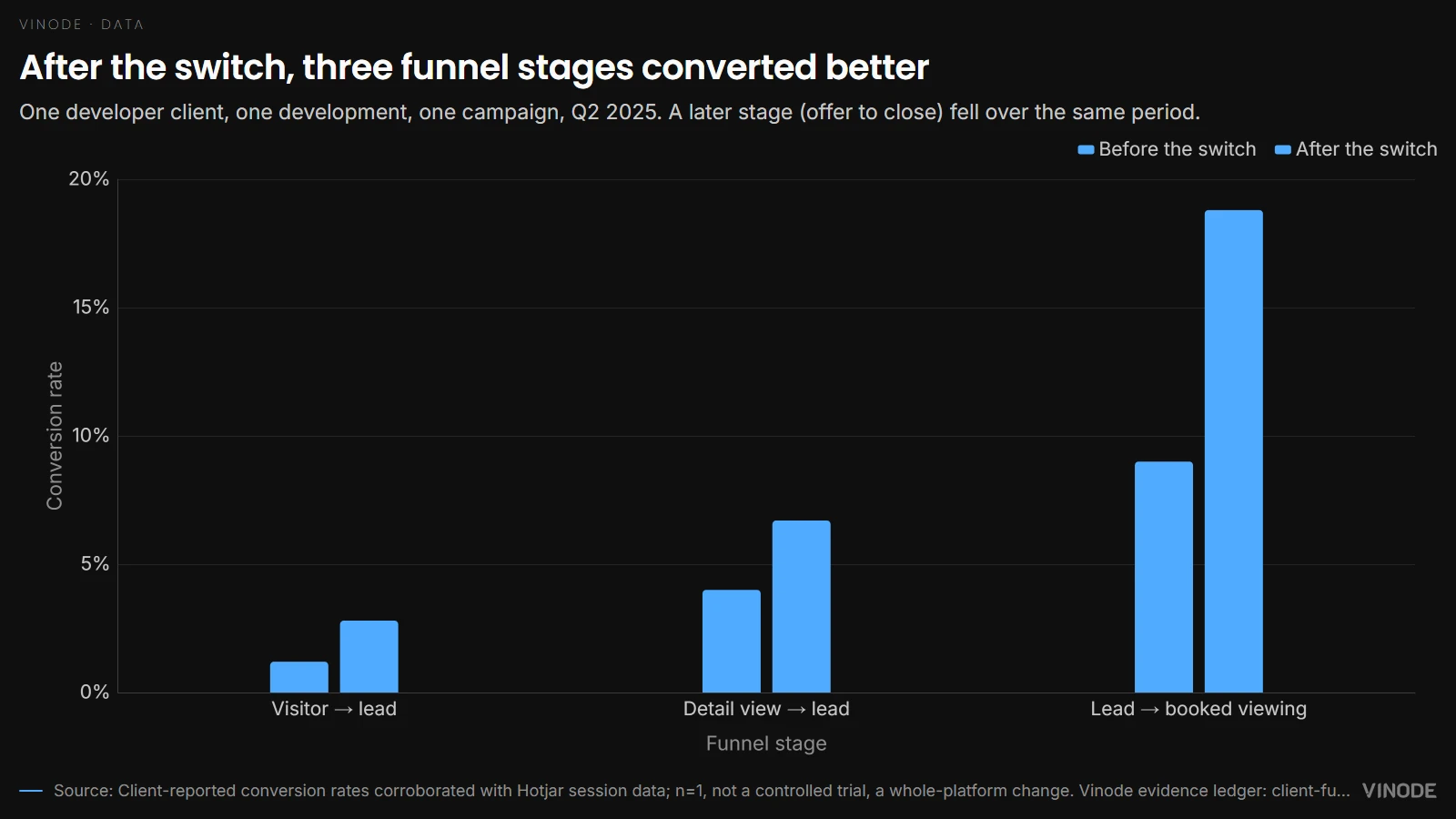
We have one narrow result. For one developer client and one campaign in Q2 2025, the client-reported lead-to-booked-viewing rate moved from 9.0% before the switch to 18.8% after it. We checked the result against engagement data. The offer-to-close stage fell in the same period.
This was not a controlled trial, and one campaign is not an industry benchmark. It shows the useful point: one seam can improve while a later seam gets worse. A funnel average can hide both. We would rather see one ugly stage than a smooth report that merges every failure into "lost."
One before-and-after result, n=1. The offer-to-close stage fell in the same period.
Source: Vinode measurement - as of
Run the overdue-handoff list before changing the CRM
"We need a better system before we can fix this." A better system may make the work easier. It is not needed for the first audit. Use the CRM you have and export every open lead and deal. Add owner, delay limit and escalation to every transition. Sort by elapsed time. One named person checks the oldest gaps daily and sends exceptions to people who can act. We think that list is worth more than a perfect funnel chart reviewed once a month.
Do not copy time limits from a generic benchmark. A viewing confirmation, discount approval and solicitor handoff run on different clocks. Set each limit with the team doing the work. Tight enough to show drift. Realistic enough that a breach means something.
This audit is not for teams that refuse shared records or give nobody authority to challenge a late handoff. A dashboard cannot fix missing authority.
Cross-company handoffs need one boundary owner
"The broker is a separate company. We cannot control their inbox or process." Correct. A marketer, developer, broker and solicitor may use separate systems under separate managers. No CRM can force those companies to share one process.
Start with the boundary you control. Pick one seam with visible overdue records. Name its owner, time limit and escalation. Run the daily check, then compare overdue records and stage conversion. If the team still cannot see what sits between inquiry and reservation, do not buy more leads yet. Fix the handoff you can name.
See the buyer context your sales team can keep
Walk through Vinode's Back Panel and map where your handoffs still need a human owner.


AI Property Imagery in 2026: A Trust and Governance Playbook for Developers
A label tells buyers that AI touched an image. It cannot tell your team which design revision supports the image, who approved its claims, where it is live, or how to withdraw it.
The New-Build Sales Platform Checklist
Two agents reserve the same unit from two laptops, both reservations go through, and the listing stays available for eleven minutes. Test one live unit through inventory, availability, attribution and discount approval before you choose a platform.

AI Search Is Shrinking the Click: What Property Developers Should Measure Instead
AI answers can remove the visit before it happens. Keep tracking search traffic, but judge it by what follows: qualified arrivals, unit exploration, contextual enquiries and reservations.