
What banks require pre-sold before they fund construction

Key Takeaways
- Published sales-velocity benchmarks each start their clock at a different point, so comparing your pace to one is usually comparing unlike things.
- The only pre-sale clock a lender writes into your construction facility runs from launch to threshold, and no published benchmark measures it.
- In the US the mortgage-eligibility gate and the construction-loan covenant interlock, so falling below one stalls the reservations you need to clear the other.
- The one like-for-like comparison is launch-quarter absorption on a shared clock: the GTHA ten-year opening-quarter average was 56% in the Q2-2024 report.
The number on the term sheet is not the number in the benchmark
You are watching a reservation count. It updates most weeks, and lately it is the first thing you open in the morning, because the construction facility for the scheme is still being negotiated and the bank keeps returning to the same line: how many units are pre-sold. Every published figure you check to reassure yourself says something slightly different, so you are left guessing whether your pace is normal or whether the launch is quietly failing.
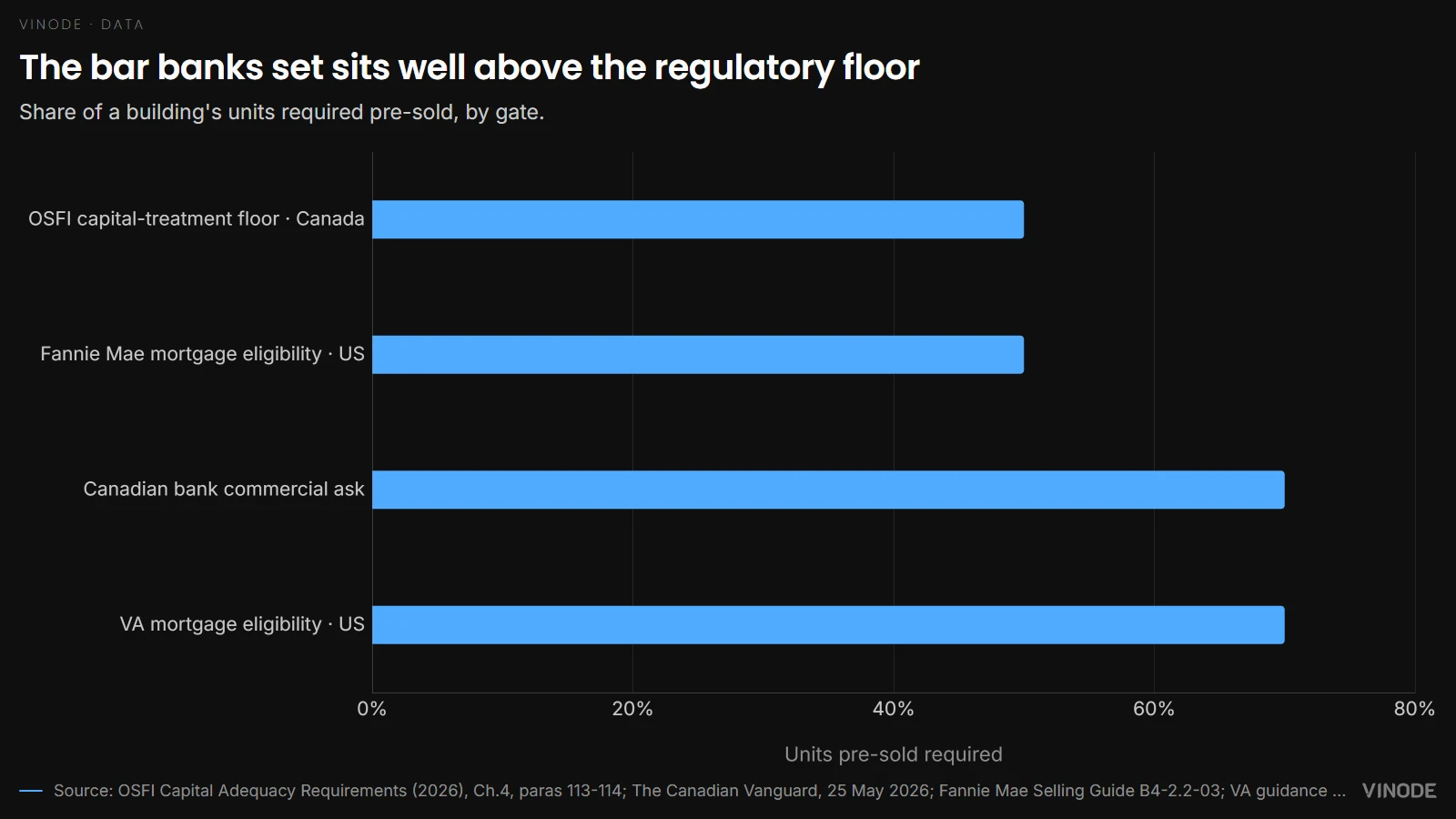
In Canada, lenders typically want about 70% of a building's units pre-sold before they release the construction loan. In the United States there are two separate gates: a new-build condo needs 50% of its units sold before individual buyers can get a conforming mortgage at all, and on top of that sits whatever pre-sale share your own construction facility conditions its drawdown on. Those targets tell you what to clear. They do not tell you whether your current pace clears them, because every benchmark you are laying yourself against starts its clock at a different moment than the one the lender wrote into your loan. The gap between the number you can look up and the one that binds your capital is what this piece is about.
The presale threshold, by market
Canada: about 70%
Share of a building's units lenders typically want presold before they fund construction. It is the banks' own line, well above the 50% regulatory floor (The Canadian Vanguard, 25 May 2026).
US mortgage gate: 50%
Units sold or under contract before a new-build condo is eligible for conforming financing, so individual buyers can get a mortgage. The VA is stricter, at 70% (Fannie Mae B4-2.2-03).
US facility covenant: case by case
The presale share your own construction loan conditions its drawdown on, set between lender and sponsor. It sits on top of the mortgage gate, not instead of it.

A threshold is a lender's choice, not a law
It helps to separate who sets the number from what the number does. The federal banking regulator, OSFI, sets no pre-sale requirement at all. What it sets is how much of its own capital a bank must hold against a construction loan. Under OSFI's capital rules, a residential construction loan drops from a 150% risk weight to 100% once pre-sale contracts pass 50% of the total, or the borrower has at least 25% equity at risk; and for a high-rise of five storeys or more, the typical condo tower, only the pre-sale route counts, not the equity one (OSFI, Capital Adequacy Requirements (2026), Chapter 4, paras 113-114). A lower risk weight means the bank ties up less capital against the same loan, so it can advance more against the same project.
So the regulatory floor is 50%. The 70% figure most developers actually hear is the banks' own line, well above that floor: lenders typically want about 70% of a building's units presold before advancing the loan (The Canadian Vanguard, 25 May 2026). That 20-point gap between the regulatory floor and the commercial ask is discretionary, which is exactly why it can be argued down, as the next section shows.
There is a reason the condominium side feels this so acutely. In OSFI's own rules, purpose-built rental is exempt from that high-rise pre-sale test, and CMHC insures and cheaply finances rental besides; there is no equivalent programme for condominium development. The rental side has a public backstop and a softer capital rule. The pre-construction condo side lives or dies on its pre-sales.
The United States runs two thresholds that are easy to conflate, and conflating them is the common mistake. One is mortgage eligibility. For a new-construction condominium project to be eligible for conforming financing, Fannie Mae requires 50% of the total units sold or under contract (Fannie Mae Selling Guide B4-2.2-03), and the VA is stricter, requiring bona fide agreements from purchasers other than the developer for 70% of units (VA guidance, answer 2449). The other is your own construction-loan covenant: the pre-sale share your facility conditions its drawdown on, set case by case between lender and sponsor. Two different gates, owned by two different parties.
How the mortgage gate stalls your construction draw
Treat those two US thresholds as one system, because the state of one changes the other. Fall below the 50% mortgage-eligibility line and individual buyers at your project can no longer get conforming mortgages. A buyer whose financing falls through hands the unit back, so a reservation reverts to unsold inventory, so your firm-sale count stops climbing, so your own construction covenant stalls. The gate you were not watching reaches over and jams the one you were.
This is the mechanism no lender-comparison page frames, because it only becomes visible when you stand in the developer's seat and watch both numbers at once. A sponsor tracking only the facility covenant can be defeated entirely by the eligibility gate, and never see the cause, because on their own dashboard the covenant number simply refuses to move.
The coupling above is the US structure. In Canada the binding gate is the lender's own pre-sale covenant, sitting on the OSFI capital-treatment floor described earlier, and the buyer-mortgage side does not jam it the same way. Either way, this describes how the condition works. It is not advice on your own facility.
The threshold is being renegotiated right now
The clearest evidence that this number is a choice rather than a constant is that the industry is publicly asking to have it lowered. In reporting first carried by the Globe and Mail and summarised by The Canadian Vanguard on 25 May 2026, several Canadian developers went on the record: Ian MacLeod, SVP residential at Dorsay Development Corp., argued the bar should come down to 50%; Pouyan Safapour of Devron Developments put the workable level at 30-40%; Neil Chrystal, president of Polygon Realty, asked lenders for more creativity in how they advance loans (The Canadian Vanguard, 25 May 2026). These are not distressed operators. They are established firms describing a gate that current sales conditions cannot clear.
No one can get to the presale level that they need to give the bank.
When the people who have to clear a threshold say in public that it cannot be cleared, the honest reading is that the threshold and the market have drifted apart. That is worth holding onto, because it reframes a slow reservation count. Some of what a developer reads as their own underperformance is really the whole market sitting below a line that was drawn for a different one.
Four velocity benchmarks, four different starting events
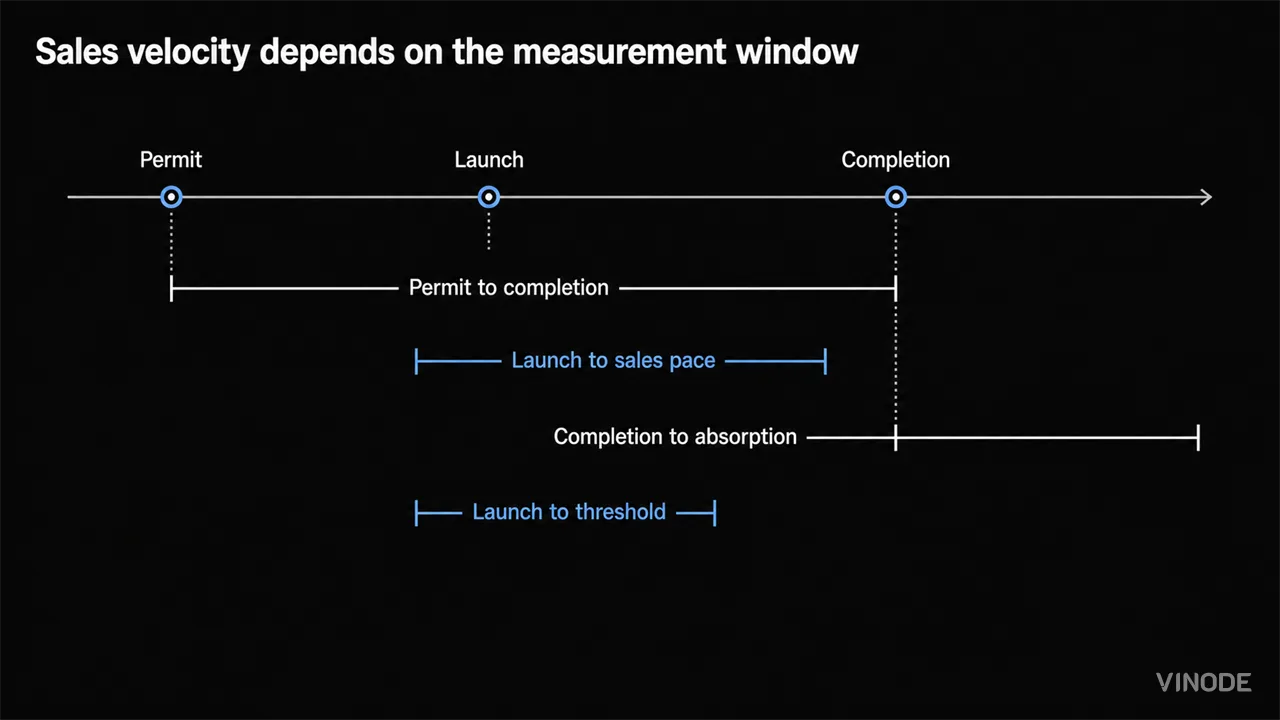
Every velocity benchmark you might reach for is measuring real activity accurately. The trouble is that each one starts counting at a different event, so laying your number beside the wrong one compares two unlike things and reads the difference as performance. Four clocks are in circulation, and telling them apart is the whole task.
The four clocks
Permit to completion
Construction time. NAHB and Census put US 20+ unit multifamily at about 22.1 months in 2024 (NAHB analysis of Census data). Measures how long the building takes, not how fast it sells.
Launch to sales pace
Absorption from release. Urbanation, UK reservation rates, Molior. Measures how quickly units sell once marketing opens.
Completion to absorption
Census and HUD SOMA. Measures how fast finished inventory fills after the building is done.
Launch to threshold
The condition inside your construction facility. Nobody publishes it, and it is the only clock with money attached.
The permit clock is the runway. That construction window in the card above is the length of time a pre-construction sales programme is selling into, and that is the only role it plays here. The clock that governs your capital is the fourth one, launch to threshold, and nobody publishes it, because it is specific to your facility and your reservations. It is the one number you cannot look up and the only one the lender writes into the loan.
Where reservation rates and absorption rates mislead
Two live examples show how easily the clocks get crossed, and both are worth internalising, because you will meet them in your own board pack.
The first is a convention gap inside a single metric. UK housebuilders report a net private reservation rate: private homes reserved per open sales outlet per week. In spring 2026 the large builders sat in a tight band, with Taylor Wimpey at 0.72 excluding bulk deals (trading statement, 28 Apr 2026) and Persimmon and Barratt Redrow a little below it (Persimmon 2026 AGM update; Barratt Redrow, 15 Apr 2026). The catch is in the words excluding bulk. Every builder reports the rate two ways, with and without bulk and build-to-rent sales (the private rented sector, or PRS), and the two conventions differ by 0.02 to 0.03. Quote an including-bulk figure against an excluding-bulk one and you have manufactured a gap out of a definition. Molior, which tracks London schemes of 20+ private homes, describes a higher-performing scheme as selling around one home a week (Molior, London Q3 2025), which lands in the same band from a separate source.
The second is an inversion. The US Census and HUD Survey of Market Absorption (SOMA) also reports an "absorption rate", and for newly completed condominiums and co-ops it ran 67% at three months for units finished in Q4 2024 (NAHB, 30 May 2025). But SOMA starts its clock at completion, because that market's norm is absorbing a building that already exists. Pre-construction selling inverts that: you fill the building before it is built. Two figures that share the name absorption rate and measure opposite halves of the timeline.
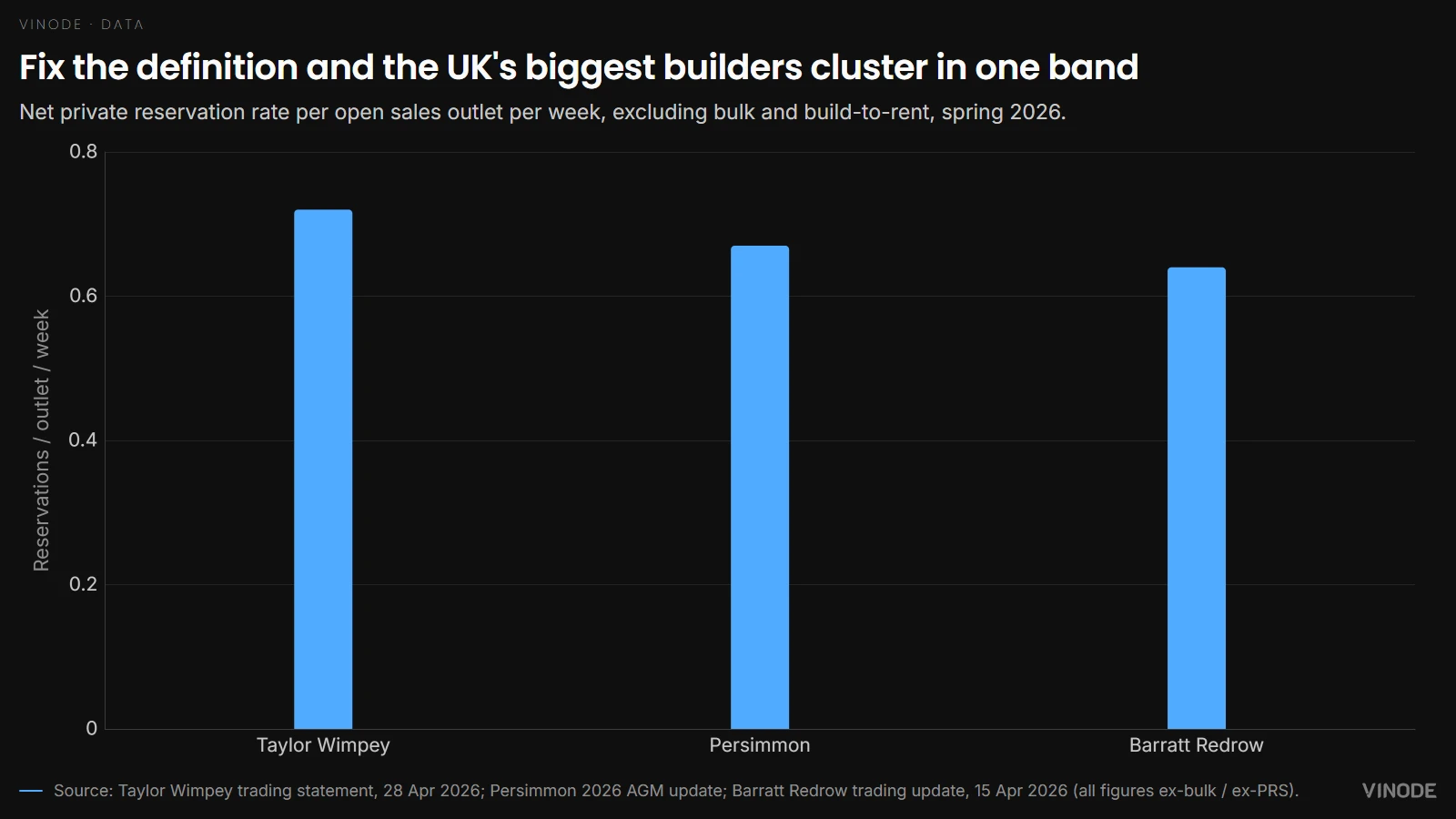
Whether a quoted reservation rate includes bulk or build-to-rent sales is the single most common way these figures get mismatched, and it is the same mistake as comparing across clocks: one metric wearing two definitions.
Read your reservation pace on the clock that matches
There is exactly one honest comparison a pre-construction developer can run against a published benchmark. Urbanation's ten-year average opening-quarter absorption for the Greater Toronto and Hamilton Area was 56% in its Q2-2024 report, down from 60% in the Q2-2022 report and 66% in the 2021 one (Urbanation). That benchmark has itself fallen ten points in three years, so each figure has to carry its report date, and averaging them would mean nothing.
Against it, set our own reservation curve, measured from our project data across our pre-construction developments of 20 or more units, through mid-2026, and kept anonymized to portfolio level: no project count, no unit totals, no single client broken out. It is front-loaded: about 30% of units reserved in the launch month, 60% by the end of the first quarter, and 90% by the seventh. What makes it usable next to Urbanation is that both numbers count the same thing, cumulative share of inventory from launch, so they lay side by side with no arithmetic in between. That shared footing is what the cross-clock comparisons lack.
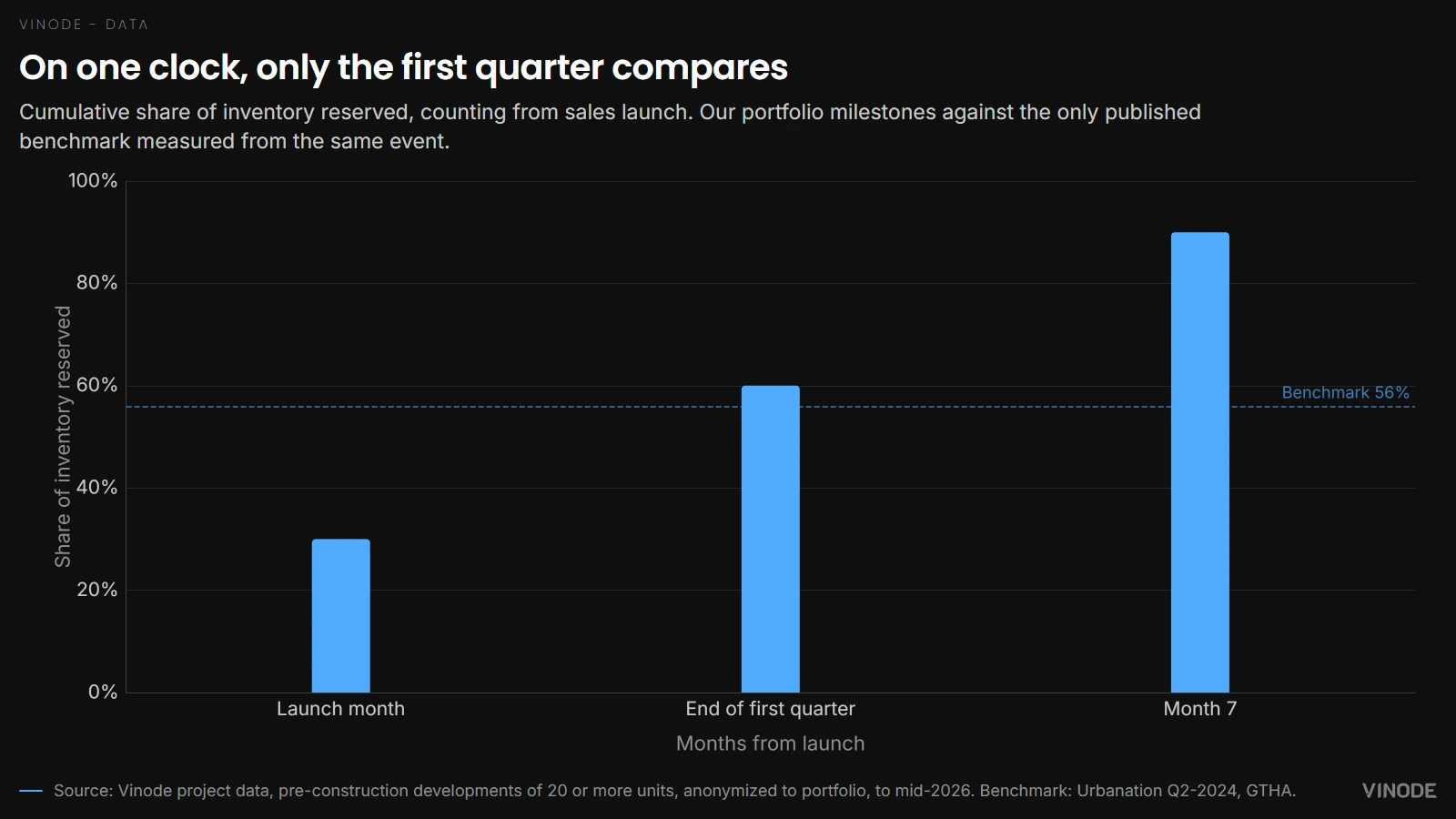
The decision rule is small, and it survives contact with a real board meeting: before you set your pace beside any benchmark, name which event starts its clock, and only compare like against like. A large share of the underperformance a developer reads into their own numbers dissolves the moment you run that check. What remains after it, a pace that genuinely trails the like-for-like launch-clock benchmark, is a real signal, and this frame will not talk you out of it. That is the point of getting the measurement right. It tells you which problem you actually have.
This exercise only earns its keep when a pre-sale-gated facility is what stands between you and your drawdown. If the scheme is all-equity, or it is purpose-built rental with CMHC support behind it, the threshold is not the condition your capital hangs on, and you should be watching a different number entirely.
While you sit below the threshold, the project carries its land and pre-development cost without drawing the construction facility, so every extra month under the line is an interest cost. Put rough numbers on it: a scheme carrying, say, $60 million of land and soft cost at 9% a year runs about $450,000 a month in carry, so a launch that takes three months longer to clear the pre-sale gate is on the order of $1.35 million. The figures are illustrative and generic - use your own capital stack and rate. The point is only that a slow reservation count is not a soft marketing metric. It has a monthly price, and it is denominated in interest. None of this is financial advice.
Move sell-out speed out of the marketing budget
Sell-out speed usually gets filed as a marketing number. The launch campaign owns it, reports on it every week, and it sits on the same slide as cost-per-lead. That filing is the mistake. The reservation count is the condition that releases your construction draw, so it belongs in the capital stack, watched as closely as any other covenant and read against the one benchmark that shares its clock instead of whichever figure sat at the top of the search results.
The number already lives somewhere in your pipeline, whether that is a spreadsheet or the panel where you manage units. Finding it is not the work. What changes is who watches it, how often, and against what.
See a pre-construction scheme running
Vinode turns a development into an interactive 3D experience that sells homes before construction starts. Explore a live project, or talk to us about where your reservation count lives.


We measured when a pipeline crosses the presale line, not just whether it will
When GTHA opening-quarter absorption averaged 66%, the sold percentage was enough to forecast a presale crossing date. Then absorption fell to 17%. Three pipeline inputs produce the crossing date your lender asks for: stage-conversion rates, a cancellation haircut, and remaining inventory.

Digital Sales Gallery: What to Test Before the Display Suite Opens
The afternoon before opening, the sales lead sends herself a test enquiry and the sales desk cannot find it. Four things go wrong most often in a digital sales gallery, and each has a test you can run on the real devices and a fallback if it fails.

AI Property Imagery in 2026: A Trust and Governance Playbook for Developers
A label tells buyers that AI touched an image. It cannot tell your team which design revision supports the image, who approved its claims, where it is live, or how to withdraw it.