
What a slow property page really costs you in lost enquiries

Key Takeaways
- No published statistic measures how many enquiries a slow property page loses; every figure quoted online is borrowed from another industry.
- The closest honest proxy is Google and Deloitte's finding that a 0.1-second mobile speed gain cut bounce on lead-generation pages by 8.3%.
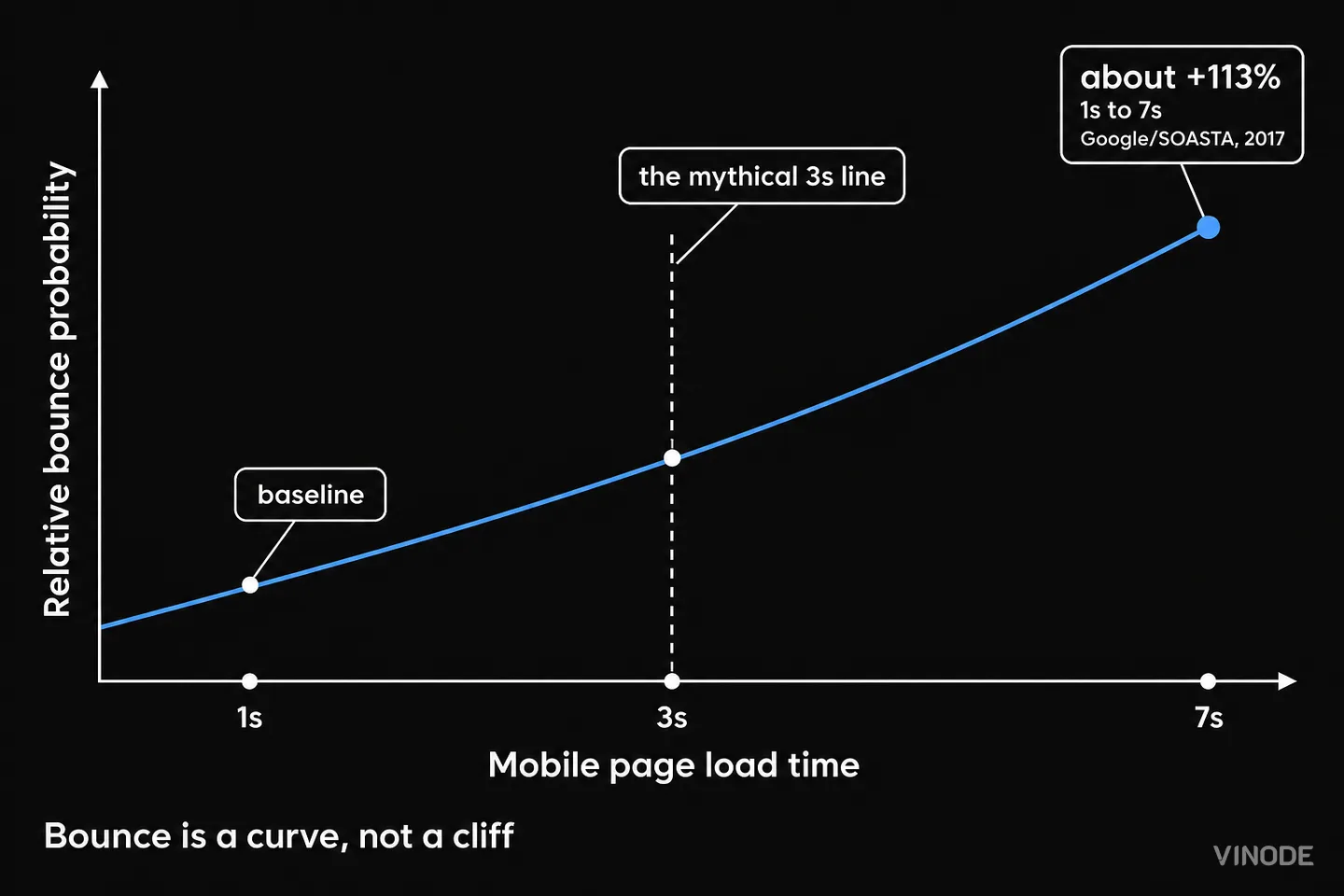
- Bounce climbs steadily as a page slows; Google and SOASTA measured a 113% rise in bounce probability between one and seven seconds.
- A property page cannot compress its way to speed because its payload is the visual media itself, so the only structural fix moves the 3D render off the device.
The business case for fixing a slow property page almost always opens with the same slide. A developer's marketing lead has a quote from an agency to rebuild the launch microsite, and to justify the spend internally they need a number. So they reach for the one everyone reaches for: 53% of visitors leave a page that takes longer than three seconds to load. It lands well in the room. It is also being asked to carry an argument it cannot hold, because it is undated, it was never measured on real estate, and it is not a count of lost enquiries.
Two beliefs usually arrive with that slide, and both are slightly wrong. The box below lays them out; this piece takes them apart in that order. What it will not do is hand you a fabricated real-estate enquiry number, because there isn't one to hand you.
The two beliefs this takes apart
- "A slow page costs me leads, everyone knows the 53% stat." The stat is real, but it is 2016, cross-industry, and about abandonment, not enquiries.
- "My page is slow because of unoptimised images, so an audit will fix it." True for a brochure site, false when the page's job is heavy interactive 3D.
The number everyone quotes doesn't measure what you think
The 53% figure is genuine, and it is Google's. It comes from a 2016 article, The need for mobile speed, on Google's Ad Manager blog, and the underlying data is Google Analytics from March 2016 across a sample of 3,700 sessions, measuring mobile visits that were abandoned when a page took longer than three seconds to load (Google, The need for mobile speed). Every clause in that sentence matters, and every clause is what gets dropped when the number is pasted into a deck. It becomes "53% of buyers leave a slow property page," which is three edits away from what Google actually measured. The original number covers none of those things.
Here is the uncomfortable part for anyone building the case. Quoting the bare 53% as a current, real-estate fact does not strengthen the case; it opens a small credibility leak. The moment someone on the buyer's side follows the citation, they find a nine-year-old, cross-industry mobile-abandonment number, and now they are left wondering what else on the slide is borrowed and undated. A dated figure with its provenance stated out loud is the stronger argument: it invites the citation instead of hoping nobody follows it.
Google Analytics data, March 2016, n=3,700, across all industries. A real Google figure, but not a measure of property enquiries (Google).
The closest number you can actually cite
Start from what an enquiry actually is. A property enquiry is a lead-form submission: a name and a phone number, a request for a brochure, a viewing booked. It is a lead-generation conversion, so a retail cart-abandonment stat is the wrong shape to reason from. There is one study that isolates speed as the variable and reports a lead-generation figure, which makes it the least-strained proxy available.
It is Milliseconds Make Millions, commissioned by Google, prepared by Deloitte Ireland, and built on data supplied by Fifty-Five, analysing mobile-site data across retail, travel, luxury and lead-generation brands. The study measured the effect of a single 0.1-second improvement in mobile speed. On lead-generation information pages, the pages closest to a property enquiry, that 0.1 second improved the bounce rate by 8.3% (Deloitte, Milliseconds Make Millions). The same study tracked retail and travel brands too, but those figures measure a purchase at checkout, so they sit as directional context. The grid below sets all three side by side.
What one tenth of a second moved (Deloitte / Google, per 0.1s faster)
Lead generation
Bounce improved 8.3%. The closest proxy to a property enquiry, and the figure to actually reason from.
Retail
Conversions up 8.4%, order value up 9.2%. Directional context; these measure purchases at checkout.
Travel
Conversions up 10.1%. Directional only; a booking is a different action from a property enquiry.
One warning before you build a spreadsheet on that 8.3%. It is a marginal effect measured in a specific speed range on those brands' sites, not a linear law you can multiply. "A 0.1-second gain moved lead-gen bounce by up to 8%, attributed to Google and Deloitte" is a defensible sentence. "Shaving a second gets me 83% more enquiries" is not, and anyone numerate will catch it. Use the figure at the size it was measured.
One number from our own data
The public literature has no real-estate enquiry-speed figure, but our own records hold one worth putting on the table honestly. On one developer's project we have the before-and-after of the sales funnel from when they moved off their previous marketing platform onto fast, pre-rendered Vinode delivery, on the same development, same nearby area, same price band. Website-visitor-to-lead conversion went from 1.2% to 2.8%. That is a single client and a single campaign, and it is not a controlled speed study: the switch changed more than load time, so read it as what a faster, richer experience did end to end, not as speed acting alone. It is one real number from real estate, with its limits stated out loud, which is more than the borrowed 53% offers.
1.2% to 2.8% on the same development, same area and price band. One developer client, one campaign (n=1), corroborated by our own engagement data. Not a speed-isolated study: the whole platform changed.
Source: Vinode measurement - as of
And it compounds down the funnel. On the same before-and-after, the end-to-end rate, website visitor all the way to a closed sale, moved from 0.01% to 0.06%. Read that as many small per-stage gains multiplying on tiny absolute numbers, not a headline 'five times more sales' you can promise anyone: it is one client, one campaign, and the offer-to-close step actually dipped. It sits here as the honest full shape of one real funnel, caveats and all.
0.01% to 0.06% end to end on the same development. A compounding of small per-stage gains on very small numbers, n=1 - cite it only with the absolutes and the caveats, never as a bare '5x'.
Source: Vinode measurement - as of
How bounce actually climbs with load time
The three-second line does quiet damage to how people think about this, because it invites a pass/fail mindset: am I under three seconds or not. The same body of Google research that gets flattened into "53% at three seconds" actually describes a continuous curve. In Google and SOASTA's 2017 mobile-speed benchmarks, as a mobile page's load time grew from one second to seven, the probability that a visitor bounced rose 113% (Google/SOASTA, 2017). The curve rises across that whole range, with no flat stretch before three seconds and no cliff at it.
That changes the useful question for a developer. The thing worth knowing is how much you leak for every second you sit above two, and there is no magic line you clear and then stop caring about speed. A page at 4.5 seconds is losing enquiries to a page at 3.5, and both are losing to a page at 2.
For a genuinely media-heavy property page, a performance audit has a hard ceiling. The enquiry cost turns on one architectural decision the checklist never reaches: where the heavy 3D work actually happens.
Why a property page can't compress its way out
Here is where the standard advice runs out of road. The usual playbook is well known and mostly correct: compress the images, lazy-load what is offscreen, cache aggressively, defer the scripts, put it all behind a CDN. On most sites that closes the gap. On a property page it has a ceiling, and the reason is structural: the thing making the page slow is the reason the page exists. You cannot compress your way out of a real-time 3D engine running live in the browser, because the engine is the point. Property pages are the page type most tempted to trade speed for richness, an immersive walkthrough, a live 3D model, a heavy interactive tour, and that temptation is exactly what manufactures the abandonment the earlier numbers describe.
When the heavy 3D is computed on the buyer's phone, the audit cannot save you, because the payload it would trim is the media itself. The only structural move is to take that work off the device: render the scene ahead of time on hardware you control and stream it to the browser as video, so a five-year-old phone plays back finished frames instead of computing them. The delivery side of the same idea is server-rendered static HTML served from an edge CDN, which keeps time-to-first-byte and the first paint fast. In Vinode's own testing, the same experience loads in roughly two seconds when it is pre-rendered and streamed, against about six seconds for a WebGL build and about twelve for an in-browser Unity build. Those three figures are Vinode's own comparison rather than an independent benchmark, so treat them as a vendor claim, but the direction is the architectural point: pre-rendered playback wins on the hardware buyers actually carry. The deeper version of that speed argument lives in photoreal 3D under three seconds in the browser, and the metric-by-metric breakdown is in do 3D property tours hurt Core Web Vitals.
There is a real reason this matters for the enquiry specifically, not just the load time. On a page built this way the enquiry is a first-class, measured event: the lead form flows straight into a CRM, gets scored, and is attributed through to the deal and the unit it concerns. That is the exact thing a slow page otherwise leaks silently, a buyer who wanted the brochure but closed the tab before it loaded, with no trace left behind.
One caveat, though, about who this fix is not for. If your property page is a marketing or brochure page whose slowness genuinely is unoptimised images and a bloated plugin, the ordinary audit is the right and sufficient answer, and a streamed-render architecture would be overkill. The hard ceiling only appears when the buyer's phone is the thing rendering the 3D, not merely loading ordinary assets.
Watch it load on your own worst phone
Open a live Vinode project on the least capable device and the flakiest connection you can find. That is the environment your buyers actually open it in.

The Unit-Specific PDF a Buyer Actually Asked For
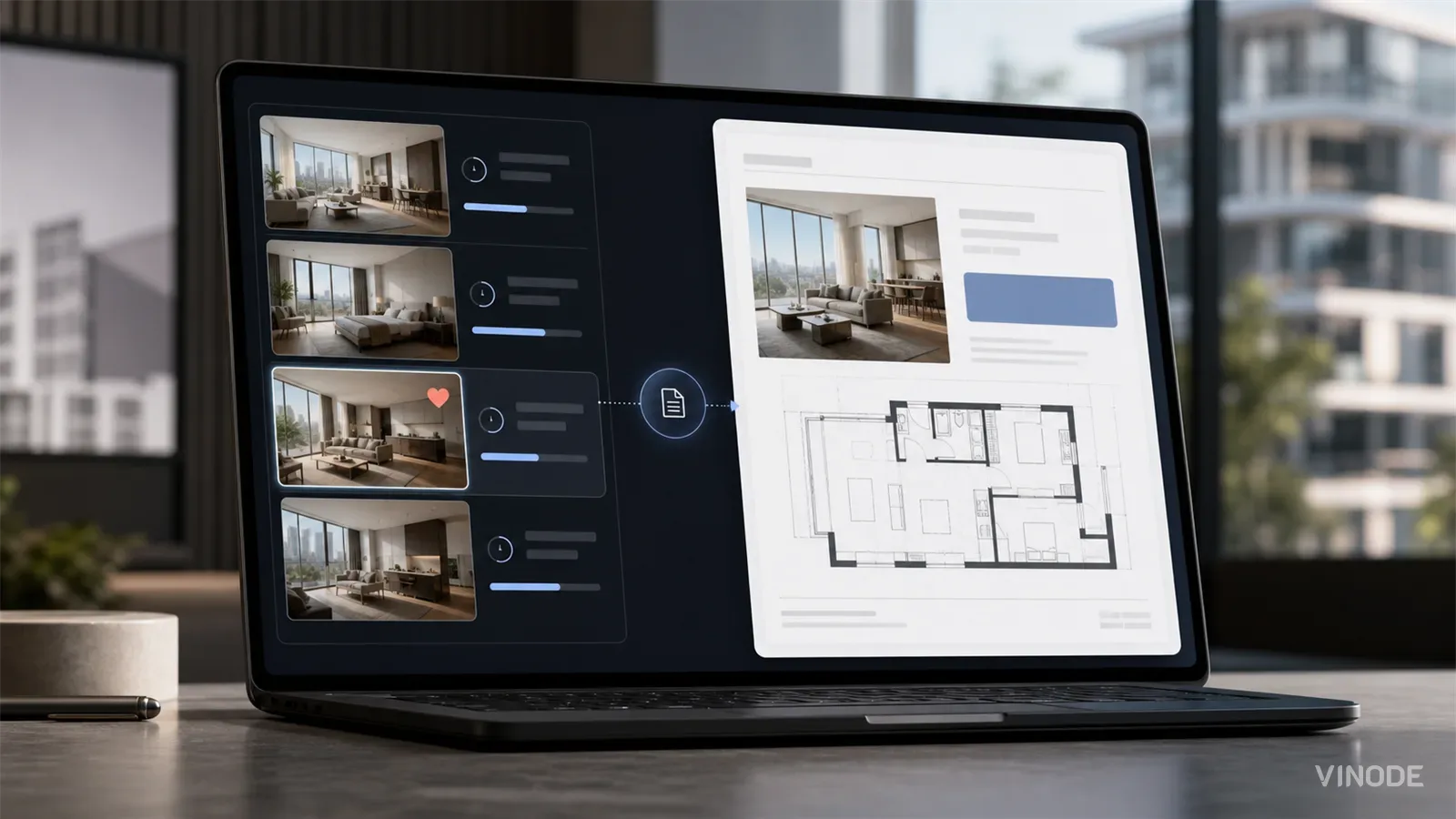
A buyer spends nineteen minutes on one two-bed, saves it, and gets the forty-one-page development brochure the next morning. Once a sales platform records the unit a buyer chose, the generic brochure becomes a decision to ignore that choice.

Expression of interest before release day: capture unit demand
640 names and no idea which side of the building they want. An expression of interest campaign pays off when the form is joined to the units each buyer explored, and each of these checks has a pass, a fail and a cost.

AI Search Is Shrinking the Click: What Property Developers Should Measure Instead
AI answers can remove the visit before it happens. Keep tracking search traffic, but judge it by what follows: qualified arrivals, unit exploration, contextual enquiries and reservations.