
Gaussian Splatting for Real Estate: A Reality-Capture Layer, Not a Replacement for Pre-Rendered 3D
Key Takeaways
- Gaussian splatting can only reconstruct what physically exists, so off-plan and pre-construction inventory stays the job of pre-rendered 3D.
- A splat bakes lighting and color into its points at capture, so changing a finish or floor plan means recapturing, not editing.
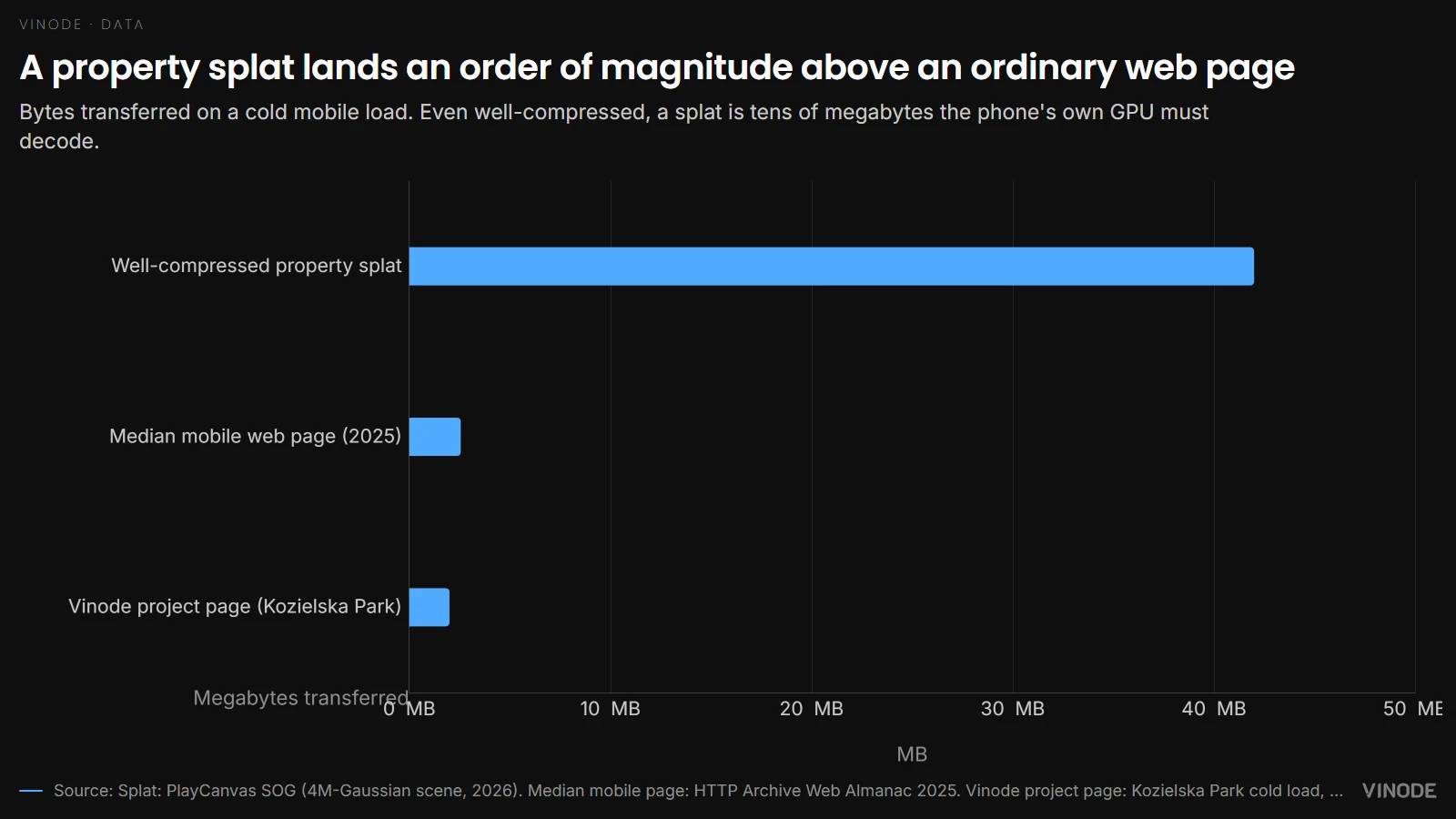
- Even well-compressed, a property splat runs to tens of megabytes that the viewer's GPU must decode, whereas a pre-rendered tour streams as about 2 MB of video.
- The strongest setup is hybrid: capture the built site and finished units as splats, render the unbuilt buildings, and ship both in one browser experience.
A marketing lead at a residential developer spends an afternoon reading about Gaussian splatting. Every page says roughly the same thing: this is the future of reality capture, it is photoreal, and it runs in a plain browser. By the third open tab the conclusion writes itself, that splatting is about to make their architectural renders obsolete. Then they pull up the plan for the next release, and the whole frame collapses on one detail. The buildings in that plan do not exist yet. There is nothing on the site to photograph, and splatting captures only what a camera can already see.
The dividing line is what already exists
Splatting and pre-rendered 3D keep getting compared as if one is an upgrade of the other. They are not on the same axis. A Gaussian splat is reality capture: you photograph or film a physical subject, and software reconstructs it as millions of tiny colored points you can then fly a camera through. Pre-rendered 3D starts from the opposite place. An artist builds a scene that has no physical original, and it stays a designed, editable model all the way to delivery.
So the useful question at the front of a project is not which technique wins on paper. It is whether the thing you need to show is already standing. In most projects that single answer determines which tool applies.
You cannot photograph a building that has not been built, so off-plan and pre-construction inventory has no subject for a camera to record. That is most of what a developer sells. Sales usually open before ground is broken, on a plan and a promise, which is exactly the case a splat cannot serve at any capture quality you throw at it.
One clarification saves a lot of confusion here. Splatting belongs to the same family as photogrammetry and 360 tours: all three record something that exists. Rendering is the other family, the one that depicts what does not. The market tends to pile all of it into a single bucket labeled 3D, even though the two families answer different questions about whether a subject already exists.
Why you cannot edit a splat
Here is the limit the capture vendors rarely put on the page. A splat bakes color and lighting into its points at the instant of capture. The representation stores how the scene looked, not a material you can swap or a light you can move.
Picture a buyer standing in a captured show kitchen who wants to see the walnut cabinet option instead of the white one on display. In a rendered model that is a material swap that takes minutes. In a splat there is no cabinet object to reassign. Every point that samples a cabinet face already carries the white surface color, and the way that white bounced light onto the countertop and floor was recorded along with it. To show walnut you rebuild the room in software or shoot the space again. The same is true for relighting a room for an evening viewing, or redrawing a floor plan the developer revised last week.
This is not a feature waiting for the next release. Relighting and editing a splat are open research problems, which is the whole reason work like GaussianShader, Relightable 3D Gaussians, and Reflective Gaussian Splatting exists. Each is an attempt to bolt on the editable light and material model that ordinary splatting does not carry.
The reason splatting can't take the off-plan job isn't resolution. It's that a captured scene is frozen, and a sales process is nothing but changes.
A rendered scene never hits that wall. Because it stays a model, the walnut cabinet is a material assignment and the evening light is a slider, both handled without anyone driving back to the site. That editability is the quiet reason configurable interiors and unbuilt buildings live on rendering.
Every time a show unit's finishes change, or you restage it for a new buyer segment, a splat of that room is out of date and has to be shot again. Plan and budget for repeat capture visits any time the space it records keeps changing.
What it costs to put a splat on a phone
Weight is the other constraint, and it is easy to wave away because splats compress well. A raw splat scene is genuinely enormous, and the compression is real engineering. PlayCanvas, a WebGL engine vendor with no stake in property sales, open-sourced an SOG format that squeezes a four-million-Gaussian scene down to a small fraction of its raw size (PlayCanvas). The catch is where that fraction lands.
PlayCanvas SOG compresses a four-million-Gaussian scene from about 1 GB of raw PLY to 42 MB, a 95% cut. Even so, the viewer's own GPU has to decode and draw every point.
Source: PlayCanvas engineering blog - as of
The consequence is a device problem. Tens of megabytes still land on the phone, and the phone's own GPU decodes and renders those points in real time. On a five-year-old handset that is precisely the hardware you cannot rely on. For scale, the median mobile web page came in around 2.56 MB in 2025 (HTTP Archive Web Almanac), and a full Vinode project page such as Kozielska Park transfers about 2 MB on a cold load, because the heavy 3D was pre-rendered off the device and arrives as streamed video rather than points the phone has to draw. That puts a property splat an order of magnitude above an ordinary web page, and ties its frame rate to the GPU in your buyer's hand.
Weight is not the only place capture struggles. It also fights the exact surfaces a modern apartment is built from. Standard splatting resolves at most one reflective layer per pixel, so glass, water, and mirrors are its hardest case. To a buyer scrolling the tour it shows up as motion: the reflection in a window does not track the way a real one would as the camera orbits, so it swims, doubles, or hangs in the air like a floating smudge, and a mirror can dissolve into a cloudy patch instead of a clean image. A glass-walled tower, all balustrades and curtain wall, is the kind of subject where those artifacts are hardest to avoid.
When splatting is the right tool
Capture is the right tool for one specific job: showing something that already stands. A finished show unit, the real site as it looks today, the streetscape and surrounding context from a drone pass, these are exactly what a camera can record and a splat can reconstruct at a fidelity a render has to work hard to reach.
On developments like Kozielska Park in Katowice, Safa Al Fursan in Riyadh, or the +Colonia project in Uruguay, the built environment and the surroundings are real and photographable. Where a subject is already there and settled, capture is a legitimate choice.
Where each technology belongs
Reach for capture
A finished show home, the site as it stands today, drone context of the real surroundings. There is a physical subject to point a camera at.
Reach for rendering
Unbuilt buildings, off-plan units, configurable interiors and finishes. There is nothing yet to photograph, and the design keeps changing.
Use both, in one experience
The strongest setup for a real development uses both technologies for the jobs each does well, inside a single browser experience: splat-capture the existing site and any finished show unit, render the unbuilt buildings and the configurable interiors, and let a buyer move between them without ever noticing the seam.
So when a capture vendor tells you splatting is the future of property marketing, answer with your own inventory. How much of what you are selling is already built? For the part that stands, capture is worth a serious look, with the file weight and the glass problem priced in from the start. For the unbuilt buildings, and for any interior a buyer will still configure, rendering remains the only option that can show them at all.
See what pre-rendered 3D looks like on your own phone
Explore a project
Masterplan 3D for Phased Estates: How to Show Phase One Without Overselling Later Phases
A phased estate contains several levels of certainty at once. The masterplan should make that difference visible, then absorb a later-zone redesign without discrediting the phase-one material buyers already saw.

Why rendered glass façades read as fake: the optics of IGU deflection
Archviz glass reads as fake for a reason no roughness slider reaches. Real curtain-wall panes are slightly bowed, each one differently, so adjacent panes reflect the sky at slightly different angles. A render's panes stay flat because the CAD geometry is flat, and that flatness is what the eye catches.

Off-Plan Rendering: What Reaches the Buyer
A new marketing manager inherits 140 JPEGs, one MP4 and no model. Everything the 3D model knew about the units stayed on an artist's workstation, and three vendors are about to rebuild it by hand. What reaches the buyer depends on what leaves the studio.