
Off-Plan Rendering: What Reaches the Buyer
Image co-authored with help of AI for illustrative purposes
Key Takeaways
- Off-plan rendering creates spatial information, unit data, floor plans and availability, that image-file delivery leaves behind at the first handoff.
- A folder of render files means three separate vendors rebuilding what the 3D model already knew.
- Pre-rendered payload scales per view rather than per unit, so a 528-unit development carries roughly the same weight per screen as a six-house estate.
In her first week at a developer, a new marketing manager sent me a shared folder with the subject line "this is everything we have". Inside were 140 JPEGs, an MP4 flythrough and a PDF brochure from the previous year. She wanted to know if we could build the new sales site from it. I asked where the 3D model was. She asked the studio. The studio said the model was thier working file and had not been part of the delivery, wich was true, becuase nobody had asked for it. Everything the model knew, which unit was on which floor, what the kitchen looked like in oak against walnut, whether 4B was still for sale, was on an artist's workstation in another city. What she had was pictures of a building, and she was about to pay three vendors to rebuild what the pictures could not tell her.
What reaches a buyer from an off-plan render depends on what leaves the studio. Hand over image files and every team downstream rebuilds the model's knowledge by hand, in three systems that disagree with each other. Hand over the 3D project itself as a connected platform and the website, the unit selector, the sales-office kiosk and the CRM all read the one source. Four pairs of hands touch the render before a buyer sees anything, and the information is lost at exactly one of them.
The architect hands over flat drawings
What arrives at the studio is layouts, elevations, site plans and a material schedule. There is no photography, no real light to measure and no site to visit, because the building does not exist. Everything in the 3D model has to be authored from those flat drawings, and that is what makes off-plan diffrent from rendering a building that is standing. The render is the first time anyone sees the building in three dimensions, including the developer who commissioned it.
The studio hands over image files, or it hands over the model
The artist builds the model in Unreal Engine, Maya, Cinema 4D or Blender. Exteriors, interiors, floor plans, walkthroughs, the full scope, because off-plan needs all of it. A productized package takes two to four weeks and a bespoke project two to three months.
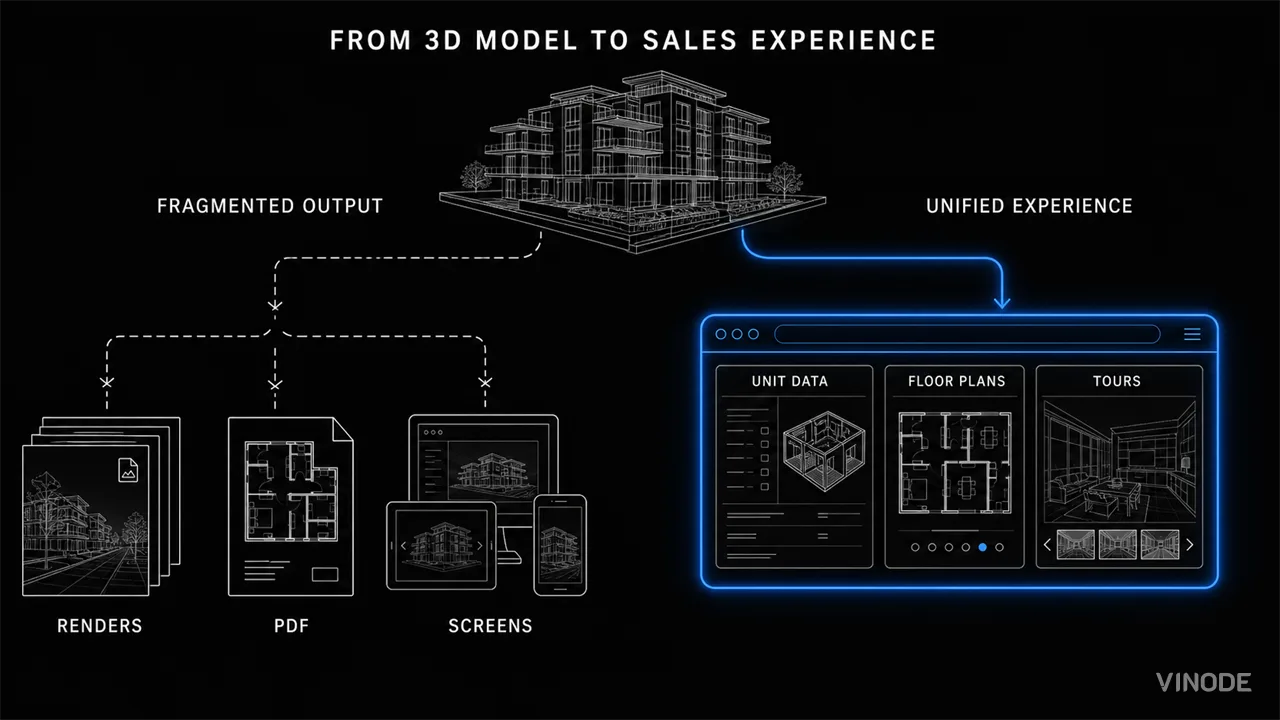
Then the chain forks. Most studios export image files and maybe an animation, and the model stays behind. Everything it knows about which unit is where, which floor plan belongs to which apartment, what finishes are on offer and whether a unit is reserved, stays on the workstation, the way it did for the marketing manager with the folder.
The other path is to hand over the 3D project itself as a connected platform, so the model drives the website, the unit selector, the kiosk and the CRM. The data survives the handoff because what changes hands is access to one system, and no file has to carry it.
Marketing builds three systems out of one folder
The marketing team recieves a folder of images and a video, with no unit data and no connection to the model, and they do competent work with it. They build a website around the images. A second vendor builds a CRM. A third builds the kiosk app for the sales office. Three systems, maintained separately, and they do not talk to each other.
The marketing team did nothing wrong here. They were given files, so they built around files. The fragmentation was decided by the format of the delivery, before any of them were hired.
Sales inherits three systems that disagree
The sales team is the fourth owner, and the one that takes the blame. The website says a unit is available when it was reserved yesterday. The kiosk shows the finishes from last month. An overseas buyer asks about a unit and gets whichever answer the system nearest to hand gives. Someone builds a PDF brochure by hand, and it is out of date by the time the buyer opens it.
Then the developer rings to ask why a sold unit is showing as available, and the sales team is the one on the call. The defect went in two owners earlier, at the studio door, when the deliverable was images instead of a connected system.
Hand over the project, and every owner reads one source
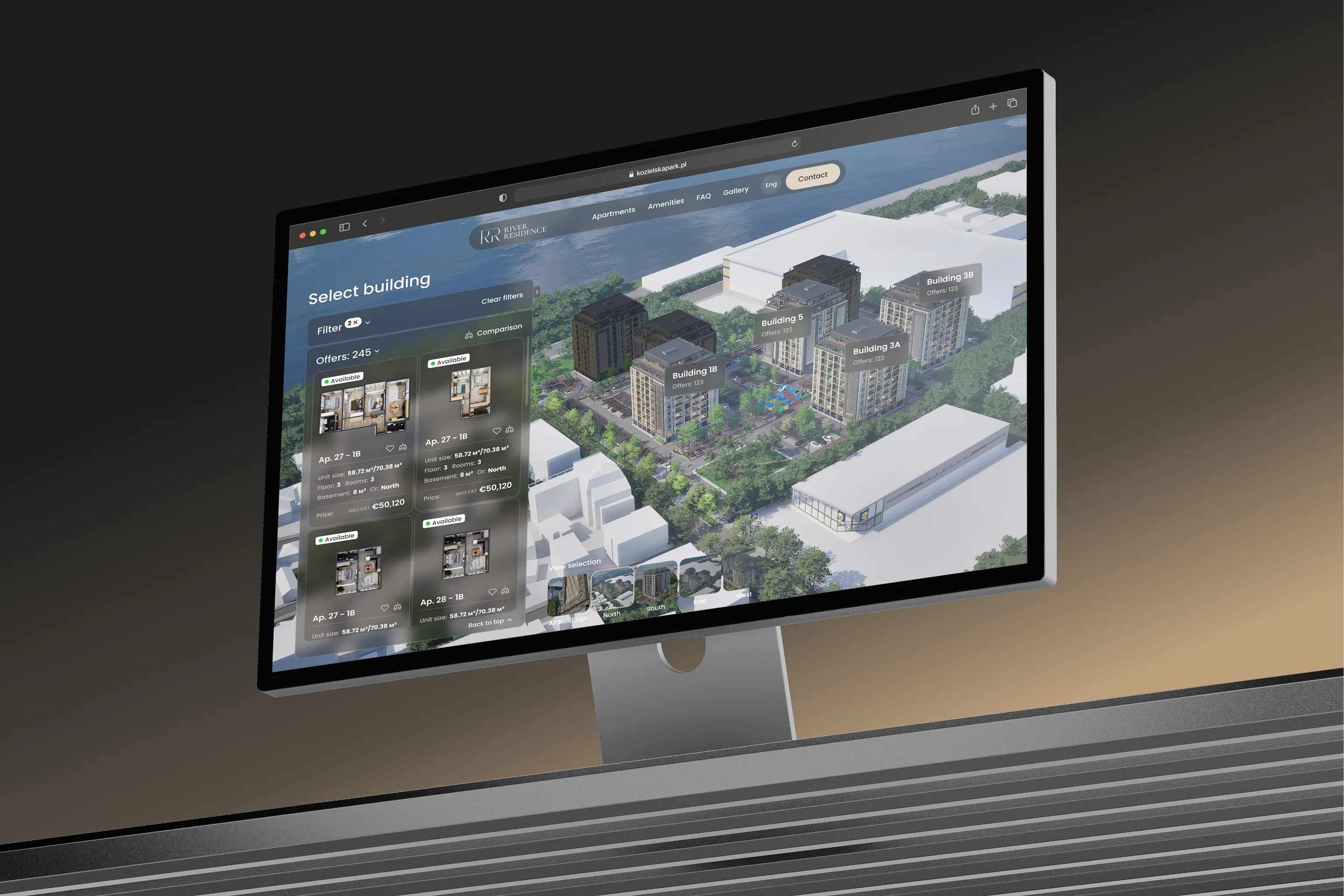
The fix belongs at the studio door, three owners before the sales team takes the call. When the studio hands over the project as a connected system, every owner downstream works from the same live source and no team re-enters what the model already knows. A unit that gets reserved updates once, everywhere. This is not for a developer who needs a dozen hero shots for a brochure and has no units to manage; image delivery is fine there, and cheaper.
Safa Al Fursan in Riyadh is 528 units on one 3D model, from masterplan to apartment tour, on any device. River Residence in Bulgaria lets the buyer configure interior finishes inside the same project, which only works because the data survived the studio door. Kownatki is 20 houses in three build stages with live availability per stage from one source.
Pre-rendering runs the heavy compute once and caches the result as video. We measured Malinowskiego at 1.81 seconds to load and about 3.2 MB in total, a quarter above the median mobile web page of 2.56 MB in the Web Almanac 2025. The payload is per view rather than per unit, since each screen loads a cached clip however many apartments the development has, so Safa Al Fursan's 528 units weigh about the same per screen as Malinowskiego's six houses.
The trade is that the artist chooses the viewpoints and every angle is designed. For off-plan, where the developer controls how a building that does not exist yet is presented, that is usually the right call. When plans change mid-construction, a connected platform updates without re-commissioning, and the same 3D project produces every marketing output, which is a big part of what you own at the end.
~103,000 sessions blended across 13 developments we host, July 2024 to July 2026. About 2 minutes on mobile, closer to 5 on desktop.
Source: Vinode measurement - as of
If you need a dozen hero shots for a brochure and you do not have units to manage, image delivery works fine. Connected platform pays off when the development has enough moving parts (units, stages, pricing, availability) that keeping them consistent across website, CRM, and sales office becomes its own job.
If you are commissioning a rendering project, the images will be good. The decision that matters is what format you receive and how many systems your team builds around it before a buyer can browse a unit on a phone. Ask what leaves the studio. A connected platform keeps one source, one update and one link from a buyer's phone to the sales-office kiosk, and the marketing manager with the folder would have started her first week with a model instead of a question.
See what leaves the studio
Open a live Vinode project on your phone. Unit selector, floor plans, interior tours - one link, any device.

AI Property Imagery in 2026: A Trust and Governance Playbook for Developers
A label tells buyers that AI touched an image. It cannot tell your team which design revision supports the image, who approved its claims, where it is live, or how to withdraw it.
The New-Build Sales Platform Checklist
Two agents reserve the same unit from two laptops, both reservations go through, and the listing stays available for eleven minutes. Test one live unit through inventory, availability, attribution and discount approval before you choose a platform.
AI Search Is Shrinking the Click: What Property Developers Should Measure Instead
AI answers can remove the visit before it happens. Keep tracking search traffic, but judge it by what follows: qualified arrivals, unit exploration, contextual enquiries and reservations.