
Off-Plan Real Estate Marketing: A Developer's Guide from Pre-Launch to Reservation
Key Takeaways
- Your best-qualified buyer is the first to walk when the site, the sales floor and the brochure disagree about one apartment.
- A blank contact form discards the unit-level record the buyer just built.
- The honest measure of an off-plan launch is cost per reservation, not total lead volume.
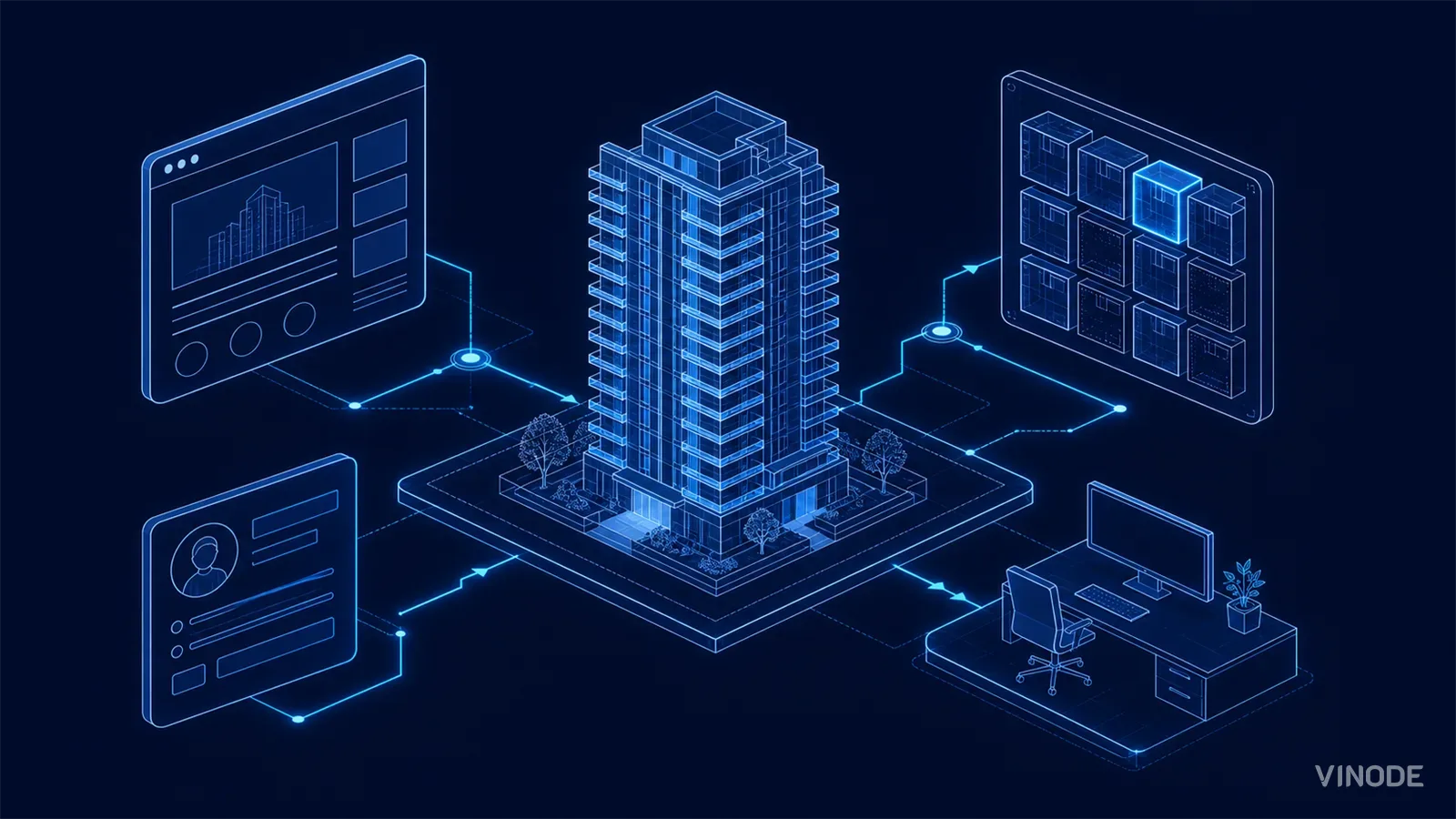
- A working launch does four jobs: make the development understandable, help the buyer find a relevant unit, preserve that choice, and hand it to sales.
The launch that hit every number and stalled
Picture the launch that works on paper. The campaign delivers its traffic, the forms fill, and the weekly lead count lands where the forecast drew it. Everyone relaxes. Then a quarter passes, the reservations have barely moved, and the post-mortem blames the market, the price, the season, anything except the machinery, because the machinery reported success the whole way through.
We have watched this enough times to name what went wrong, and it is almost never the top of the funnel. The website said a two-bed in the east building was available at one price. The sales team's spreadsheet said it was on hold. A brochure the buyer downloaded last week quoted a third figure, because someone edited the web page but not the PDF. The campaign sent every click to the homepage. Three systems described the same apartment three ways, and the buyer, who had done real work to find it, quietly lost confidence and left.
Here is the reframe this guide is built on. Off-plan marketing is not, at its core, a traffic problem; attention for a well-shot development is the cheap, solved part. The hard part is that a buyer assembles a precise, unit-level record of what they want (this building, third floor, two beds, a terrace, under a price) and a generic contact form discards all of it the moment the enquiry begins. Lead volume looks healthy because attention-to-enquiry, the one seam that never broke, is all it measures.
A launch therefore has four jobs: make a development that does not physically exist yet understandable; help the buyer identify a relevant unit; preserve the context of what they chose; and hand that context to sales. Miss any of the last three and you get the launch above. One note on words: I use the UK and Gulf term off-plan; Australia says off-the-plan and North America pre-construction, but the mechanics are identical whichever your market uses.
Why an unbuilt product changes the job
Selling a finished home is confirmation: the buyer stands in the room, and marketing's job is to get them to the door. Off-plan inverts that. There is no room. The product is a promise rendered in CGI and a construction schedule, and the buyer is asked to commit real money, often a deposit that is hard to unwind, to something they can only interpret. The decision leans on trust and comprehension far more than persuasion, and it is rarely made in one sitting.
That last point we can measure. Across the developments we host, returning visitors make up about 29% of sessions and stay roughly 1.9 times longer than first-timers on the same development. People come back, bring a partner or a parent or an investment adviser, and look again. The off-plan decision is long, multi-visit and multi-stakeholder. I will not put a number of months on it, because we have not measured one honestly, but the shape is there in the return rate.
That sets the first job precisely. It is not "commission good CGI." It is to make the development understandable enough that a nervous buyer can build an accurate mental model of a place that does not exist, and trust it. Photoreal exteriors help, but understanding is spatial: where the unit sits in the massing, what it overlooks, how the floor plan lives. Load time matters because comprehension cannot start until the thing appears. Because our experiences are pre-rendered and streamed as video, with no scene computed on the buyer's device, they open fast; one live project home we measured reached full load in 1.81 seconds with the page and player under a megabyte. Read it as an existence proof and nothing more: one load, a European desktop, a warm CDN edge.
Pre-rendering buys that speed, and the device reach comes with it. It asks for one thing back: the buyer explores authored paths through the development rather than roaming it freely in real time. For an off-plan sales page that trade is usually worth making. Which format suits a given project is its own argument, made in interactive 3D vs virtual tour vs video and why pre-rendered 3D beats real-time.
Our own GA4 read across the developments we host; the measured signature of a long, multi-visit off-plan decision.
Source: Vinode measurement - as of
Positioning decides functionality, not the brand deck
Before a single asset is commissioned, one decision determines what you build: who is this development for, and what do those people need in order to say yes. Positioning in off-plan is a spec. It tells you which content and functions the site requires, and if a positioning choice does not change what you build, it is decoration.
Work it through and it makes itself. An owner-occupier wants to feel the space: interiors, light, the walk from door to kitchen, the view from the balcony. An investor buying the same unit wants floor area to the square metre, orientation, comparables and the inputs to model a yield; the emotional tour is close to noise. A first-time buyer needs the process explained, a downsizer reassurance about single-level living, a luxury buyer restraint and specification. Each is a different set of pages and filters, derived from the segment, not a brand adjective.
One segment is larger than most developers plan for: the buyer who will never stand on the site. Across the developments we host, sessions arrive from 161 countries, and buyers browse in more than fifty device languages. Much off-plan interest comes from people who will not, or cannot, visit before they decide, so the whole experience has to work without a site visit, in the buyer's language, on the buyer's device. Treat that as a hard requirement from the first wireframe. The specifics (reservations, deposits, the identity and source-of-funds checks a cross-border buyer has to clear) belong to selling off-plan to remote and overseas buyers and the overseas reservation and deposit playbook; the positioning point is that "buyers who cannot visit" is a first-order segment you design for from the start.
Positioning is a spec: each segment names content and function
Owner-occupier
Content: interiors, light, the lived walk-through. Function: virtual tours, floor plans that read on a phone, a shortlist to bring back to a partner.
Investor
Content: floor area, orientation, comparables, phasing. Function: unit-level data to compare side by side, filters on area and yield inputs, downloadable specs.
Overseas buyer
Content: what the owner-occupier needs, plus process and legitimacy. Function: the whole journey working without a site visit, in their language, on their device.
The minimum asset system, held together by shared data
There is a standard shopping list for a launch: brand identity and messaging, exterior and interior CGI, a masterplan, floor plans, a unit selector, virtual tours, location and amenity content, construction and specification information, brochures, sales-office material. The list is not wrong. The word that does the work is minimum: what you need to open the doors, against a search page that will sell you the maximal version of every item.
The list is also a trap, because it presents these as separate deliverables from separate suppliers on separate timelines. They are one system sharing one dataset, and the moment they stop sharing it, they drift. A price changes on unit 3B. The website updates that evening. The brochure, generated a month ago, does not. The sales office prints its own sheet from a spreadsheet a third person keeps. Three surfaces now quote three prices for one apartment, and the buyer who spots the gap does not think "someone forgot to sync a PDF." They think the developer is disorganised, or testing them.
The fix is structural. Unit data (names, prices, attributes, availability) lives in one place, and every asset draws from it. When the brochure is generated per selected unit from the same record that feeds the website, a price change reaches the download automatically, because there is no second copy to forget. That is what "shared data" buys, and why the personalised brochure is worth building properly; there is a worked example in the River Residence interactive sales engine. On timing, productised packages come together in about two to four weeks and bespoke projects in two to three months, a realistic anchor for asset production done as one connected build rather than ten disconnected ones.
Fast-moving inventory run through spreadsheets and hand-edited pages does not drift if everyone is careful. It drifts because it is more than one copy. The fix is a single record every surface reads from; a stricter update rota only asks the same broken process to try harder.
The website is a sales environment
A brochure broadcasts. A sales environment lets the buyer do work and leaves a trail of what they did. That changes how you judge every element. Instead of asking whether it looks good, you ask which of the buyer's real questions it answers, and you structure the site in the order those questions arrive: is this for me; which unit type suits me; what is still available; what will it feel like to live here; what does it cost; what do I do next. Navigation, filters, unit pages, live availability, downloads and CTAs get judged against that sequence.
Two of those questions are answered before the buyer reads a word, by whether the page loads. Most of your buyers are on a phone: across the developments we host, mobile is the majority surface, with roughly 56,000 mobile sessions against about 46,000 desktop. And mobile audiences are unforgiving. Google's data puts mobile-visit abandonment above 53% once a page takes over three seconds (The need for mobile speed), and bounce probability rises about 90% as load climbs from one second to five (mobile page speed benchmarks). On an off-plan page carrying rich 3D, performance is the first gate the sales environment clears, on the worst device in your audience.
I am not going to make this the performance post. Measuring Core Web Vitals on a 3D page lives in measuring Core Web Vitals for a property 3D tour, whether 3D hurts those scores in do 3D property tours hurt Core Web Vitals, and the enquiry cost of a slow page in the slow property page and lost enquiries. Form design has its home in property lead forms that convert. The point is the reframe: the site is where understanding turns into a shortlist, so build it as a place where the buyer does work and leaves a trail.
The unit selector is a qualification system
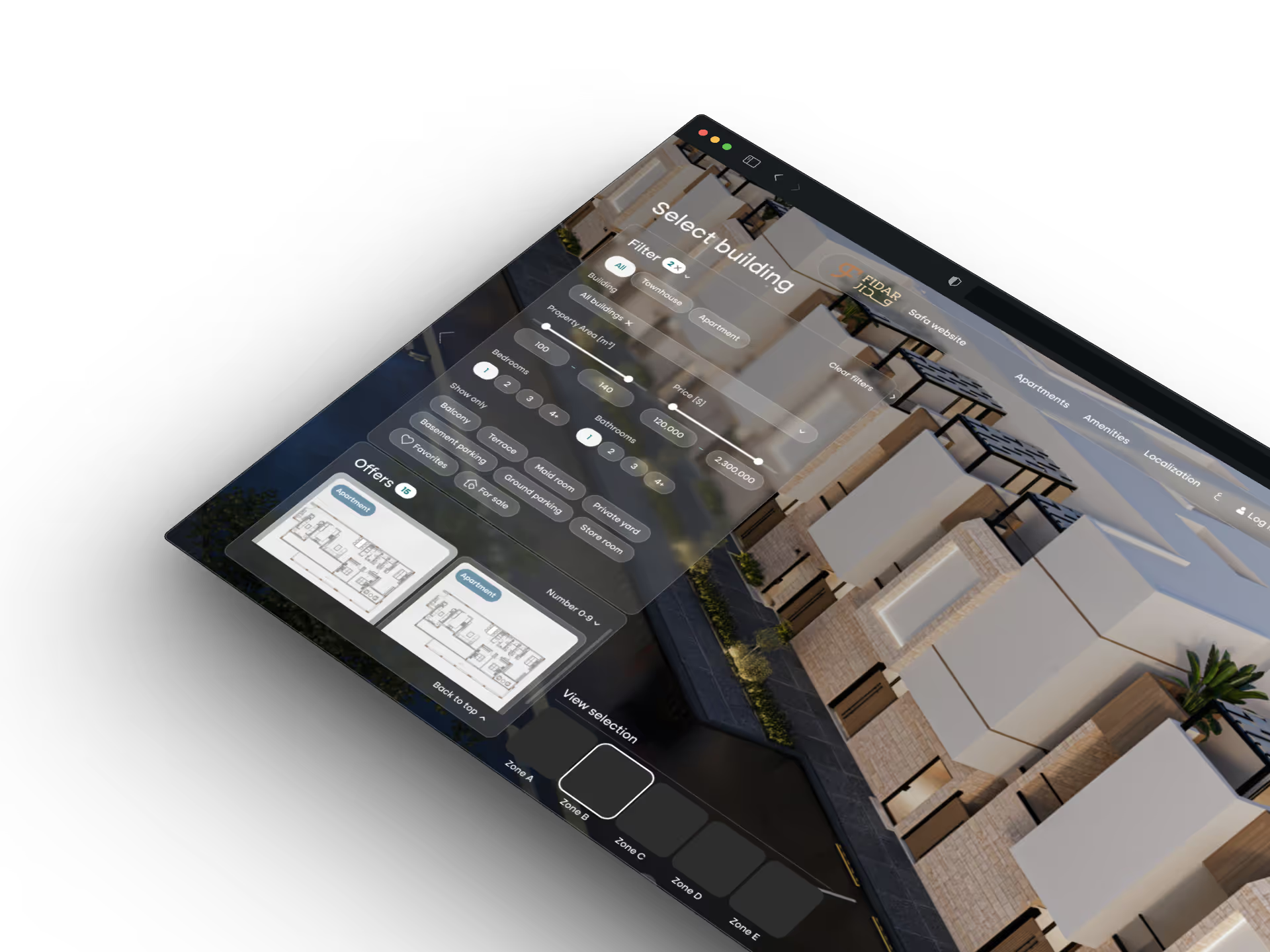
Here is the hinge the whole argument turns on. A unit selector looks like a browsing toy: pick a building, filter by bedrooms, spin the floor plan. Every choice inside it is intent data of a quality paid media would pay dearly for: building, floor, bedrooms, area, orientation, outdoor space, price band, availability, and the specific two or three units they kept returning to. The buyer is not just looking. They are qualifying themselves, in their own words, for free.
And they do it; this is behaviour we can see in the data. On one of our developments, traffic reached more than seventy distinct individual-apartment pages inside a single building; the zone view for that project alone drew 3,475 sessions at about 3.8 pages each, sessions running close to five minutes. People drill from zone to building to floor to apartment, deliberately and repeatedly. The intent data is real, granular, and there to be captured or thrown away.
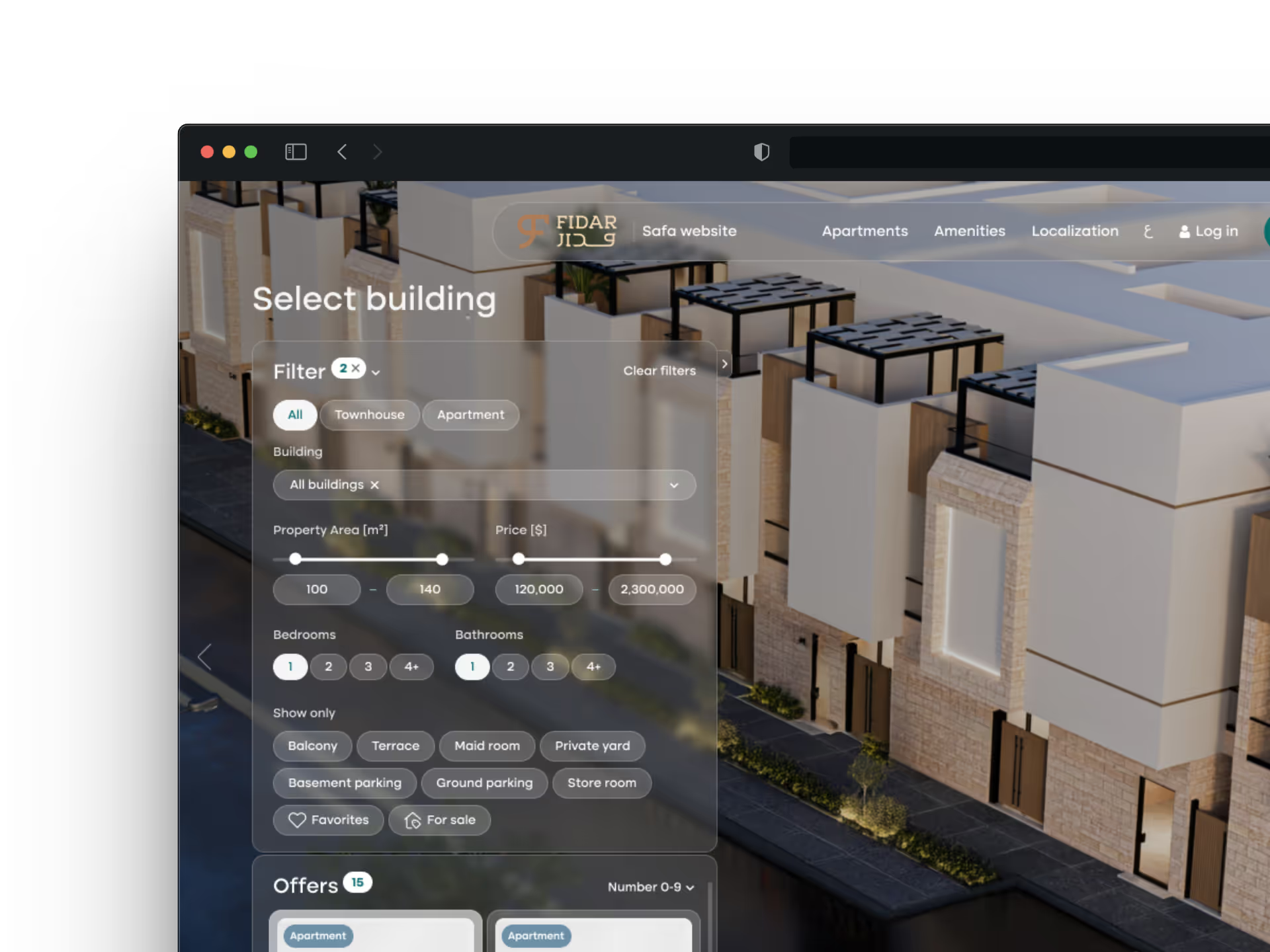
I should complicate that before it sounds too clean. Depth like this is not guaranteed by owning the tool; it is earned by the offer and the audience. Two developments on the same platform explored very differently, at about 3.6 versus 6.7 page views per session, and engaged-session rates across four ranged from 40% to 75%. The selector enables the drilling; whether it happens depends on whether the development is worth drilling into. A tool cannot rescue a proposition the market is lukewarm about, and any vendor promising otherwise is overselling.
So the claim is narrow and load-bearing. The selector is a qualification instrument, every filter is a recorded preference, and the only question that matters next is whether that preference survives the enquiry or dies at the contact form. How to design the selector itself, from filters that avoid decision fatigue to floor plans that read on a phone, is covered in unit selection UX, the configurator without decision fatigue and interactive floor plans in the sales cycle.
What the selector really is
- Every filter a buyer sets is a recorded preference, not a page view.
- Buyers drill from zone to building to floor to apartment on their own; the intent data is real.
- The contact form decides whether that record reaches the salesperson or vanishes.
Preserving context: the record that already knows the unit
This is where most funnels quietly fail, and where the fix is most concrete. When the buyer who spent five minutes shortlisting two apartments finally clicks "enquire," one of two things happens. Either a blank contact form asks for a name and email, discarding everything they just told you, or the enquiry arrives already carrying the units they viewed, the time on each, and the source that brought them. The difference is not tone or diligence. It is a data model.
In Vinode's Back Panel, the CRM and CMS in one back office, a contact record stores the units a person viewed and the time they spent, alongside name, email, phone and source. Lead capture is auto-linked to the contact, and attribution runs from the submission through to the deal and down to the individual unit. "The buyer's context follows them to the salesperson" is a field in a record: the salesperson opens the lead and already knows which two apartments to talk about, before the first call.
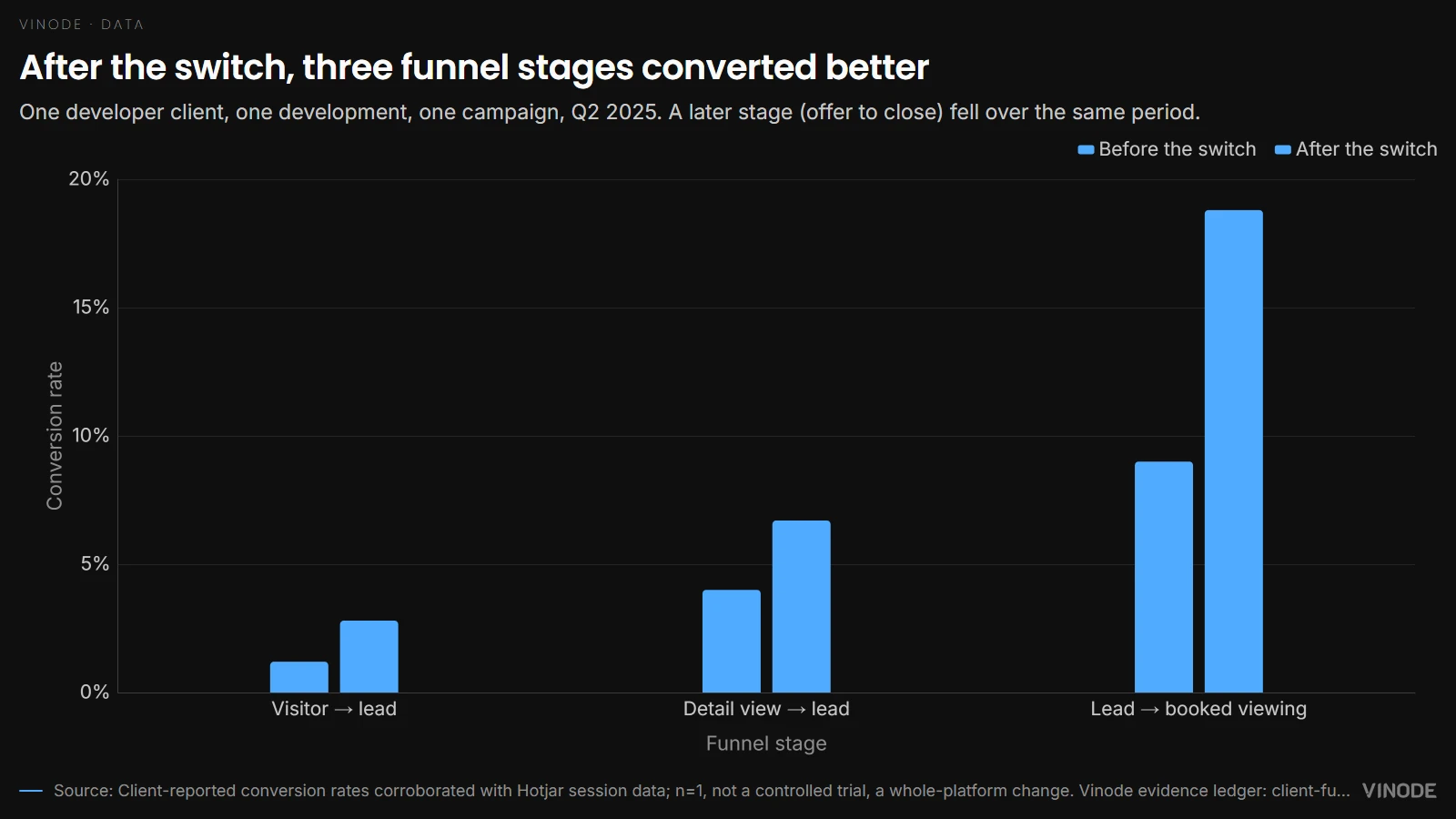
The effect of connecting the system this way is measurable, though the answer we have is narrow: one developer client, one development, one campaign, in the second quarter of 2025. The stage rates were client-reported and we corroborated them with Hotjar session data. This is not a controlled trial and the sample is one, so read it as a single measured instance and weight it accordingly. Before and after the switch: website visitor to lead rose from 1.2% to 2.8% (up 133%), property-detail view to lead from 4.0% to 6.7% (up 68%), and lead to booked viewing from 9.0% to 18.8% (up 109%). Compounded end to end, overall visitor-to-sale moved from 0.01% to 0.06%. I quote the absolute rates deliberately, because that last figure is a roughly five-fold jump built out of tiny numbers, and reporting it as "5x" without the 0.01% is exactly the inflation this brand refuses.
And one stage moved the other way: offer to close came down over the same period. We report it because it makes the rest believable. A funnel where every stage improves is a marketing artefact; a funnel with one regression in it is a measurement, and I would rather you trusted the 133% because you saw the stage that fell. Two more caveats matter as much as the numbers: this was a whole-platform switch, so I cannot credit the unit selector alone, and I will not tell you what the old system was, because the only fair framing is before and after.
How that record and its pipeline are built out, from contact to deal to stages, is one back office for CRM and CMS and a generic CRM versus a new-build sales CRM. Whether it connects to the CRM you already run is does Vinode integrate with our CRM.
One developer client, one development, one campaign, Q2 2025. Client-reported and Hotjar-corroborated, n=1, not a controlled trial, and a whole-platform change rather than an isolated A/B.
Source: Vinode measurement - as of
One source of truth for availability
The context that reaches the salesperson is only as trustworthy as the availability behind it. Off-plan inventory moves throughout a campaign: a unit goes on hold, a reservation firms up, a promotional price opens on the slow-selling stack facing the car park. If those states live in a spreadsheet one person edits and a website another updates, they will disagree, and they will disagree at the worst moment, with a buyer asking a salesperson about a unit that sold yesterday.
Asking three people to keep three copies in sync is a process that fails by design, which is why the answer is one source of truth. In the Back Panel CMS, each unit carries an availability state (free, reserved, sold, or promotional), and the website, the sales office and the reporting all read from that record. Change it once and every surface reflects it, because there is one surface underneath. Holds, reservations, agent assignment and follow-up history hang off the same record, so the story about unit 3B is identical whoever is telling it.
The same single record that holds a buyer's context also has to hold their permission to use it: consent is captured per purpose, and a contact can be anonymised or erased on request. I name those as features, not legal advice. The mechanics of inventory go deeper than this pillar should, in developer CRM and unit inventory management; the law around consent and attribution is jurisdictional and belongs to cookie consent and lead attribution and data ownership and GDPR, stamped to your market, which I will not pretend to do from a blog post.
Planning an off-plan launch?
Tell us about the development: units, phases, timeline. We will walk you through how this system would run it, and what it would take to build.
Send paid clicks back to the decision
Everything so far captures a buyer's intent; paid media is where developers most often reset it. Search, social, portals, email and retargeting are all fine channels, and I am not going to walk through configuring each, because that is the listicle this guide exists to avoid. The single decision that matters is the destination. An ad's job is to return the buyer to the decision they were making, and a campaign that lands every click on the homepage pays for reach and then spends it to reset the context the site just built.
The destination should match the intent behind the click. An investor ad lands on the investor page with the yield inputs. A retargeting ad to someone who shortlisted two-bed units in the east building lands on those units, with their live availability showing. A launch-phase ad lands on the phase that is actually releasing. None of this costs more than pointing everything at the homepage; it simply aims the same budget at the decision, so the selector, the record and the live availability are allowed to do their job.
Continuity into the sales office
The website does not replace the salesperson; it changes what the meeting starts from. When the lead lands already carrying the buyer's shortlist and source, the salesperson opens somewhere useful (those two apartments, that orientation, that price band) instead of spending ten minutes re-gathering what the buyer already told the site. The buyer never has to explain themselves twice, which is a small thing buyers notice a great deal.
That continuity has to survive every channel the sale travels through: a phone call, an email thread, a video call for the overseas buyer, the sales-office displays, and the reservation itself. And the agent is not being designed out of this. In the US, about 46% of buyers begin their search online, yet 88% still purchase through an agent (NAR 2025 profile of home buyers and sellers). The online system's role is to hand that agent a buyer who is already qualified and oriented.
Two mechanics carry the thread into the room. A personalised brochure is generated for the specific unit a buyer chose, so what they take away matches what they explored. And the same experience runs as a standalone offline kiosk app in the sales office, so the walk-through the buyer explored online is the one the salesperson opens on the gallery screen. The wider set of sales-floor changes is what changes on a new-development sales floor and the offline sales gallery kiosk; speed to lead is off-plan lead nurture and speed to lead.
Measure cost per reservation, not lead volume
If the launch that opened this guide reported success the whole way to its own failure, the reason is the metric. Total lead volume is the most flattering number a launch produces and among the least useful, because it counts the one seam that rarely breaks and stays silent about the three that do. It rewards a campaign that fills a disconnected funnel exactly as much as one that fills a connected one, right up until the reservations do not come.
The alternative is a ladder read from the bottom up, engagement into consideration into sales; the grid below itemises each rung. What changes is where you put the headline. Move it to the top rung, to cost per reservation by source and unit type, because that is the one cut a disconnected funnel cannot flatter. It measures which channel and which apartment converted attention into a signed reservation, which is the only thing a launch is finally judged on. The rates underneath it (lead-to-contact, appointment-to-reservation, velocity by unit type) tell you where the ladder is leaking and what to release next, and lead volume settles into its proper place as a diagnostic input for the sales team.
The measurement ladder, read from bottom to top
Engagement
Qualified traffic, unit-selector usage, return visits. Portfolio engaged-session rate around 52%, up to 68-75% on higher-intent developments.
Consideration
Units viewed and shortlisted, floor-plan and brochure downloads, tour engagement, enquiry completion. The intent data made visible.
Sales
Lead-to-contact, contact-to-appointment, appointment-to-reservation, time to reservation, velocity by unit type, and cost per reservation.
Cost per reservation also reframes the budget conversation, which developers usually want to have as a price. Separate two things. Infrastructure cost has a knowable shape: on Google Cloud GPU pricing in July 2026 (T4 in us-central1, and both move), our modelling puts a 500-concurrent-viewer launch hour at roughly $60 to $175 in GPU time if you stream real-time pixels to every viewer, against essentially zero marginal compute for pre-rendered files served from a CDN edge. The busiest single month across our hosting drew 10,367 sessions delivered as static, edge-cached files with no per-viewer render cost, which is why pre-rendering keeps a launch-day spike from becoming a runaway bill.
One aside, because it is the part I find genuinely elegant and cannot let pass: the same pre-rendering that flattens that cost curve is also why the whole experience runs with no live server behind it at all, which is precisely what lets it drop onto an offline kiosk in a sales office and keep working when the venue wi-fi gives out on the busiest day of the campaign. But I digress. What Vinode charges to build and run a project is a different question from the infrastructure, and it resolves to a custom quote shaped by project size, the assets you already have, and scope, not a figure I can put in a blog post.
An indicative launch sequence
Sequence is where listicles reach for a timeline and miss the only useful thing about one: the dependencies. What must run in order, and what can run at the same time.
Some things are strictly sequential. Positioning comes first, because it decides what every later asset is for. The data model and unit inventory come second, because the website, brochures and CRM all draw from them, and building assets before the shared dataset exists is how you end up with three copies to reconcile. Testing precedes launch, on real devices, without exception. Everything between those anchors can overlap: CGI production alongside the website build, paid-media setup alongside CRM configuration, sales-office material alongside the public site. Assuming the whole thing is a relay race, one baton at a time, is how launches slip by months for no structural reason.
Be sober about the clock, because off-plan windows are long. In the US, buildings of twenty or more units averaged about 22 months from permit to completion in 2024 (Eye on Housing, on Census data). The payoff of building the system properly across that window is that the sale does not wait for the building. Folded across our portfolio of twenty-plus-unit developments, the average time to sell out runs around 12.7 months, and roughly seven in ten units tend to be reserved by the time buildings are finished. Those are portfolio figures, rounded and not tied to any one project. For the compressed path, launching a development microsite in two weeks walks it, and can I sell before construction answers the question head on.
A working checklist
This is the part you can lift and use, and it lives here, in the post. There is no gated download, because a checklist you trade an email for is just another lead form pretending to be a resource. The test for every line: does it serve one of the four jobs the launch has to do.
Off-plan launch checklist, grouped by the four jobs it serves
Strategy
Positioning names the segments; every segment names the content and function it needs. If a positioning choice changes no asset, cut it.
Content
CGI, masterplan, floor plans, unit selector, virtual tours. Every asset draws from one shared unit dataset, or it will drift.
Technology
The site loads in about two seconds on the slowest phone a real buyer will use, structured around the buyer's real questions in their order.
Data
The buyer's shortlist and source reach the CRM record the salesperson opens. Availability is one source of truth every surface reads.
Sales operations
The salesperson starts from what the buyer already chose. Personalised brochure per unit; offline kiosk for the sales floor.
Measurement
Cost per reservation is the reported headline; lead volume sits beneath it as a diagnostic input.
Where the next launch will leak
Do one thing differently before the next launch. Walk every asset and integration you are about to pay for past a single question: which of the four jobs does this do, and does the buyer's context survive it? The place where the answer is "none of them," or "the context dies here," is precisely where a fully-funded campaign leaks its best-qualified buyers, quietly, while the lead count keeps looking healthy. Find that seam before launch, not in the post-mortem.
See how the pieces connect
Watch an interactive development website tie unit discovery, live availability and CRM into one system.

The Unit-Specific PDF a Buyer Actually Asked For
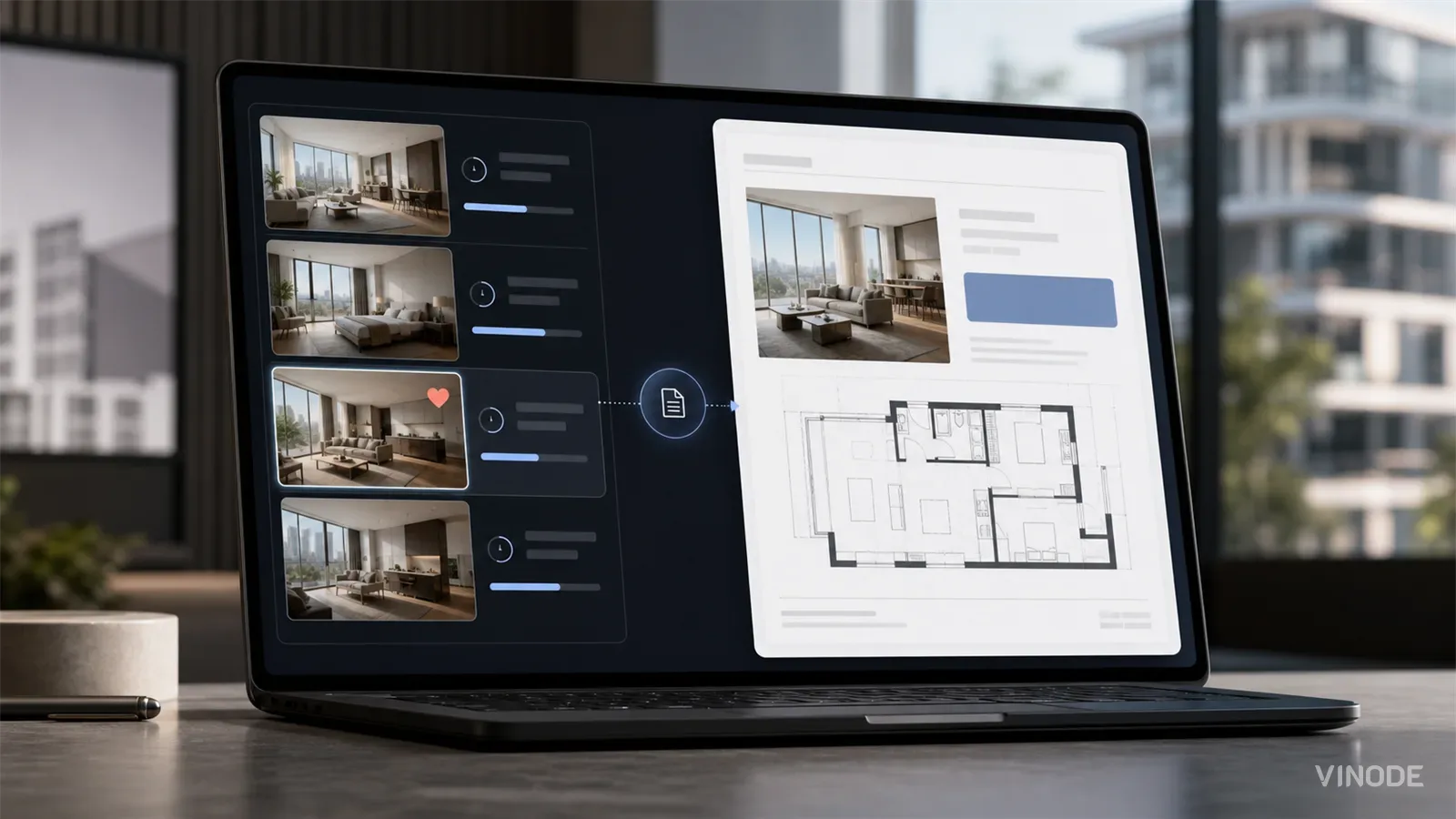
A buyer spends nineteen minutes on one two-bed, saves it, and gets the forty-one-page development brochure the next morning. Once a sales platform records the unit a buyer chose, the generic brochure becomes a decision to ignore that choice.

Expression of interest before release day: capture unit demand
640 names and no idea which side of the building they want. An expression of interest campaign pays off when the form is joined to the units each buyer explored, and each of these checks has a pass, a fail and a cost.

We measured when a pipeline crosses the presale line, not just whether it will
When GTHA opening-quarter absorption averaged 66%, the sold percentage was enough to forecast a presale crossing date. Then absorption fell to 17%. Three pipeline inputs produce the crossing date your lender asks for: stage-conversion rates, a cancellation haircut, and remaining inventory.