
Selling off-plan to overseas buyers who can't visit the site
Key Takeaways
- For a remote off-plan buyer, trust comes from the neighbourhood and masterplan around the unit, not a prettier interior render.
- Vinode has no buyer-facing deposit checkout; the online reservation captures unit-level intent and hands a warm lead to a rep.
- Keep availability honestly live and bound to the sales system, so a distant buyer never chases a unit already sold.
- Match the effort to project size; a six-unit local build selling to walk-ins needs almost none of this.
A buyer in Singapore has a floor plan open at one in the morning her time. The building she is looking at does not exist yet. It is a foundation and a set of Unreal renders on a development site several thousand miles away, in a city she has never visited, priced in a currency that isn't hers. She likes unit 704. She is not going to fly out to walk it. Somehow, from that screen, she has to decide whether to commit a deposit.
When a developer's sales team pictures this buyer, two instincts fire. Spend more on the renders, make the kitchen glow. And find an online 'reserve' button so she can lock the unit herself before she cools off. Both instincts are aimed slightly wrong, and this piece is about where.
The remote, overseas buyer is the norm here, not the edge. Across our developments, visitors arrived from 161 countries and in 52 different languages - a browser-based tour reaches a genuinely global audience. Anonymized aggregate, from our own GA4.
Source: Vinode measurement - as of
Spend the render budget on the neighbourhood
Everyone spends the render budget on the inside of the apartment. It is the most photogenic thing and the easiest to drop into a brochure. But the interior is not what the remote buyer is anxious about. She can read a floor plan. What she cannot do from a screen is stand on the street, look at the beach, gauge how far the port is, or feel whether the surroundings are a construction pit or a real neighbourhood. That context is the one thing a listing photo can't hand her, and it is exactly the thing she can't go and check for herself.
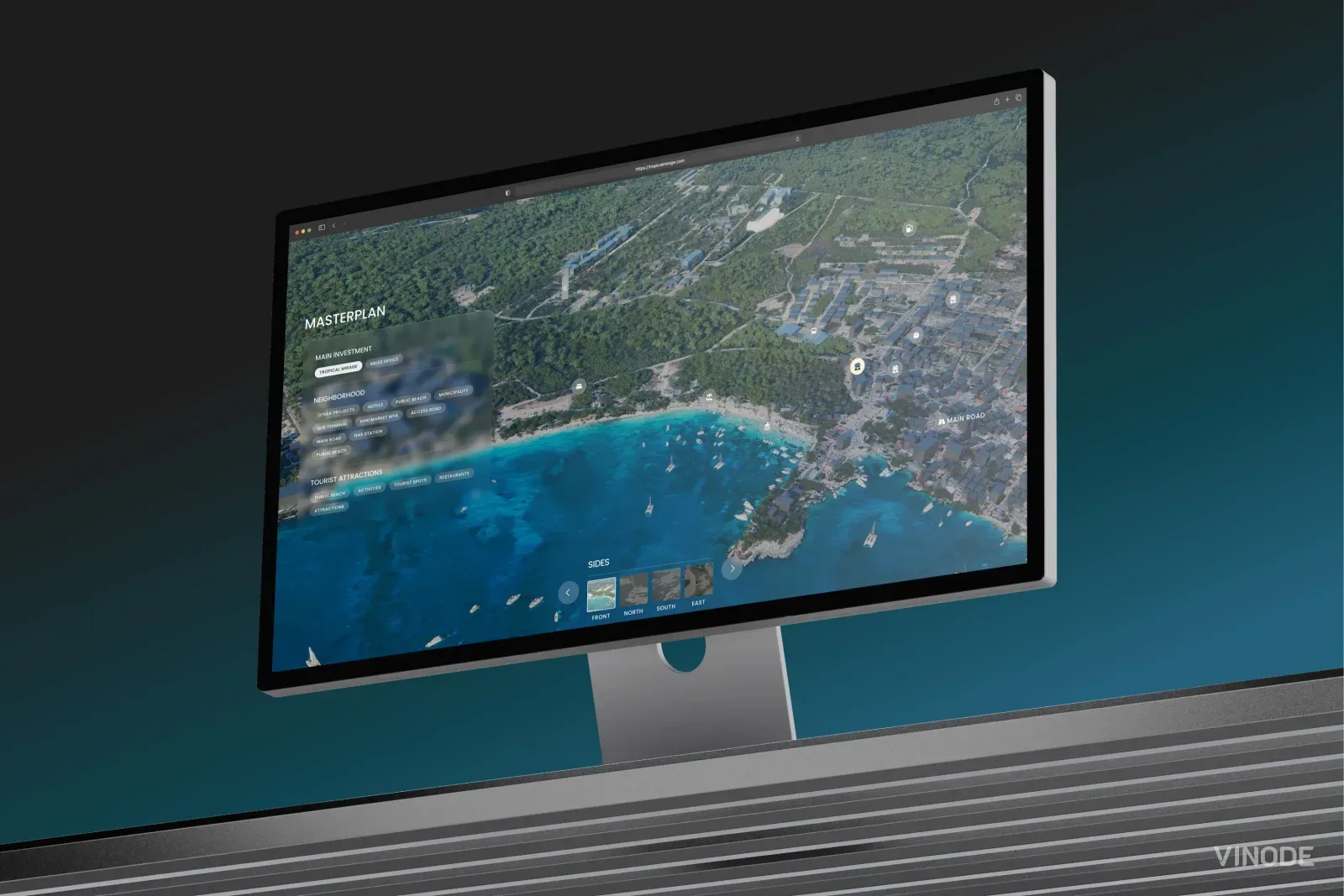
Vinode's cleanest case for this is Tropical Mirage in Bayahibe, on the south coast of the Dominican Republic. The developer was selling to international buyers who would never see the site before signing, so the experience was built as an interactive neighbourhood map: the development and sales office at the centre, with more than twenty mapped points of interest around them, the public beach, the port, the natural pool, the diving school, restaurants and shops. The line the team used for it was 'selling a Caribbean address, not just an apartment.' The surroundings are the investment; the apartment is what you get to live in.
The same move scales. Mascolonia, a 515-hectare coastal masterplan in Uruguay, is navigable district by district, so a buyer anywhere can grasp its size and see where a given plot sits inside it. Safa Al Fursan in Riyadh renders the surrounding government masterplan into the far view instead of dropping the buildings onto a generic skybox, because for a high-net-worth international investor buying thousands of miles from the site the district going up around the units is what the money is really betting on.
So here is the first opinion this piece will defend. Interior tours have become table stakes. If you have a fixed budget and are deciding where the last of it goes, put it into the neighbourhood, the masterplan, and the city, ahead of a fourth lighting pass on the show kitchen.

The VR tour that won't open on the buyer's phone
There is an overrated version of 'sense of place,' and it is the heavyweight real-time or VR walkthrough that dazzles on the demo laptop and never opens on the buyer's actual phone. A remote buyer is, by definition, on whatever device and connection she has where she lives, which might be a mid-range Android on hotel wifi. If the experience computes every frame on her device, it is only ever as good as that device, and the most important buyer you have is the one most likely to get a loading spinner.
Vinode's build goes the other way. The 3D is pre-rendered and streamed as video rather than computed live, so it loads quickly, runs on low-powered phones, and works offline as a sales-office kiosk. The reason it matters for this buyer in particular is simple: the fast, light path is the one that reaches her at all. We have made the underlying rendering argument already and won't relitigate it here (pre-rendered 3D versus real-time).
One honest limit, stated as a limit. None of this fully replaces a site visit, and you shouldn't promise a buyer that it does. What it does is reduce and de-risk the visit. A buyer who has explored the neighbourhood, filtered down to the two or three units she likes, and studied the floor plans arrives already qualified, and some buyers will still fly out before they sign. That's fine. The aim is to turn the trip into a confirmation rather than a first look.
Pre-rendered and streamed, so a mid-range phone reaches the experience instead of watching a loader. (Vinode-published figure, not independently benchmarked.)
Stop looking for the Reserve button
Here is the part where honest content is scarce, which is also the part where the temptation to overclaim is strongest. Marketing copy across this whole category promises the overseas buyer can 'reserve online.' Read literally, that means she picks unit 704, pays a holding deposit in her browser, and the unit is hers. That flow, a buyer-facing reservation and deposit checkout, is not something Vinode has. It is worth saying plainly, because pretending otherwise breaks trust with the exact person you're trying to reassure, and she is the type to notice.
The closest the product gets is River Residence, where global buyers configure a unit before a brick is laid: switch between three interior styles in a click, add parking, choose kitchen finishes, and review financing options. Read that last verb carefully. Review financing options, not pay. It is a configuration-and-review experience: the buyer shapes the unit and looks at the numbers, and nothing changes hands online.
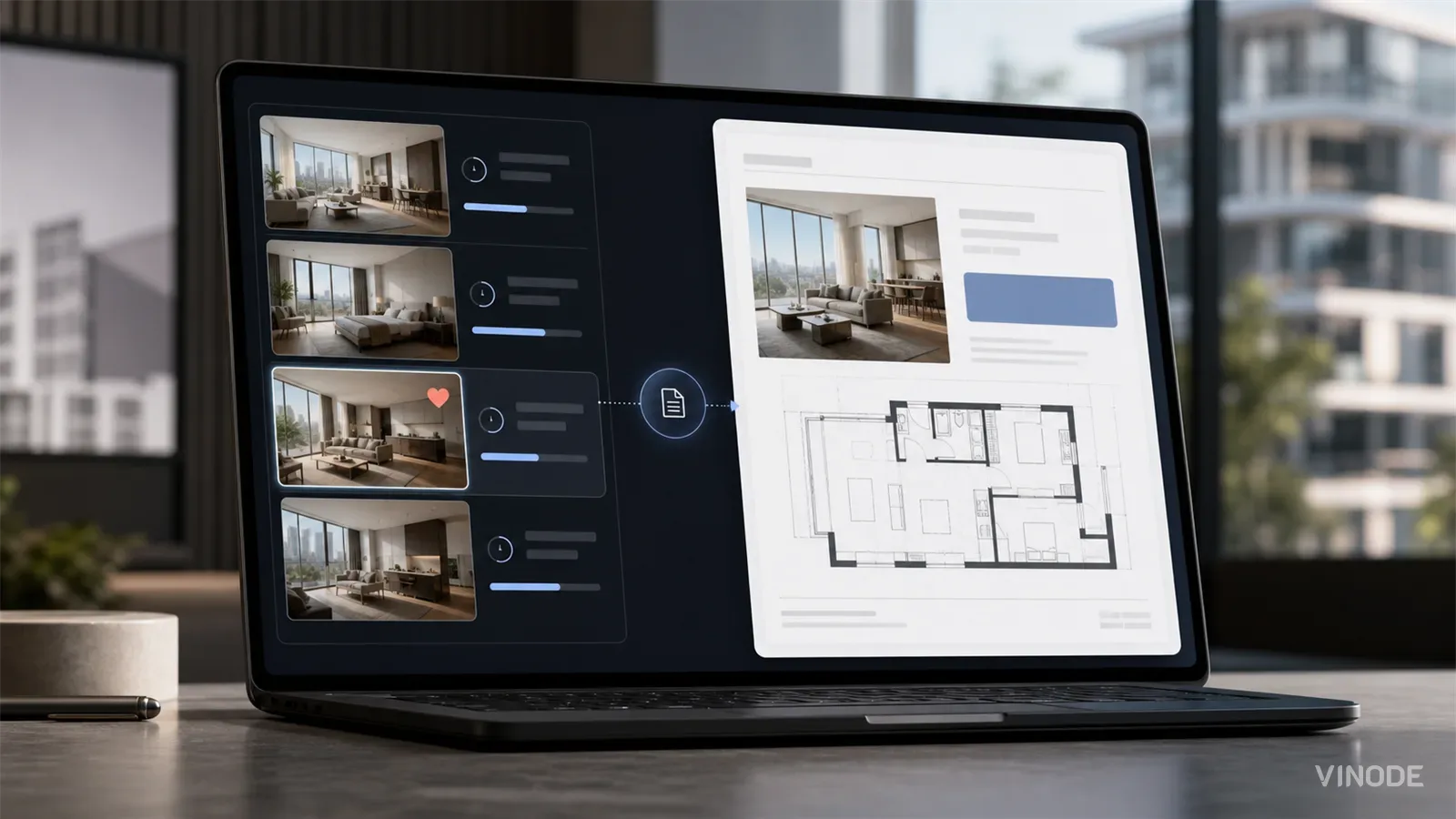
So what is the real online reservation for a remote buyer? It is intent capture handed warm to a human. When she selects a unit, the experience generates a dynamic PDF for that specific unit: its floor plan, current price, and the preferences she set. That is the artifact she keeps and forwards to a spouse or an advisor in another time zone, which is how off-plan decisions actually get made across a household. When she fills in the enquiry form, the submission lands in the CRM auto-linked to a contact, scored, and attributed to the specific unit she was viewing. The form works around the clock, so an enquiry arriving at 3am the seller's time isn't lost; it becomes a task for a rep with the context already attached. Internally, 'reserved' is a deal stage the sales team sets, and a discount-request workflow with approval limits exists for negotiating remotely.
The lead half of this is a topic in its own right, covered in lead forms that convert, and the browse-to-choose seam in unit-selection UX. The point for the remote buyer is that what reaches the salesperson is a named person attached to a specific, priced, currently-available unit, with a record of what she looked at.
Keep availability honestly live
A remote buyer's second question, right behind 'can I trust what I'm seeing,' is whether any of it is still available at the price shown. Buying from a distance, she has learned to assume the good units are gone and the site is out of date. So live availability does real work. Portada, a 172-unit complex in Croatia, binds its public availability and pricing to the back panel, so sold units never resurface as available. When a unit goes, it drops out of the experience. She is never chasing something already spoken for, and the price on screen is the price the developer is standing behind today.
This closes a loop with the context argument. The same live inventory that keeps the buyer trusting what she sees is what makes the lead worth working when it lands. Sales gets an enquiry pinned to a real, currently-available unit.
Be ready for the deposit question
There is one question a serious off-plan buyer always asks, and no amount of 3D answers it: how is my deposit protected before the building exists. It is her money going into what is currently a foundation. Dodging it, or pasting a generic reassurance, is the mistake. Deposit protection for pre-construction is jurisdiction-specific, and the honest move is to have your project's actual answer ready, the escrow arrangement, the payment schedule tied to construction milestones, whatever it genuinely is, and to say it in plain language the moment she asks. The full operational motion once she clicks reserve, how a holding deposit differs from a binding reservation, whose job the KYC and AML checks are, and where currency belongs, is worked out step by step in the reservation, deposit and KYC playbook.

Don't state a universal escrow rule you can't cite. Protections differ by country and by project. Document your specific arrangement in advance and keep it ready to send, so the answer arrives in minutes rather than after a week of the buyer wondering.
Which projects need live inventory, and which don't
Everything above assumes a project that justifies it. Plenty don't. A six-unit boutique building selling to buyers who live in the same city and will happily drop by does not need live inventory across time zones, unit-level attribution, or a masterplan flythrough. For that project, a clean set of renders, a PDF price list, and a contact form are genuinely enough, and instrumenting it like a 500-unit development is over-engineering you'll pay for twice.
The calculus flips as the project scales and the buyers spread out. A phased development of several hundred units selling to global investors needs the filterable live inventory, the availability integrity, and the CRM attribution precisely because those are painful and error-prone to hand-build and keep in sync (whether to build that yourself or buy it is its own build-versus-buy decision). Safa Al Fursan lets a buyer filter all 528 units one-thumbed on a phone; you don't stitch that together from spreadsheets and emailed PDFs and keep it honest. The localization that actually ships here is language. Units carry per-unit translations, and real projects run in their buyers' languages: St. Gallen in German, Kownatki in Polish and English, the Safa projects for the Arabic market.
And there is a failure mode that has nothing to do with the technology. A fast, beautiful experience feeding a sales team that takes four days to answer an overseas enquiry is worse than a plain site with a rep who replies within the hour. If nobody is set up to work leads across time zones, the better front end just lets you disappoint people faster.
What to fix first for buyers who won't visit
If you sell off-plan to buyers who won't visit, the work isn't a better render. Four things, in priority order:
- Spend the trust budget on context, the neighbourhood and masterplan around the unit, before the interior polish.
- Design the reservation to capture unit-level intent, the exact unit, its current price, and the preferences she set, in a record the sales team can work.
- Make availability honestly live, so a sold unit disappears instead of baiting the buyer.
- Have your deposit-protection answer written and ready before she asks.
See how a remote buyer actually decides
Walk a live Vinode project the way an overseas buyer would, then talk to us about your development.

The Unit-Specific PDF a Buyer Actually Asked For
A buyer spends nineteen minutes on one two-bed, saves it, and gets the forty-one-page development brochure the next morning. Once a sales platform records the unit a buyer chose, the generic brochure becomes a decision to ignore that choice.

Expression of interest before release day: capture unit demand
640 names and no idea which side of the building they want. An expression of interest campaign pays off when the form is joined to the units each buyer explored, and each of these checks has a pass, a fail and a cost.

We measured when a pipeline crosses the presale line, not just whether it will
When GTHA opening-quarter absorption averaged 66%, the sold percentage was enough to forecast a presale crossing date. Then absorption fell to 17%. Three pipeline inputs produce the crossing date your lender asks for: stage-conversion rates, a cancellation haircut, and remaining inventory.