
How I sold a 67,000 m² Riyadh masterplan to an investor 5,000 miles away
Key Takeaways
- Remote buyers hesitate at the handoff where they must join the masterplan to their own unit, well past any question of render sharpness.
- One unbroken flyover from the district down to a chosen duplex removes that stitching work and the doubt it invites.
- Rendering the scene ahead of time and playing it as a stream keeps this affordable, since the buyer's phone never builds the world.
- Cloud pixel streaming rents a GPU for every simultaneous viewer, so its bill grows with each person who opens the launch-day link.
How do you sell a 67,000 m² mega-development to an investor sitting 5,000 miles away, in a city he may never stand in?
When we built Safa Al Fursan, a masterplan in Riyadh, that was the literal problem on the table. A global buyer was ready to commit to a specific two-story duplex in a development that does not physically exist yet. He had seen a gorgeous aerial of the whole scheme. He had, separately, seen a walkthrough of an apartment. What he did not have was a way to know that the apartment in the second window sits inside the neighborhood he saw in the first. Everything the sale depends on lives in that missing connection.
The problem isn't resolution, it's the seam
The instinct, when a remote buyer hesitates, is to blame the pictures and buy better ones. Sharper renders, a slicker 360 tour, maybe a headset. I think that instinct is wrong, and it is expensive to be wrong about. Remote-buyer certainty rarely fails because a render is not photoreal enough. It fails at the handoff. The buyer sees the masterplan, clicks into a unit, and is quietly left to stitch "the vision" to "the thing I would actually own." That stitch is where doubt lives when someone is wiring money across an ocean.
Static renders and 2D site plans are not worthless here. They are cheaper, faster to produce, and perfectly fine when the buyer already knows the neighborhood and just wants to see a facade. The problem is structural. They treat the whole scheme and the single unit as two separate deliverables, and they hand the viewer the job of joining them. For a buyer who cannot fly in, that joining is unpaid work, and it is exactly the part that stalls the deal.
One motion, from the city down to the living room
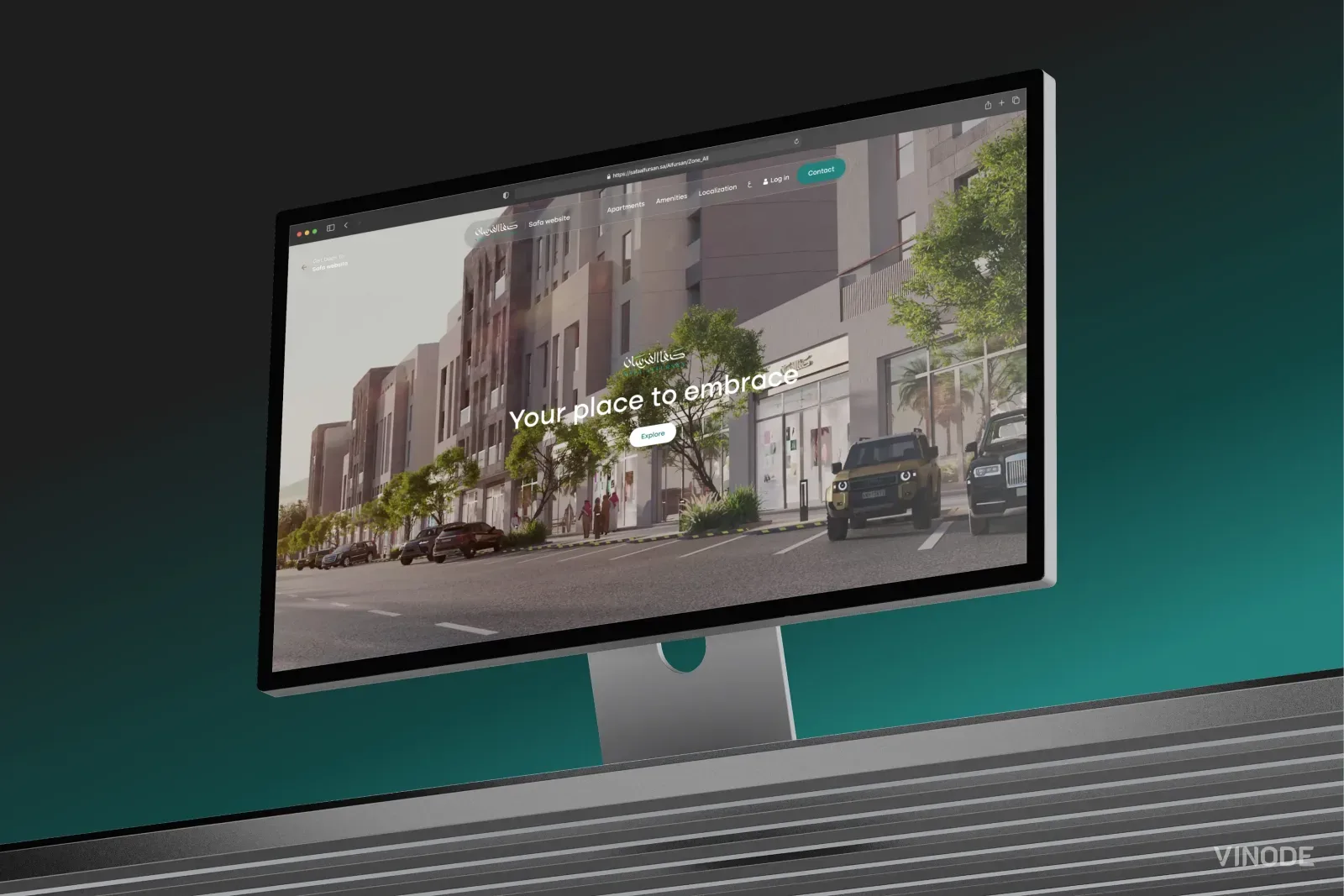
So we did not try to win on resolution. We closed the gap by making the whole thing one continuous motion. On Safa Al Fursan we gave the sales team the power to fly a client out over the massive far-view environment, the whole development and the surrounding city context, and then zoom, without a cut or a reload, all the way down into the living room of a specific duplex. No second file to open, no point where the client is handed off to work out for himself how the two views connect.
That far-view matters more than it looks, because a buyer at this level is buying into a district, not just a building. Safa Al Fursan sits inside Dahiyat Al Fursan, the National Housing Company's mega-district northeast of Riyadh, more than 35 million m² with over 69,000 homes planned on completion. Being able to show that context, the roads and amenities his duplex will actually sit among, is a large part of what turns a render into a decision.
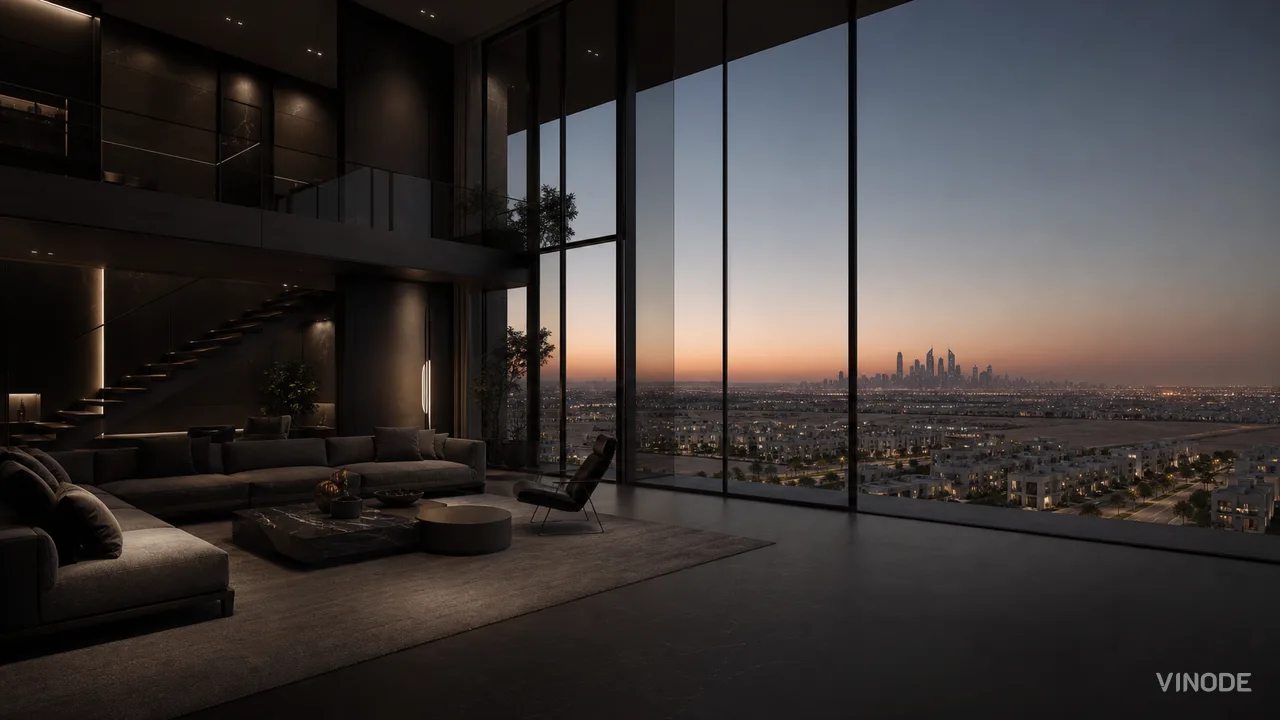
The scale of Safa Al Fursan, held in one continuous experience with no reload between the citywide view and a single interior. Project scale is from our own build of the development.
When you can show the macro-vision and the micro-detail in one frictionless platform, you don't just sell real estate. You sell certainty.
Why this only works off the device
Here is the part that surprises people. Intuition says a bigger, richer 3D world must load slower and buckle when a crowd opens it, so scale and speed trade against each other. For us, at masterplan size, the opposite held. It came down to one architectural decision: the scene is pre-rendered and streamed as video, not computed live on the buyer's phone. His device plays a stream. It never builds the masterplan frame by frame. Decoupling the scale of the scene from the power of the device is the whole trick, and it is what makes that continuous flyover affordable across a masterplan. It also keeps the experience standing when a room full of overseas investors opens the same link at once on ordinary handsets.
So the question I put to any vendor is a single one, and it is not about how sharp the renders are. It is where the 3D actually gets computed. There are three honest answers, and they predict load time, cost, and crowd behavior better than any resolution spec ever will.
Where the 3D gets computed
On the buyer's device
WebGL or in-browser Unity renders every frame on the phone in the buyer's hand. Quality and speed depend on that hardware, and a distant investor's device is often a modest one. By Vinode's own comparison, this lands around 6 seconds to load for WebGL and 12 for in-browser Unity.
A cloud GPU per viewer
Pixel streaming runs a real-time engine in the cloud and streams the video down. It allows true free-roam, but every concurrent viewer holds their own GPU, billed by the hour. Cost climbs with your audience, and streams can cold-start slowly or drop quality under load.
Pre-rendered, streamed as video
Vinode renders ahead of time and streams the result, so the device just plays it. Loads land at about two seconds, run on low-powered phones, and adding another viewer does not add a GPU. The trade is that you follow designed paths rather than roaming freely.
The middle option is the one that quietly scales against you. When rendering happens live in the cloud, the meter runs per concurrent viewer for as long as each one explores, because cloud GPUs are rented by the hour. Fifty investors opening a launch-day link at once is fifty GPUs on the clock. Pre-rendering moves that cost to once, up front, so a launch-day crowd becomes a bandwidth question rather than a per-head rendering bill.
You will notice I have not quoted a concurrent-user ceiling. Pre-rendered streaming avoids the one-GPU-per-viewer bottleneck, so the headroom is real, but Vinode publishes no hard "supports N simultaneous users" figure and I am not going to make one up. The load and comparison numbers above are our own measurements, not an independent benchmark. Treat them as our claim, and test any vendor's on the worst phone and weakest connection you can get your hands on.
Where this is the wrong tool
The cost of pre-rendering is freedom of movement. A live engine lets a user walk anywhere, in any order, off the designed path. Our approach gives that up: you move through routes we have rendered, not an open world. For a remote sales pitch that trade is worth making, because near-instant load, device independence, and concurrency that does not bill per viewer matter far more than free-roam. For a job that genuinely needs arbitrary runtime interactivity the render cannot anticipate, a training simulator, or a design tool where the user reshapes the space, pre-rendering is the wrong choice.
That same boundary defines the category. Vinode is a sales and marketing platform, built to sell a development rather than to author its geometry. It makes no attempt to be a CAD or BIM environment, and it is not a general game engine.
The flyover earns attention, it doesn't close the deal
The flyover is what makes a distant investor lean in. It is not, by itself, what gets money wired across six time zones. That part runs on the unglamorous half of the platform. In Vinode's Back Panel the lead is captured and auto-linked to the exact unit the buyer lingered on, with time-spent-per-unit recorded and a personalized brochure generated for the duplex he selected. When your follow-up lands in his inbox referencing the specific home he explored, at a sensible hour in his own time zone, the flyover has done its real job: it created something concrete to follow up about.
What to evaluate, and what to ignore
If you are selling a large development to buyers who cannot visit, two things belong in front of any vendor. The first is continuity: whether one unbroken flow can carry a buyer from city context down into a single living room with no handoff, and whether it still holds at scale when many people open it at once on weak connections. The second is compute: which machine draws each frame, and who pays for every additional concurrent viewer. Those two sort the field faster than any gallery of hero renders.
A masterplan at this scale is squarely bespoke-tier work, the kind of build that runs a couple of months rather than a weekend. We don't publish figures for it; the number depends on the scope, and the honest answer is a custom quote. If you want to go deeper on the architecture underneath all this, we have written separately on why pre-rendered 3D beats real-time and on keeping large developments fast.
Safa Al Fursan came together with a lot of coordination on the client side, and my thanks go to the team at صفا | SAFA and Shaik Ahmed Suhail for that. Show a distant buyer the city and his own living room in one motion, and the masterplan stops being something he has to take on faith and becomes something he can act on. He commits, and the money crosses the ocean.
See a masterplan open on your own phone
The fastest way to judge continuity and load is to hold it in your hand. Tell us about your development and we'll put a live Vinode experience in front of you.

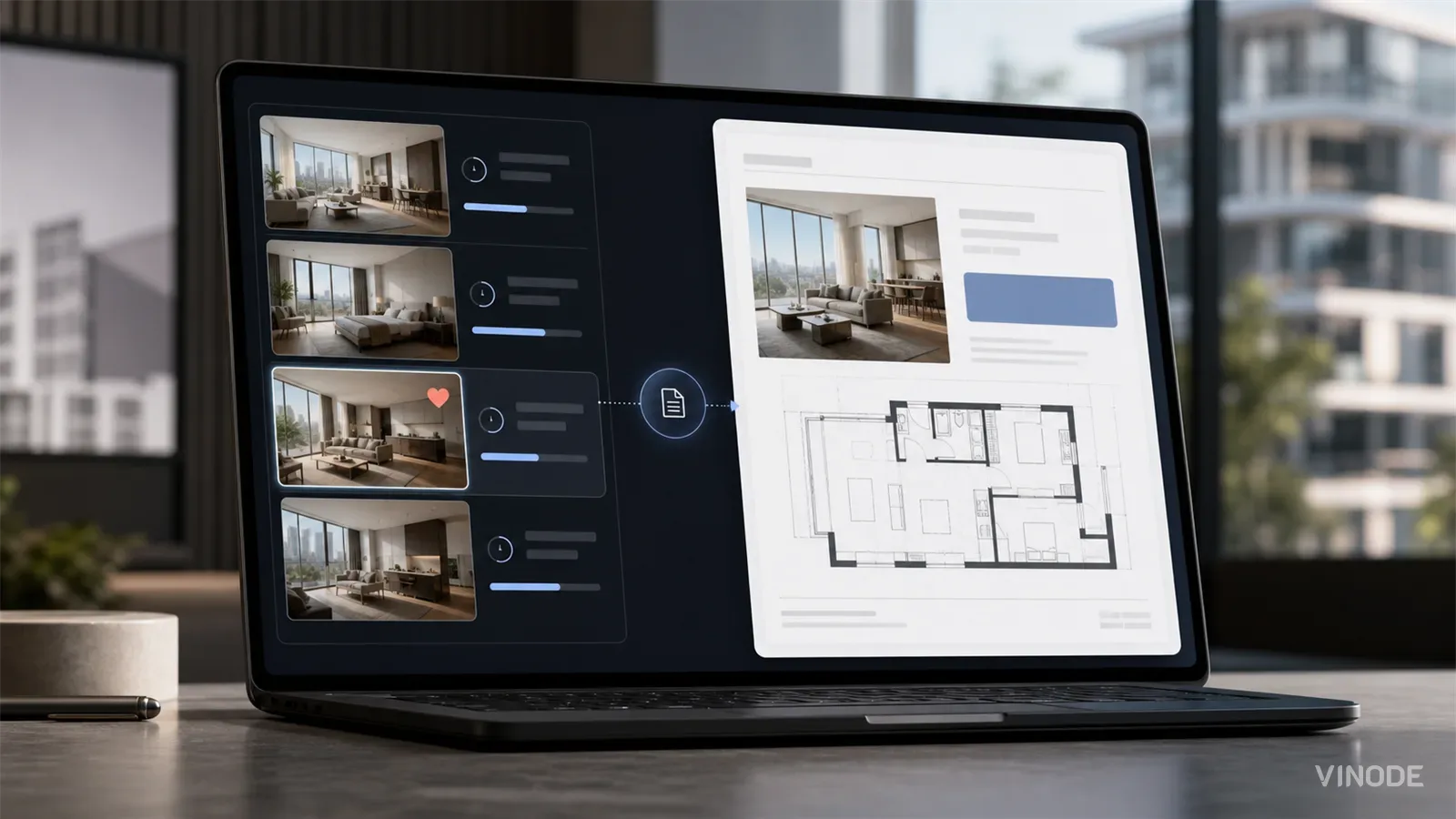
The Unit-Specific PDF a Buyer Actually Asked For
A buyer spends nineteen minutes on one two-bed, saves it, and gets the forty-one-page development brochure the next morning. Once a sales platform records the unit a buyer chose, the generic brochure becomes a decision to ignore that choice.

Expression of interest before release day: capture unit demand
640 names and no idea which side of the building they want. An expression of interest campaign pays off when the form is joined to the units each buyer explored, and each of these checks has a pass, a fail and a cost.

We measured when a pipeline crosses the presale line, not just whether it will
When GTHA opening-quarter absorption averaged 66%, the sold percentage was enough to forecast a presale crossing date. Then absorption fell to 17%. Three pipeline inputs produce the crossing date your lender asks for: stage-conversion rates, a cancellation haircut, and remaining inventory.