
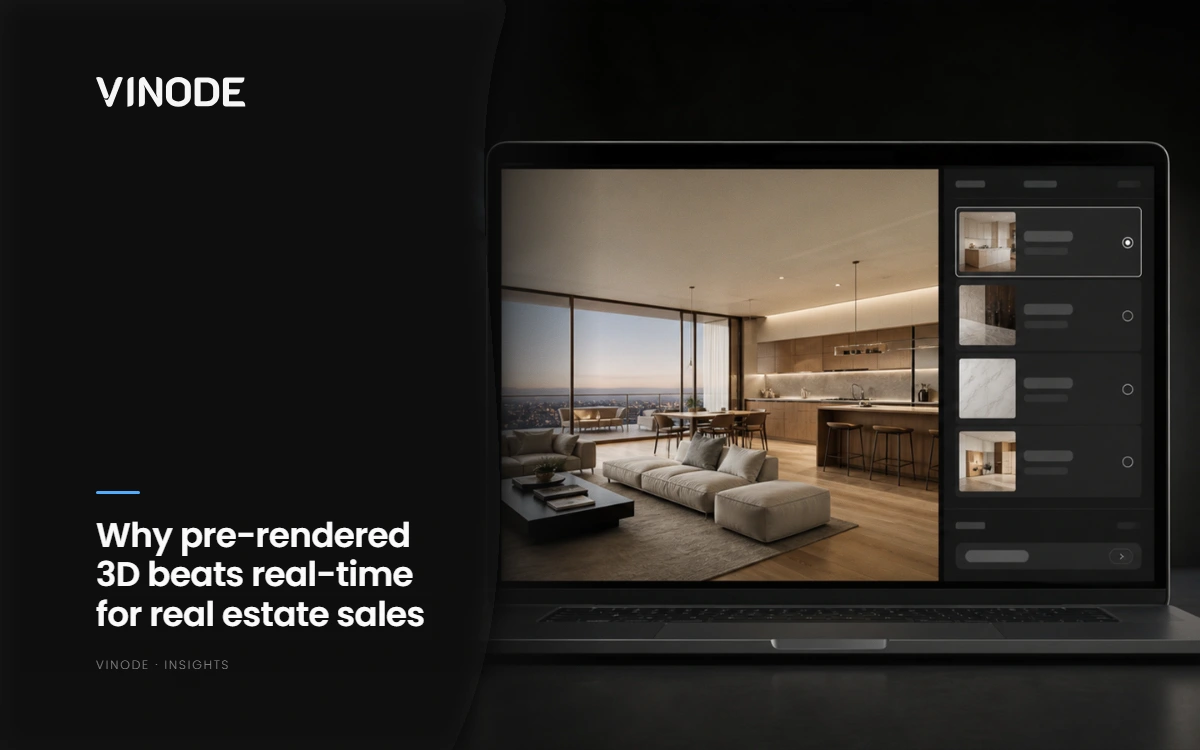
Why pre-rendered 3D beats real-time for real estate sales
Key Takeaways
- Pre-rendered 3D runs the heavy compute once on our infrastructure and streams video, so pages load fast on low-powered phones.
- Real-time engines render each frame on the buyer's device, which rewards high-end hardware and punishes the mid-range phones a sales funnel must reach.
- Real-time earns its place only for buyer-driven live configuration or a one-off hero screen with known hardware.
- Pre-rendering's cost is the re-render: a new phase or restaged unit means affected frames re-enter the pipeline, while price and availability update instantly with no re-render at all.
Every real estate developer who has sat through a real-time 3D demo knows the feeling: on the presenter's gaming laptop it looks incredible. Then a prospect opens the same experience on a three-year-old phone in a sales office with patchy Wi-Fi, and it stutters, drains the battery, or simply never loads.
That gap between the demo and the real world is exactly the problem Vinode is built to solve.
Real-time engines optimise for the wrong device
A real-time engine renders every frame on the viewer's device. To hit a smooth frame rate it needs a capable GPU, which means the experience is only as good as the hardware in the buyer's hand. For a B2B product demo that is fine. For a sales funnel that has to reach every prospect, it is a liability. High-end phones handle it well; mid-range and older handsets struggle. Battery drain and heat make a long browsing session uncomfortable, and a cold start can take tens of seconds before anything on screen is interactive.
Pre-rendered, then streamed
Vinode takes the opposite approach. The heavy lifting in Unreal Engine, Maya, Cinema 4D and Blender happens once, ahead of time, on our infrastructure. What reaches the browser is streamed video and a lightweight interactive layer on top. The result loads in two seconds, runs on low-powered phones without draining them, and works offline in kiosk mode for on-site sales suites.
Buyers don't care which engine rendered the scene. They care that it opened instantly and looked photorealistic on the phone in their pocket.
Where real-time genuinely wins
None of this makes pre-rendering the right call every time. Real-time rendering and pixel streaming earn their keep in two situations. The first is buyer-driven live configuration: when a prospect swaps finishes, moves a wall, or reconfigures a layout and expects the scene to update as they click, the set of possible combinations is far too large to pre-render in advance. The second is a one-off hero moment, such as a flagship launch event or a single controlled showroom screen, where the audience is small, the hardware is known, and paying for a GPU per viewer is a cost you can absorb.
Pre-rendering has a real weakness of its own, and it is worth naming. Any change to the scene itself means a re-render. Release a new phase, add a building, or restage a unit's interior, and the affected frames have to run back through the pipeline before anyone sees the update. The things that change most often - price, availability, a unit's status - don't: they live in the interactive layer over the video and update instantly. It is the geometry and the staging that are expensive to change, so for a development whose built form is still shifting mid-construction, the render matrix can drift out of date between updates.
So where is the line? In our experience the pre-rendered trade-off keeps paying off right up until live configuration becomes the whole point of the experience. Below a few dozen fixed variations, say three facades, four kitchens and a couple of view directions, pre-rendering every combination stays cheap and the image quality is worth it. Past that the render matrix multiplies faster than anyone can maintain it, and a real-time engine starts to earn the GPU bill it sends you. Most developers we work with are nowhere near that line: they have a fixed set of units to sell, an infinite configurator is not the job, and reaching every buyer's device matters far more than live permutations.
Overlays stretch the render matrix further
There is a middle path worth knowing about, because it moves that line. When only part of a scene needs to change, you don't have to re-render the whole frame. You render just the changed element as a mask - shot from the exact same vantage point, with everything else transparent - and composite it on top of the pre-rendered video or image underneath. Because you are only layering the delta instead of multiplying full renders, the number of configurations you can offer jumps from a dozen to hundreds or even thousands without the matrix exploding.
It is not free, and the catch is worth naming. Overlays are still expensive to produce, and every extra mask is more content to store, load and composite on-device. They also constrain what the scene can do: the ambient life that makes a standard Vinode render feel alive - drifting clouds, a plane crossing the sky, people walking a courtyard, cars moving down the street - can't survive under a static mask, because the overlaid layer has to hold still while the base video plays. Outside of a hero entry animation, an overlay-driven scene sits a little more still than a fully pre-rendered one. It is a genuine trade: many more configurations in exchange for a quieter frame.
What it means for conversion
Every second of load time is a share of visitors who bounce before they ever see your development. By moving the compute off-device, pre-rendering removes the single biggest source of drop-off in an interactive property experience, and lets your sales team send one link that works on the worst phone in the room. Match the rendering method to how you actually sell: a fixed unit mix rewards pre-rendering, a live configurator eventually rewards real-time, and most residential launches sit firmly on the pre-rendered side of that line.
Want to see it on your own phone? Explore a live Vinode project and open it on the worst device you can find. That's the whole point.


How to Move a Live Property Launch Off a Spreadsheet
Three weeks from launch, new enquiries were going into a spreadsheet tab called new leads 2. Move new leads and current unit data first, let old deals finish where they started, and leave the historical import until later.
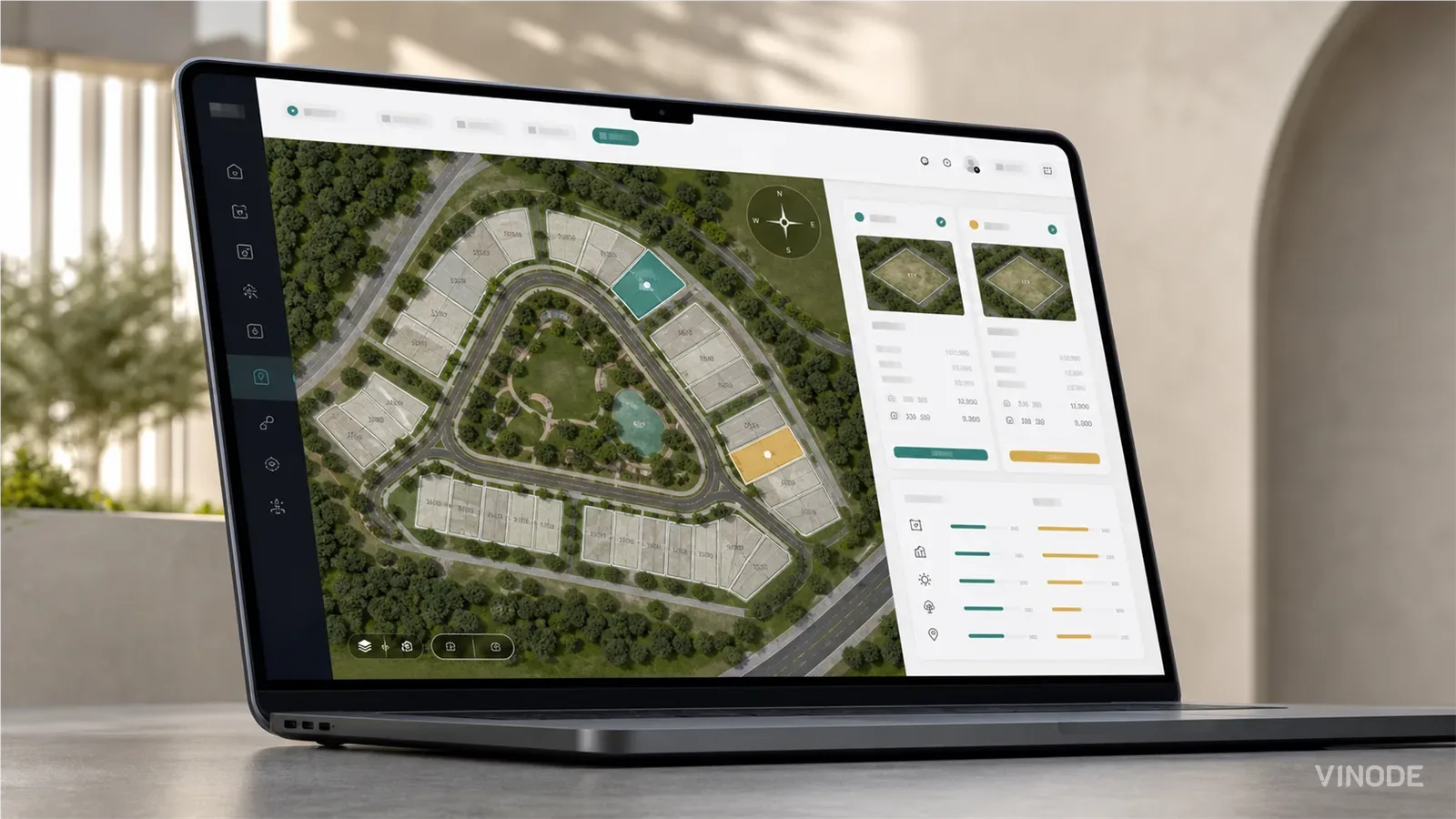
How buyers pick a plot on a housing development they have never walked on
On a six-house estate a clickable plot map does the whole job. On a varied estate the buyer still calls to ask which way the garden faces and what is behind the fence. What a plot finder has to show so that call becomes a reservation, and who at the developer keeps it current.
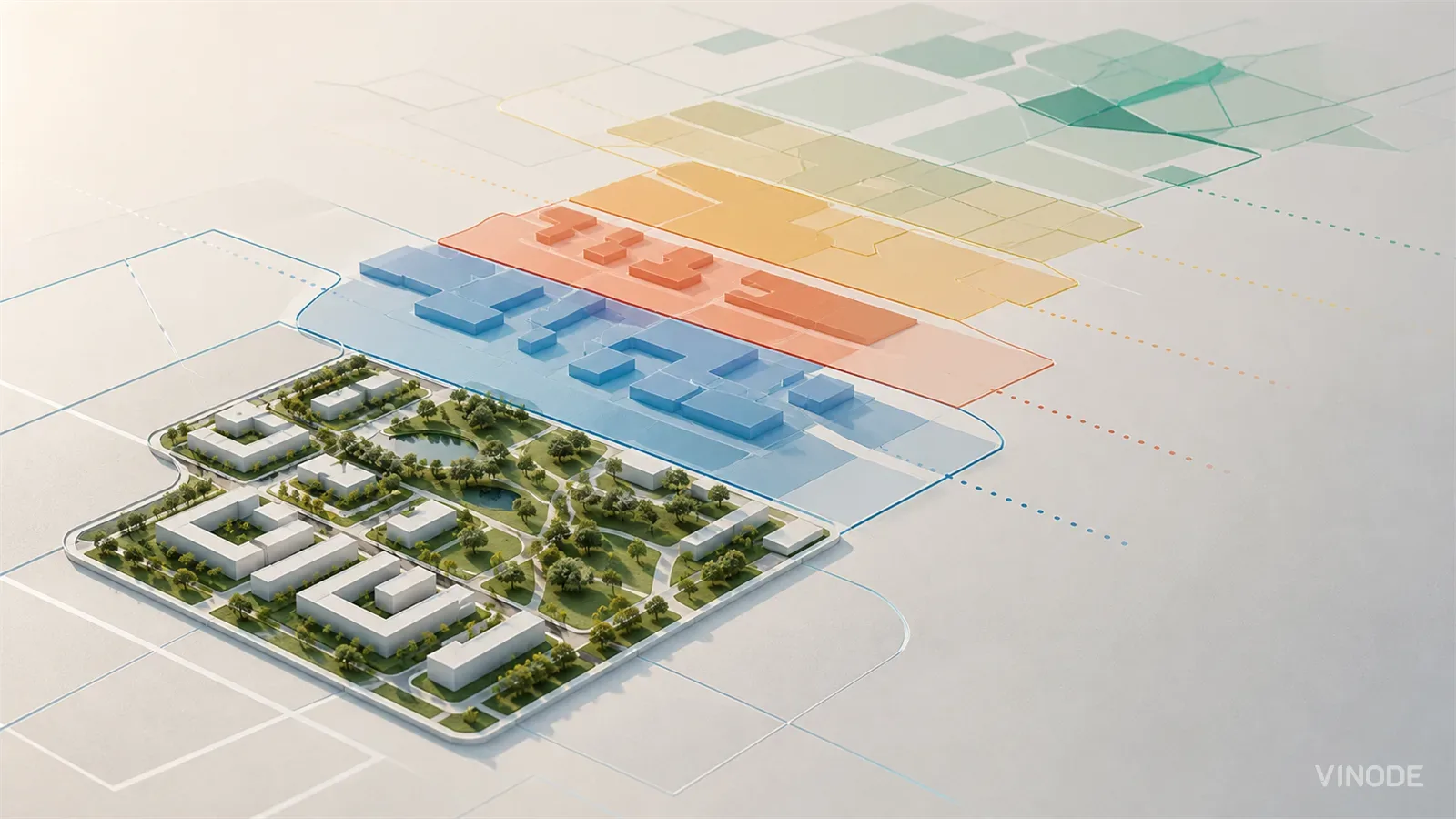
Masterplan 3D for Phased Estates: How to Show Phase One Without Overselling Later Phases
A phased estate contains several levels of certainty at once. The masterplan should make that difference visible, then absorb a later-zone redesign without discrediting the phase-one material buyers already saw.