
Photorealism that sells real estate: judge the render before you pay
Key Takeaways
- A render reads as fake when its light and materials disagree, not when its pixel count is low.
- You can judge a sample without 3D skills by demanding morning and evening light, one honest reflection, the wall junctions, and several views of the same building.
- A too-perfect render is both a quality tell and a legal claim a buyer can hold your construction to.
- Beyond a threshold, added realism costs trust, and stylised or AI images are the right spend for early massing and concept work.
A buyer walks into the finished apartment holding the brochure. The render on the page was expensive, high-resolution, and signed off by everyone in the room. Standing in the actual space, something is wrong, and they cannot say what. The light falls differently than it did on paper. The floor that gleamed in the render is matte underfoot. They do not think "the resolution was low." They think the brochure lied.
That gap is rarely a pixel problem. It is a physics problem. The render broke trust because the way light and materials behaved in it did not agree with itself, and the human eye catches that disagreement long before it can put the fault into words.
Why a render reads as fake
Real light bounces. It leaves a window, strikes a wall, loses energy, picks up the wall's colour, and carries that tint onto the floor. A believable render simulates that chain of events consistently across the whole image. A cheap one lights each surface in isolation, so the room ends up evenly bright, flat, and slightly dead. That flatness is the most common "this looks like a video game" tell, and buyers register it instantly even though they would never describe it as missing global illumination.
The underlying discipline has a name: physically based rendering. Its core rule is that a material's response to light obeys physical limits, so a surface never reflects more light than falls on it, and light and matter stay consistent instead of being faked one surface at a time. If you want the actual mechanics, Google's Filament PBR documentation and LearnOpenGL's PBR theory lay it out in full. The instinct that flags a room as evenly lit and lifeless is already reading the physics the vendor skipped, so trust it.
Too perfect is the tell
The instinct is to ask a vendor to make the render flawless. That instinct works against you. Real rooms carry wear, slight asymmetry, and the small evidence that someone lives there. A render where every surface is spotless, every material mirror-clean, and every texture identically tiled reads as synthetic precisely because reality never looks that controlled.
Watch for the warning signs you can feel without a vocabulary for them: lighting so even the room looks shadowless; floors and glass so glossy they look permanently wet; wood or tile that visibly repeats like wallpaper; and interiors so pristine that no one could plausibly live in them. Each is a shortcut in how the scene simulated light and matter.
I will reject a flawless sample faster than a slightly rough one. Perfection is the easiest thing to fake and the hardest thing to believe.
How to judge a sample without opening the project file
Here is the good news for anyone who signs off on visuals but has never touched Unreal or Blender. Catching a weak render comes down to demanding the right things in the vendor's sample and refusing the sample that cannot produce them. Call it the sample test: ask for the situations where fakery is most expensive to hide.
What to demand in the sample
The same room, two times of day
Ask for one interior lit for morning and again for evening. Consistent light shifts believably across both. Faked, per-surface lighting either stays put or falls apart.
One honestly reflective surface
A polished floor, a window, a mirror. It should reflect the actual room around it. A generic blur, or a reflection that ignores the scene, is the fastest tell there is.
The corners and the junctions
Where wall meets floor and ceiling: baseboards, shadow gaps, trims. Fakery hides in the joints, so a render that skips them feels unbuilt even when the lighting is good.
One building, many viewpoints
The multi-view test. Materials, colour, and geometry have to hold identically from every angle. This is exactly where AI-generated images come apart.
This is not about grading art. You are checking whether the render's physics stay consistent under real pressure. If a vendor can't or won't produce these views, that reluctance is the review.
A convincing render is a claim you can be held to
Here the two halves of the craft meet. The choices that make a render believable are the same choices that make it a representation a buyer can rely on, and the more persuasive it is, the more weight that representation carries.
Consider Ripani v Century Legend [2022] FCA 242 in the Federal Court of Australia. A developer marketed a Melbourne apartment with a hero render showing a roughly eight-metre free-span opening between the living area and the terrace. The architect had already advised that the span could not be built at that size and would need to be closer to three metres. The court found the render misleading and deceptive under the Australian Consumer Law, held that the marketing disclaimer gave no cure (it was described as vague and buried where no buyer would study it), and let the purchasers rescind the contract and recover their costs (Federal Court judgment).
This is one Australian case, and none of it is legal advice. The principle is not unique to Australia, though: many consumer-protection regimes treat marketing material as part of the offer rather than something sitting safely outside the contract. "Indicative only" turns out to be thin protection when the render itself is doing the selling.
Match every feature in the render to what construction will actually deliver, and treat disclaimers as a footnote rather than a shield.
When photorealism is the wrong spend
Photorealism is not always the right spend, and two situations make that clearest. The first is early. At the massing and orientation stage, what a client needs to judge is how the building sits on the plot, where the light falls across the day, and how the volumes meet their neighbours. Material accuracy is noise at that point, and forcing full photoreal there burns budget on precision the design has not earned yet. Stylised or AI-generated images answer those questions faster and cheaper. That is where AI images genuinely belong: fast, evocative, single-frame.
The second is subtler, and it is a trade-off worth naming: past a point, more realism buys less trust, not more. In some markets buyers have been burned by enough glossy launches that a render which looks too perfect reads as too good to be true, and the polish itself becomes the thing they distrust. In our experience the renders that convert are rarely the most dazzling ones; they are the ones a buyer half-believes could be a photo of a real, slightly imperfect room. Push realism past that line - mirror-clean floors, showroom-empty interiors, light with no flaw in it - and you cross from convincing into uncanny, where the buyer stops reading the space and starts hunting for the catch. When that is the risk, the honest answer is to dial the perfection down, not the resolution up.
What AI still cannot do is hold a development together. A real project needs many coordinated angles on one building with identical materials, lighting, and context, and each AI generation drifts a little from the last. Window rhythms wander, finishes shift between frames, and geometry appears that could never be built. So AI earns its place as a concept tool and loses it as a marketing-render tool at scale.
One limit is worth stating plainly whichever tool you choose: a believable render only helps a building that deserves the attention. It sharpens an honest pitch and does nothing for a bad design. If the spend is not warranted, do not make it.
Consistency is what you're paying for
When you do commit to a coordinated render, what holds it together is structural. The whole development is computed once, ahead of time, as a single coherent scene, so nothing gets reinterpreted frame by frame for the drift to leak through. What you approve in the sample is what reaches unit 528, and it stays consistent from the masterplan down to a single room.
Safa Al Fursan: 67,000 m² and 25 buildings rendered as one lag-free experience that holds up on phone, laptop, and an offline sales-suite kiosk.
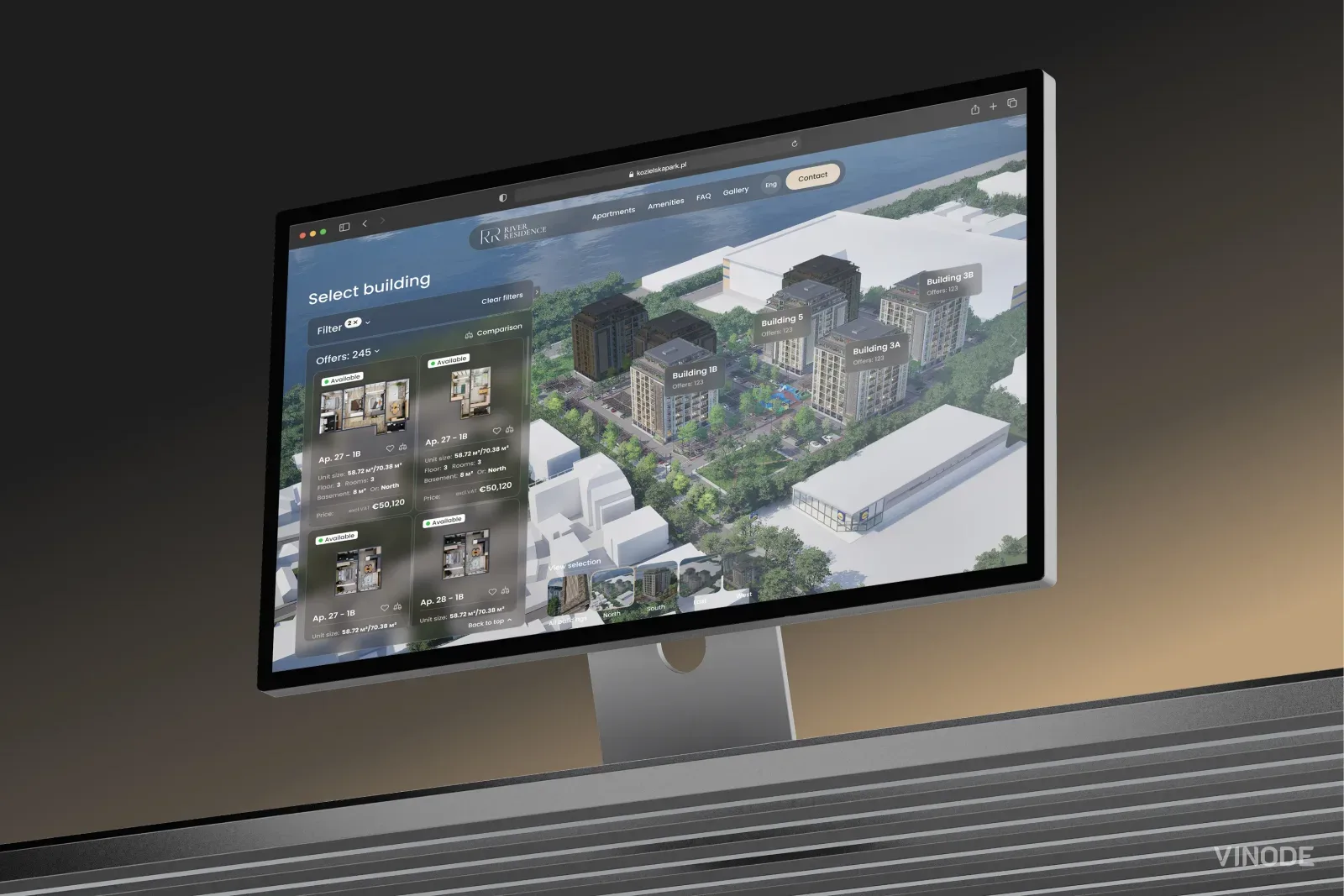
River Residence carries the same discipline into a single unit's options, keeping every swappable finish, kitchen, and configuration lit consistently as a buyer switches between them. We argued the device-and-load side of this at length in why pre-rendered 3D beats real-time; the point here is narrower. The architecture that makes it fast is the same architecture that lets the physics stay honest across every view.
Buy the render you could stand next to
The question is not how realistic you can make the visual. It is whether it would survive a buyer standing inside the finished room with the brochure in their hand. The render worth paying for is the one your sales lead can stand beside on handover day, with nothing on the page left to explain away.
See how the physics hold across a whole development
Open a live Vinode project on the worst phone you own and run the sample test on it yourself.

The Unit-Specific PDF a Buyer Actually Asked For
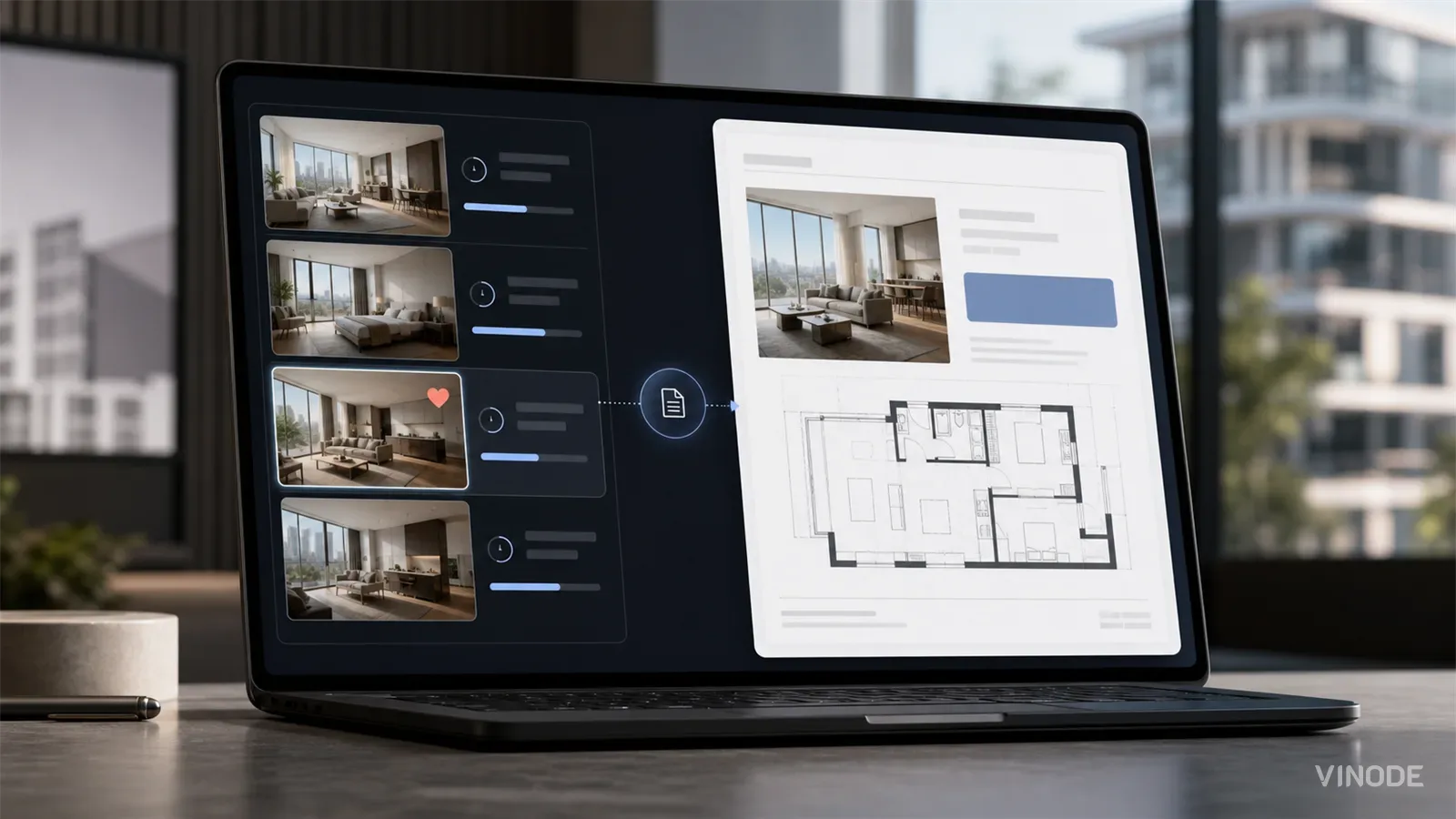
A buyer spends nineteen minutes on one two-bed, saves it, and gets the forty-one-page development brochure the next morning. Once a sales platform records the unit a buyer chose, the generic brochure becomes a decision to ignore that choice.

Expression of interest before release day: capture unit demand
640 names and no idea which side of the building they want. An expression of interest campaign pays off when the form is joined to the units each buyer explored, and each of these checks has a pass, a fail and a cost.

We measured when a pipeline crosses the presale line, not just whether it will
When GTHA opening-quarter absorption averaged 66%, the sold percentage was enough to forecast a presale crossing date. Then absorption fell to 17%. Three pipeline inputs produce the crossing date your lender asks for: stage-conversion rates, a cancellation haircut, and remaining inventory.