
The last 20% of units decide whether you hit your pre-sale date
Key Takeaways
- The units still unsold at the threshold date are a financing problem, because the facility counts units, not which ones.
- Those units stall on an unanswered question about the view and the light, not on price alone.
- An honest outward-view render from a unit justifies the price the developer already set instead of discounting below it.
- The outlook is computable: sun position is astronomy and surrounding massing is survey data, including neighbouring plots not yet built.
The discount memo is half written. Most of the development is reserved, but the same handful of units is still open and the pre-sale date is close. The team knows every one by number: low floor, poor aspect, service yard outside the window.
Those units now sit on the financing clock. Every unit counts the same toward the threshold total. Before moving the price, we would check whether the launch material answers the objection attached to each one. If it does not, commission the missing outward view first. Show what buyer will see from that home, and when the light arrives.
Before you cut the price
- Write the buyer objection beside each stuck unit, then check whether any current asset answers it clearly.
The launch library never shows the view out
Most launch libraries we see are art-directed from outside. They look at the facade, across the pool, down the best street. Then a buyer reaches unit 4B and asks the question that separates it from 11B: What will I see from inside, and when does light reach this room?
Sales answers from memory. One person says the service road is partly screened. Another says the balcony gets light later. Buyer cannot verify either answer, so the cheaper unit feels like a hidden compromise. The price becomes the obvious thing to change because the view is still blank.
The developer has already priced 4B below 11B. A truthful outward-view render explains that gap. It shows why the home costs less, without pushing it below the listed price before the real objection has been answered.
What each asset answers
Exterior hero render
Shows the building, materials and shared outdoor space. Good for launch. It leaves the buyer to imagine the outlook from one home.
Outward-view render
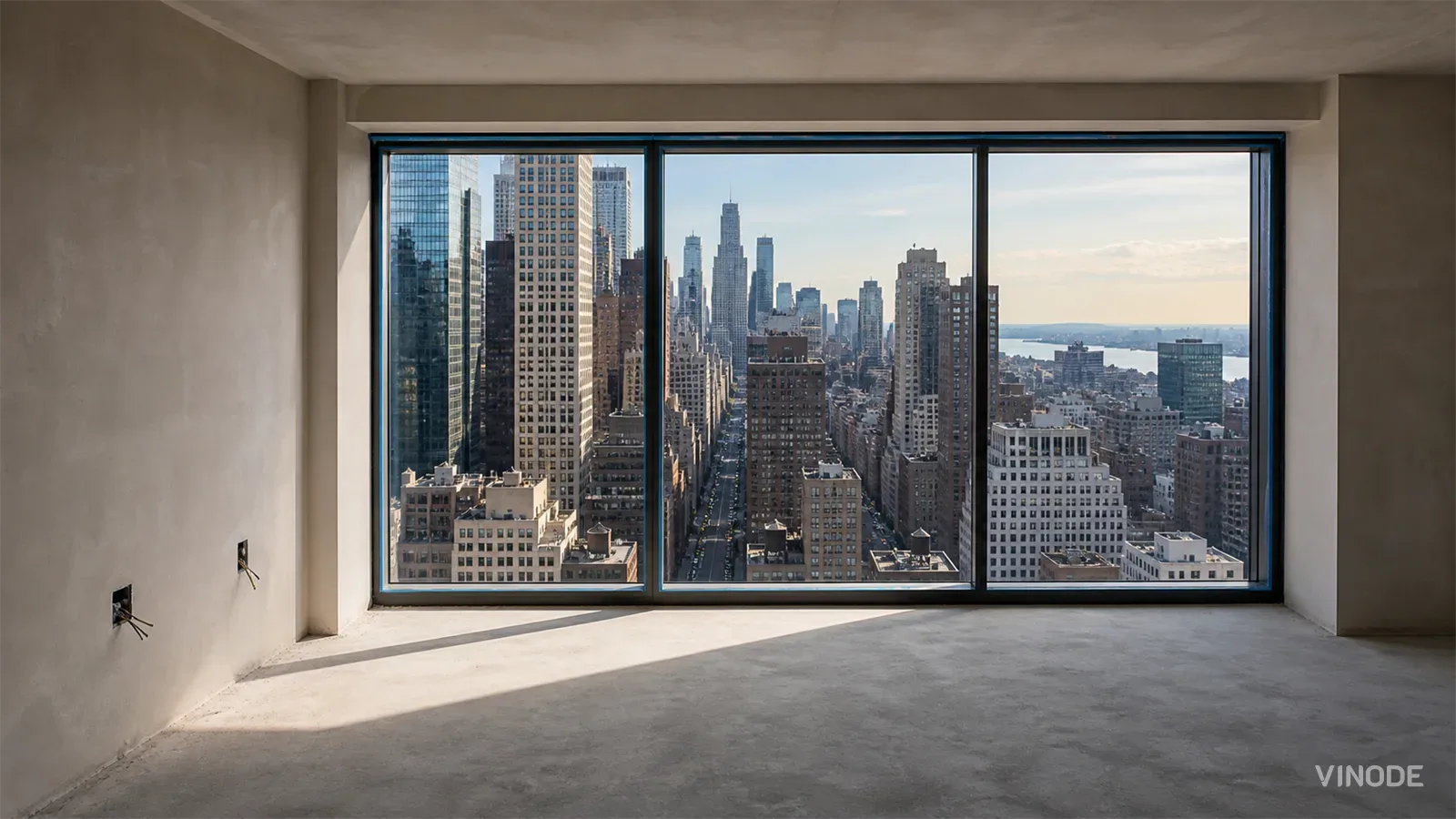
Shows what sits beyond the glass, how nearby buildings read from the room, and what the lower listed price is paying for.
Build the outlook from facts
This view is more technical than a mood render. Sun position comes from latitude, date and time. The NOAA Solar Calculator is a plain example of the arithmetic. Surrounding buildings come from survey and planning data, including approved neighbouring buildings that are not built yet. That future block is often the fact a pre-construction buyer cannot check alone.
Vinode already models buildings and surroundings. In Safa Al Fursan, we moved from the wider Riyadh context into the living room of a specific duplex, with its skyline visible through the glass. The outward view used the same delivered model and another camera.
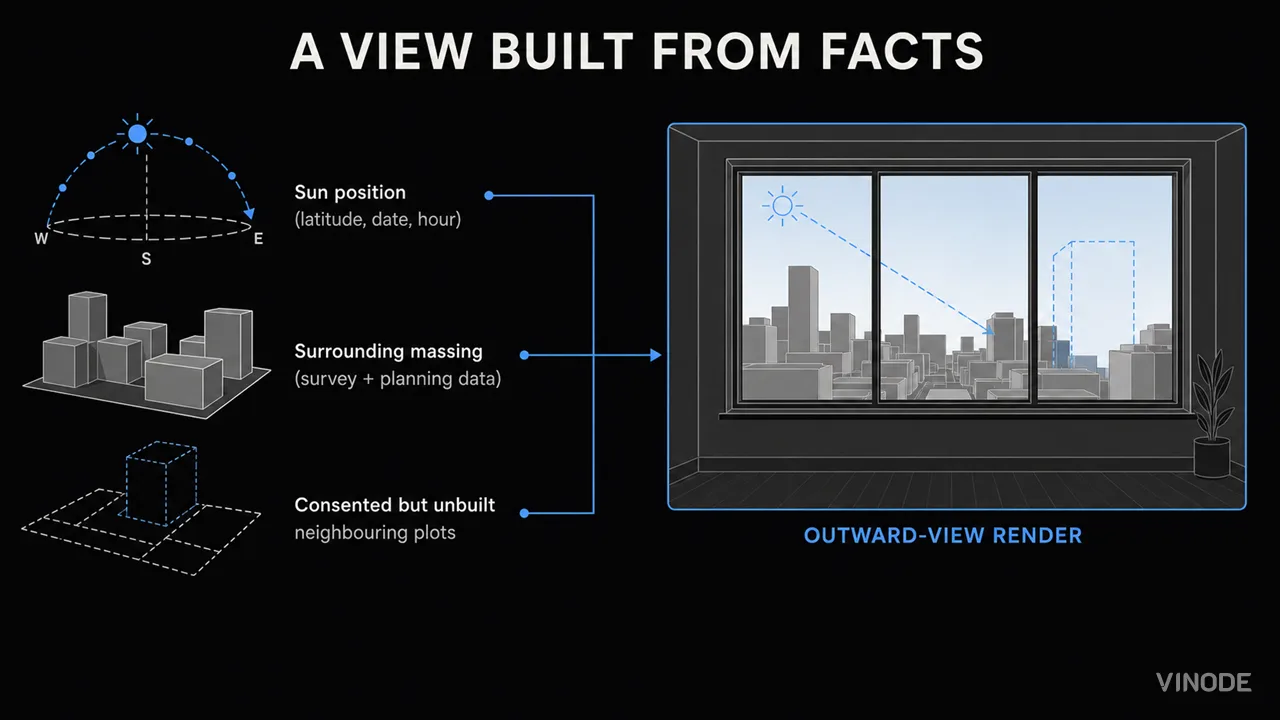
Pre-rendering makes this practical as a set of designed viewpoints. Rendering happens before the buyer opens the page, so their phone plays the result. It suits repeatable unit views, not a buyer who needs to roam anywhere in real time. We explain that trade in our pre-rendered 3D guide.
Why the last units take the longest to sell
The first reservations usually take the cleanest stock. Higher floor. Open aspect. Easy story. What remains is more diffrent from unit to unit, so one general campaign starts doing less work. A low-floor home and a home facing a future phase may share a status in the CRM, but they do not share an objection.
Our measured portfolio curve, current to August 2026, shows the size of the delay.
Across our portfolio, the final tenth takes close to half of the total selling window.
Source: Vinode measurement - as of
Floor level is already priced by buyers and developers. Conroy, Narwold and Sandy studied 2,395 condominium sales in San Diego from 2006 through Q2 2011 and found each additional floor was associated with about a 2.2% increase in sale price. The apparent penthouse premium largely went away after controlling for floor level (University of San Diego paper).
That study belongs to one city and period. It does not give us a universal price ladder, and the relationship is not linear across every building. It shows the narrower point we need here: outlook and height already sit inside the price. Marketing does not create this gap.
Show the outlook a later phase will block
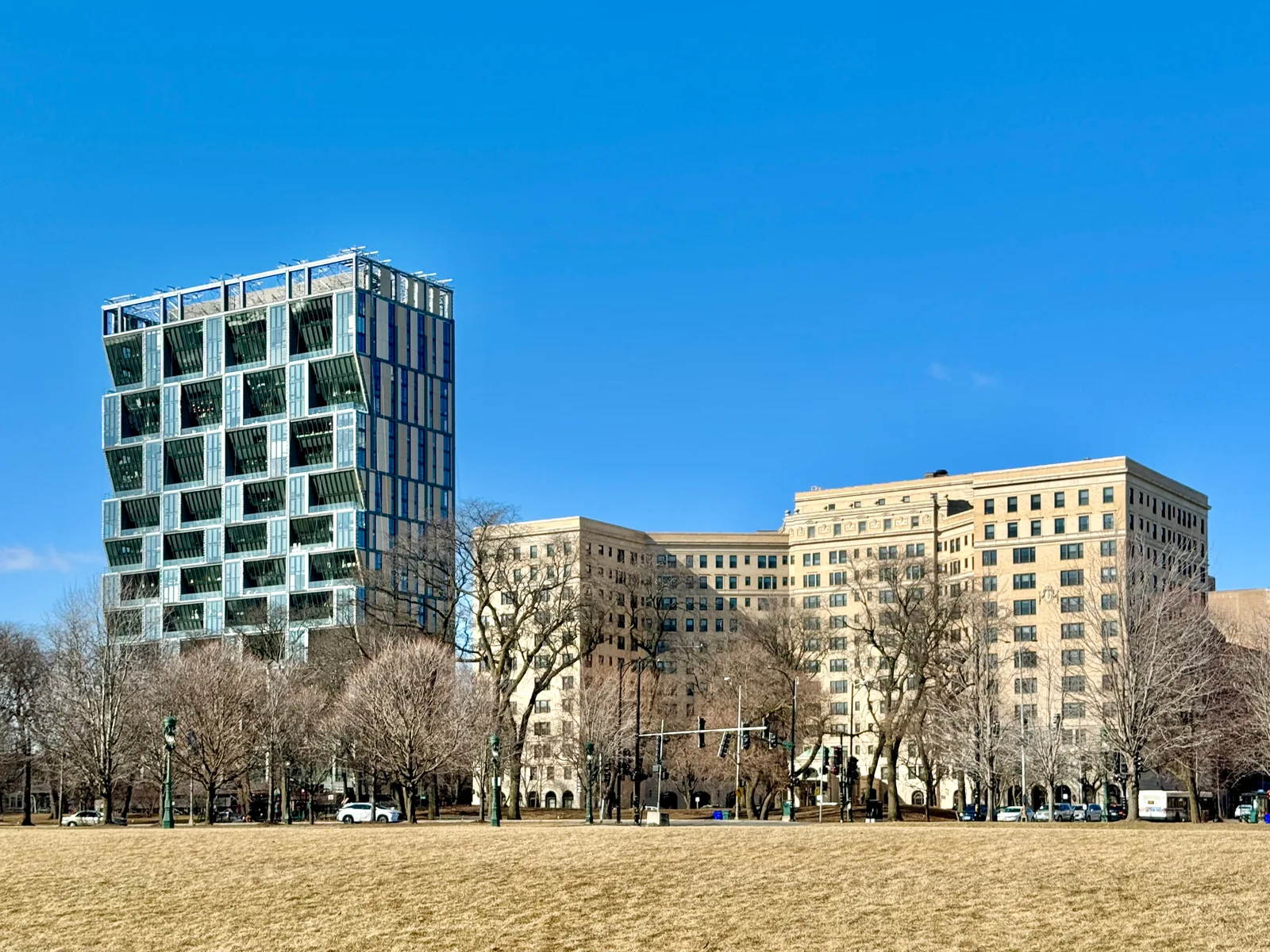
Once we choose to show the outlook, we have to show the future phase that will block it. Built, approved and illustrative surroundings should not blur into one promise. The model needs the right inputs, the date of those inputs, and a clear treatment for what is still uncertain.
This adds review work and may show a compromise some teams would rather leave vague. That is useful. Buyer can see the compromise and recieve the matching price as a reasoned choice.
This is not for a unit whose listed price is wrong or a market that has moved. We have no measured conversion lift for outward-view renders. Discounting can be right. This check simply belongs earlier in the decision.
Commission the missing viewpoint
Before the next discount approval, take the stuck units and seperate them by objection. Pick one viewpoint that answers each group. Low floor. Service yard. Future phase. Late light. Give the render team the unit camera, the surrounding model, a stated date and time, and the status of anything not yet built.
Then put that view beside the unit record the sales team already uses. The price list already tells buyers that 4B and 11B are worth different amounts. Show them why. The hard tail becomes something the team can explain with information the development already owns.
Show the view behind the unit price
Bring us the stuck-unit list and the existing 3D model. We will scope the outward viewpoints that answer the real objections.

The Unit-Specific PDF a Buyer Actually Asked For
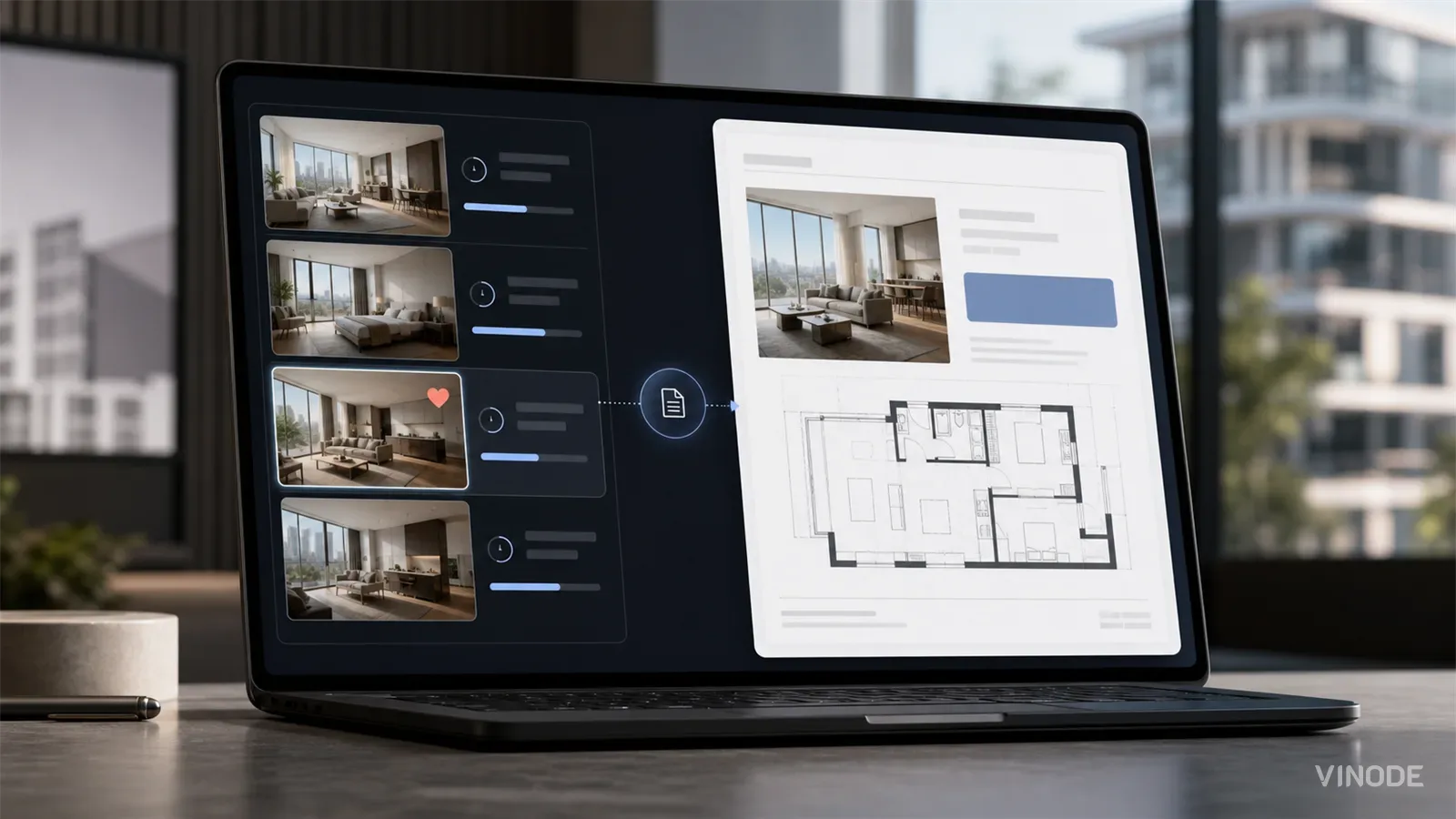
A buyer spends nineteen minutes on one two-bed, saves it, and gets the forty-one-page development brochure the next morning. Once a sales platform records the unit a buyer chose, the generic brochure becomes a decision to ignore that choice.

Expression of interest before release day: capture unit demand
640 names and no idea which side of the building they want. An expression of interest campaign pays off when the form is joined to the units each buyer explored, and each of these checks has a pass, a fail and a cost.

We measured when a pipeline crosses the presale line, not just whether it will
When GTHA opening-quarter absorption averaged 66%, the sold percentage was enough to forecast a presale crossing date. Then absorption fell to 17%. Three pipeline inputs produce the crossing date your lender asks for: stage-conversion rates, a cancellation haircut, and remaining inventory.