
Interactive 3D vs virtual tour vs video walkthrough: which format for which stage
Key Takeaways
- A photo virtual tour and a filmed walkthrough are both captured from a finished space, so neither exists for an off-plan development.
- A single CGI flythrough plays one fixed path; interactive 3D adds a driveable layer over that footage, so the buyer picks, filters, and restyles units.
- A rendered flythrough and interactive experience export from one 3D model, so the interactive layer is an addition, not a second build.
- Photo-based virtual tours become useful at handover, once show units are physically built and can be captured.
You're shortlisting for a development that breaks ground next spring. Three formats sit on the quote sheet: a virtual tour, a video walkthrough, an interactive 3D experience. They look like three tiers of the same thing, where nicer costs more. So the meeting turns into a budget-versus-polish argument, and someone asks which one "feels most premium."
That question wastes the meeting. Before immersion or price, ask what raw input each format physically requires. My view, after building these for developers who launch off-plan: two of the three answer that by eliminating themselves, and they do it for the exact project you're shortlisting for.
Sort by input, not by looks
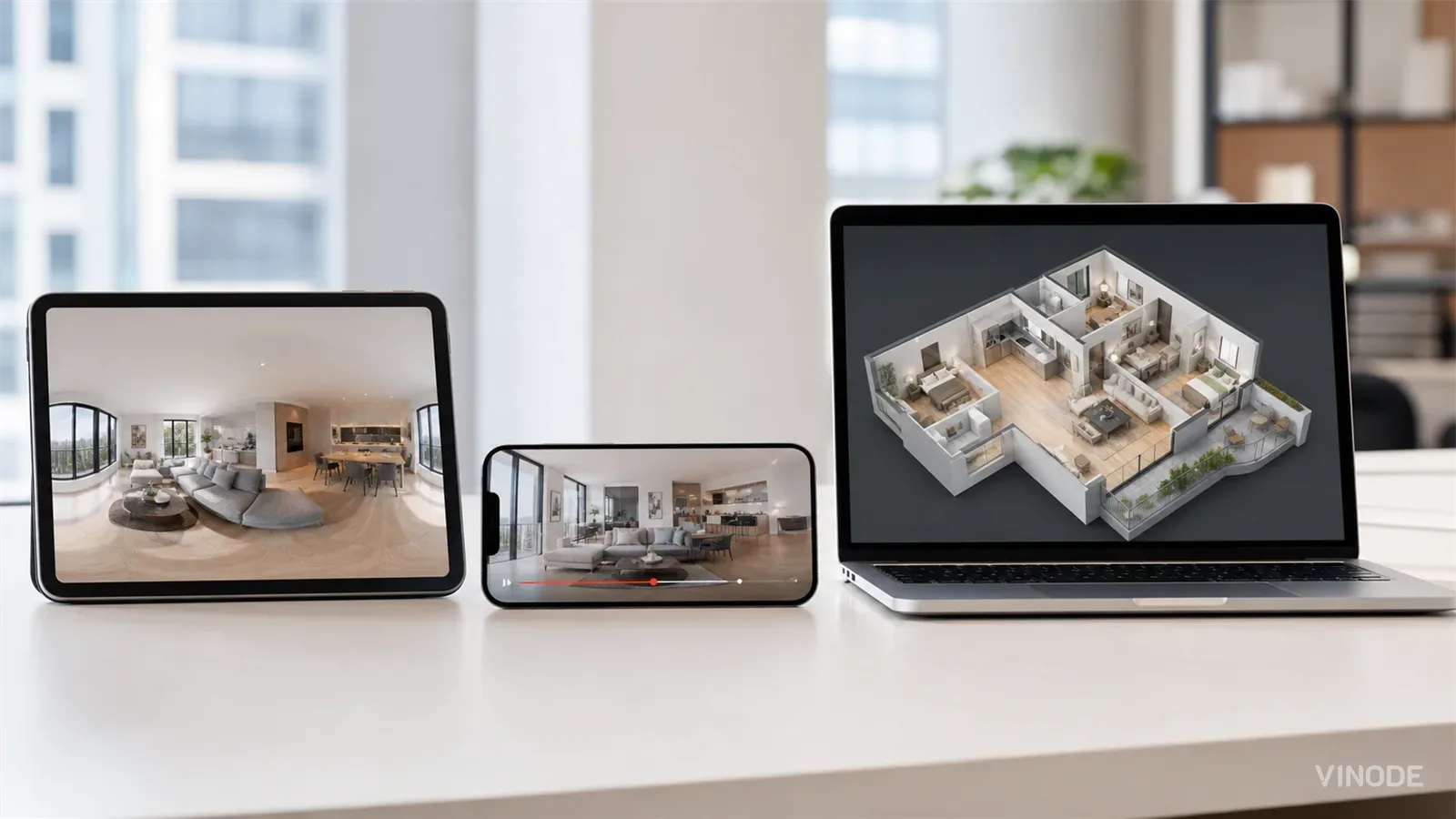
Each format has a hard prerequisite. A photo-based virtual tour (the 360° panoramas you swipe through) is stitched from photographs of a real room, so it needs a finished, furnished space standing in front of a camera. A filmed walkthrough needs the same thing: a built space to point a lens at. A rendered CGI flythrough needs a 3D model, not a building. Interactive 3D needs that same model plus a navigable layer on top of it.
So the four requirements split into two piles. Two formats need a captured, built space. Two need a model. That single distinction decides more than any comparison of resolution or frame rate.
What each format needs before it can exist
Photo virtual tour
A finished, furnished room to photograph. No built space, no tour.
Filmed video walkthrough
Somewhere real to point the lens. Same blocker as the photo tour.
Rendered CGI flythrough
A 3D model. Buildable off-plan, but the camera path is fixed.
Interactive 3D
The flythrough's pre-rendered footage with a driveable layer on top: choose a unit, filter the inventory, switch styles. Not a separate render. It's the same base, made interactive.
The off-plan fork
Now apply it to that same pre-construction scheme. There is no finished apartment to photograph and no built corridor to film, and there won't be for eighteen months. The two photographic formats aren't the affordable option or the premium option. They are simply not on the table, because their input doesn't exist yet, and no budget conjures a room that hasn't been built.
That collapses a three-way comparison into a two-way one: a passive rendered flythrough against buyer-driven interactive 3D. Both come off the model, so both work off-plan. The only remaining question is whether the buyer watches a fixed path or steers.
The honest exception runs the other way. At handover, when the show units are built, the photographic formats stop being blocked and the model-based ones lose their edge on realism, since now you can capture the actual finished space. The fork isn't fixed; it moves with construction.
On an off-plan scheme the photo tour and the filmed walkthrough both need a space that isn't built yet, so the real choice is only between the two model-based formats.
What "interactive" actually buys off-plan
A rendered flythrough is a good film. It plays the one path its director chose, start to finish, the same way for every viewer. That is fine when there is one thing to show. It falls apart when the buyer needs to compare, because a linear video can't let a buyer pick unit 14B over 9A, filter to south-facing three-beds under a price ceiling, or change their mind halfway.
The distinction here isn't video versus live 3D, and it's worth being precise about that. Interactive 3D keeps a pre-rendered video base, the same fixed-perspective footage rendered in enough permutations to stand in for free navigation, and composites an interactive layer over it, so the buyer filters, searches and highlights units against the playing video. What interactivity removes is the single fixed path; the pre-rendered delivery stays. Both formats stream video off the same model; one simply lets the buyer steer the layer above it. That is why "flythrough or interactive" isn't a choice between two rendering methods. It's a choice about whether to add the layer.
The cases where that gap bites are concrete. Safa Al Fursan in Riyadh is 67,000 m², 25 buildings, 528 units, running on an offline sales-office kiosk. When a buyer's real question is "which of these 528 is mine," a fixed flythrough can't answer it and interactive self-qualification can. Tropical Mirage in Bayahibe hands a remote buyer in the Dominican Republic an interactive neighbourhood map with 20-plus mapped points of interest (the beach, the marina, the distances), location context a single tour or a fixed camera pass can't convey. River Residence lets a buyer switch interior styles inside the tour, the branching interaction a linear film has no way to offer.
The demand for explorable formats is real and largely unmet: 58% of buyers say they want virtual tours, yet 94% of listings don't include one (NAR 2021; BoxBrownie study of 25,000 listings). Interactive 3D is how an off-plan scheme meets that demand before a room exists to photograph (NAR).
Source: nar.realtor - as of
Underneath all three is the Back Panel: live availability so a unit shows free, reserved or sold in real time; smart filters across building, size, price, room count, floor and orientation; an auto-generated per-unit PDF brochure a buyer takes away; and lead capture straight into the CRM. A flythrough is a broadcast. Interactive 3D is a tool the buyer operates, and every filter and saved unit is a signal about intent your rep never gets from a view count.
The catch is that interactivity only counts if the page actually loads. Google's Core Web Vitals guidance puts a "good" largest-contentful-paint at 2.5 seconds or less at the 75th percentile, and an overseas buyer on a mid-range phone is exactly that 75th-percentile visitor. My working rule: an interactive experience heavy enough to stall on that phone is worse than a lightweight flythrough that plays instantly, which is why the delivery method behind it, pre-rendered rather than device-rendered, matters as much as the interaction itself.
Interactive 3D does not take the buyer's money. There is no in-browser checkout and no self-service reservation. What it does is capture lead-level intent (which unit, which filters, which style) and hand a warm, qualified lead to a sales rep to close. If you need a buyer to transact unattended, this isn't that, and none of these three formats is.
One model, both outputs
Here is the part that changes the budget conversation. The rendered flythrough and the interactive experience are not two separate productions. Both are exported out of one 3D scene: the flythrough is a single camera path through it, and the navigation is built on top of the same geometry, materials and lighting. The bulk of the cost sits in building that scene, which both formats share.
So "flythrough or interactive" is not a from-scratch second build weighed against the first. Once the model exists, adding the buyer-driven layer is an extension of it, not a parallel project. That is exactly why treating them as two priced tiers, the way the quote sheet does, mis-frames the decision. It is also why the interactive route rarely costs what a naïve line-by-line comparison implies.
Which format for which stage
Match the format to where the sale is, not to which looks nicest:
- Off-plan, pre-construction: a rendered flythrough or interactive 3D, the only two formats that can exist without a built space. Choose interactive when buyers must self-qualify across many units, read location context, or branch through options. A flythrough alone is enough only when there's genuinely one thing to show.
- At handover: once show units are physically built, the photo virtual tour re-enters the picture. Now there's a real, furnished space to capture, so a 360° tour of the completed show unit becomes a genuine option, which was always the stage it suited.
Two forks sit next to this one and are argued elsewhere. Whether to dress and shoot a unit or model it is its own decision, covered in virtual staging vs interactive 3D. And on a sub-six-unit block where a phone call and a good floor-plan tool already carry the sale, the whole comparison lightens considerably. Neither changes the input rule: no built space, no photo tour.
See the interactive layer on a live off-plan scheme
Walk a real Vinode project the way a buyer would (open a unit, narrow the list, restyle an interior), then tell us which stage your development is at.

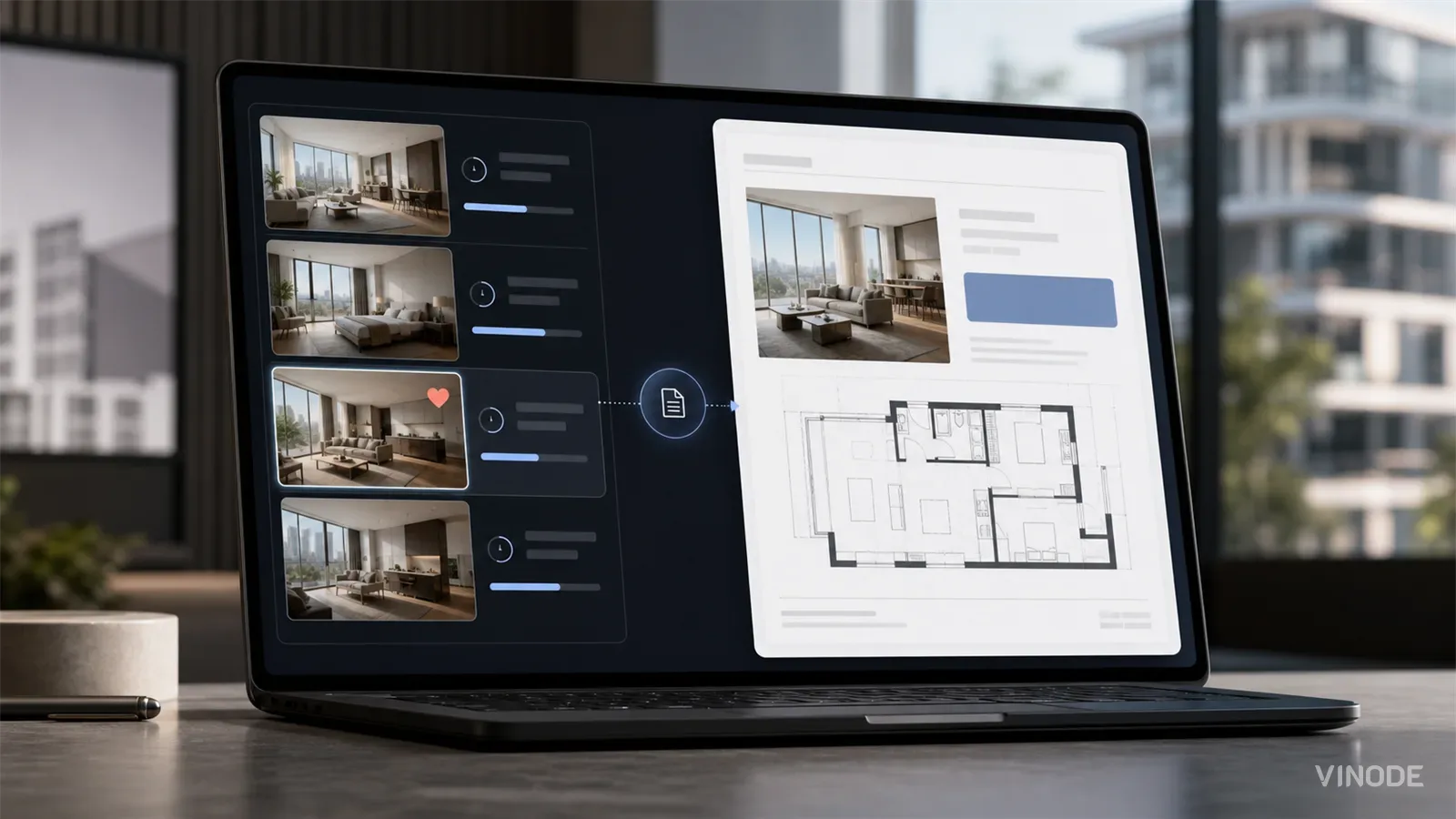
The Unit-Specific PDF a Buyer Actually Asked For
A buyer spends nineteen minutes on one two-bed, saves it, and gets the forty-one-page development brochure the next morning. Once a sales platform records the unit a buyer chose, the generic brochure becomes a decision to ignore that choice.

Expression of interest before release day: capture unit demand
640 names and no idea which side of the building they want. An expression of interest campaign pays off when the form is joined to the units each buyer explored, and each of these checks has a pass, a fail and a cost.

We measured when a pipeline crosses the presale line, not just whether it will
When GTHA opening-quarter absorption averaged 66%, the sold percentage was enough to forecast a presale crossing date. Then absorption fell to 17%. Three pipeline inputs produce the crossing date your lender asks for: stage-conversion rates, a cancellation haircut, and remaining inventory.