
CRM and CMS for property developers: what one back office actually means
Key Takeaways
- In the window when the public listing and the deal disagree, a salesperson can sell a unit a colleague already reserved.
- One word, "reserved", is both a deal stage and an availability status, which is exactly where two separate systems drift apart.
- When reserving a unit and updating its public listing are one action, the buyer and the salesperson can never see different availability.
- Bolt two tools together and the link between a deal and the unit it was for is the first thing to go missing.
A buyer calls about apartment B-207. The website she is looking at says it is available. The salesperson opens his pipeline and sees it was reserved two days ago, for someone else. Same unit, two answers, and one of them now has to be walked back with an awkward phone call.
That gap is the real problem a developer is trying to solve when they go shopping for a CRM and a CMS. Most people frame the task as a purchase: pick a CRM, pick a CMS, connect the two. The gap above is not a purchasing question. It is a question about where the unit is stored, and how many copies of it exist.
What each system actually owns
A CMS manages content. For a property developer that content is the units: each one's price, its availability, the floor plan, the gallery, the description in three languages. It faces outward, toward the public listing. A CRM manages people and deals: the contacts who enquired, where each one sits in the pipeline, the tasks and reminders that move a deal forward. It faces inward, toward the sales team. Almost every developer runs both, and the usual wiring is simple: a form on the CMS page drops a new lead into the CRM (see property lead forms that convert for that entry point).
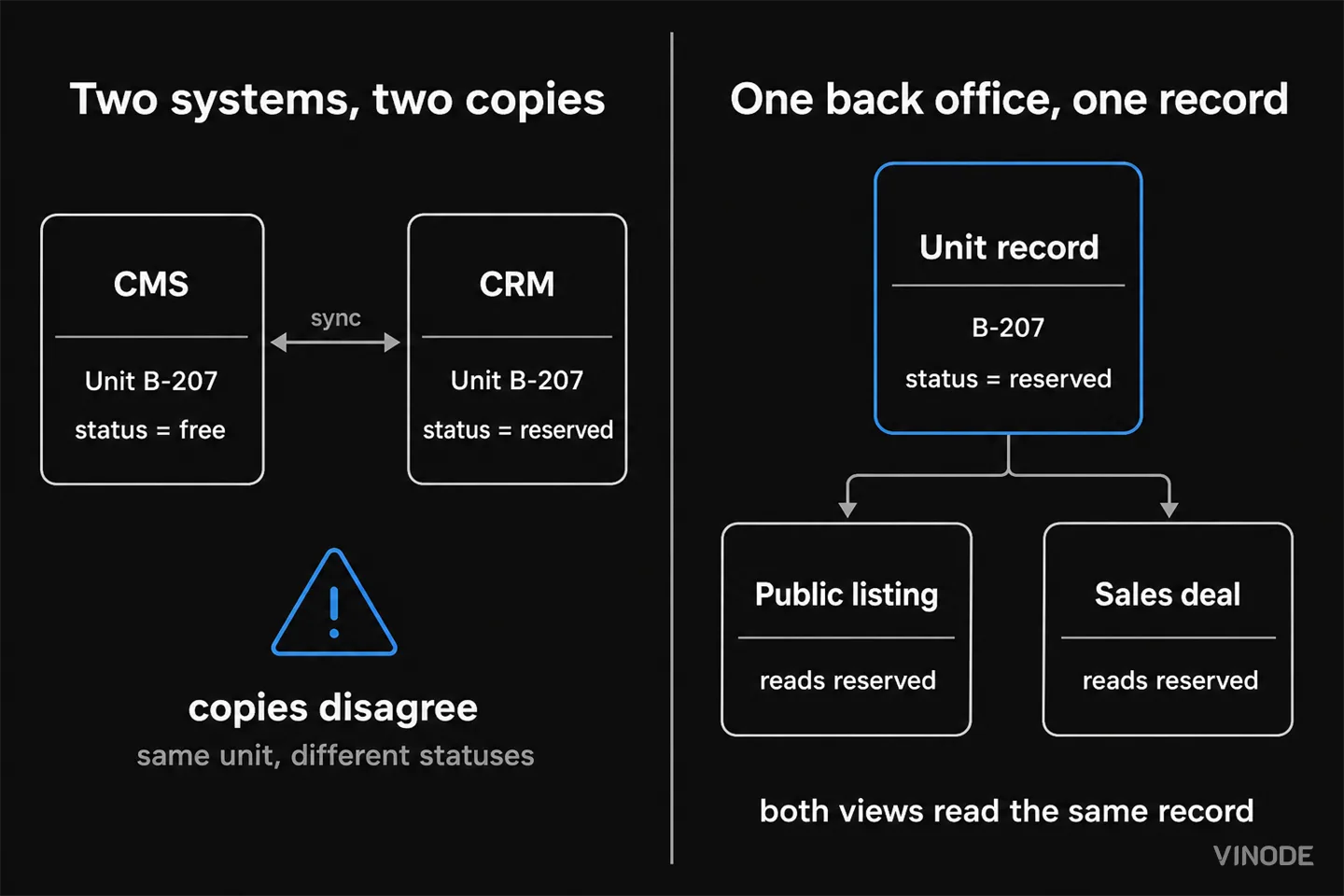
Each side keeps its own short vocabulary for a unit, in its own place. Read the two lists across and one word, "reserved", sits in both.
Two systems, one object between them
The CMS side owns the unit
Price, availability status (free / reserved / sold / promo), floor plans, galleries, attributes, translations. Outward-facing: this is what the public listing shows.
The CRM side owns the deal
Contacts, pipeline stages (open / won / lost / reserved), tasks, reminders, lead source. Inward-facing: this is what the sales team works.
For a developer, both revolve around one object
In a typical software business the CRM and the CMS barely touch. The website sells a subscription, the CRM tracks the account, and nobody needs the two to agree about a physical thing. A property developer sells units, and a unit is a physical thing that can be sold exactly once. The CMS is built around that unit. The CRM is built around the deal. But every deal is about a specific unit, so the unit is the join where the two systems meet.
That is why the unit, not the contact, is the thing a developer's tools have to agree on. A lead is worth something only while it stays tied to a specific apartment, from the first enquiry through to a signed deal. Lose that thread and you are left with a name and a phone number, and no record of which apartment the person actually wanted.
The word "reserved" is where it breaks
"Reserved" is a CRM deal stage and a CMS unit status at the same time. When a salesperson reserves apartment B-207 for a client, that single act is two facts at once. One is about the person's deal. The other is about the unit's availability. In one system those two facts are the same event, so they cannot disagree. In two systems they are two rows in two databases, written by two different actions, and nothing forces them to line up.
That is how the public page keeps showing B-207 as free while the deal already reads "reserved" in the CRM. Not because the sync is slow. Because there are two copies of the unit's status, and for a window of time they are allowed to say different things.
Inside that window a salesperson can pull up B-207, walk a second buyer through it, quote a price, and start the paperwork, all while the first buyer's reservation sits unseen in the CRM. The sale gets unwound with a call nobody wants to make: the apartment you were about to sign for is already spoken for. See one record for unit availability for the CMS side of this failure.
Why bolting two tools together doesn't fix it
The obvious answer is to buy a CRM, buy a CMS, and connect them so a reservation in one updates the other. That helps, and it beats retyping. But look at what you have actually built. Two master copies of every unit, with a wire running between them. The integration moves the unit's status back and forth. It never decides which copy is authoritative. When the two disagree, and over a long launch they will, you are back to a person choosing which database to believe.
Underneath that sits a second problem. A CRM built to sell software and services has no idea what a unit is. It models contacts and deals and nothing below them. A building, a floor, one specific apartment: none of those are first-class objects, so you fake them with custom fields, tags, and naming conventions.
So "one back office" is not a bragging right about how cleanly you wired two systems together. It is a plainer claim: the unit is stored once, and the public listing and the sales deal are two views of that single record. There is a real cost to buying it that way. A single back office means accepting one vendor's CRM instead of the strongest standalone CRM on the market, and for a sales team attached to a particular tool that is a genuine tradeoff. For most developers it is worth paying, because the thing most likely to cost a sale is not a missing CRM feature. It is a unit whose listing and deal disagree, and a shared record is the only thing that rules that out for good.
What to ask before you pick a tool
Stop asking which CRM and which CMS, and how to wire them together. The first question is about storage: is each unit stored once, or kept as two records a sync has to reconcile? The second is an audit you can run on any tool that claims to do both jobs. Pull up a closed deal and see whether it still points back to the exact unit it was for, and to the enquiry it began as, or whether that trail has gone cold somewhere between the web form and the contract.
Vinode's Back Panel puts both jobs in one place: CRM and CMS together rather than two products bought and glued, and it runs developments at real scale.
Safa Al Fursan in Riyadh runs its 3D scene, website, and mobile app on a single CRM + CMS back panel, one platform doing both jobs at the scale of a full estate launch.
Back at B-207: when its status lives in one row, reserving the apartment and updating the public listing become a single action, so the scene this piece opened with has nowhere to happen.
See the CRM and CMS as one back office
Book a walkthrough of the Vinode Back Panel and watch units, listings, and deals read one shared record.


We measured when a pipeline crosses the presale line, not just whether it will
When GTHA opening-quarter absorption averaged 66%, the sold percentage was enough to forecast a presale crossing date. Then absorption fell to 17%. Three pipeline inputs produce the crossing date your lender asks for: stage-conversion rates, a cancellation haircut, and remaining inventory.
Digital Sales Gallery: What to Test Before the Display Suite Opens
The afternoon before opening, the sales lead sends herself a test enquiry and the sales desk cannot find it. Four things go wrong most often in a digital sales gallery, and each has a test you can run on the real devices and a fallback if it fails.

How to Move a Live Property Launch Off a Spreadsheet
Three weeks from launch, new enquiries were going into a spreadsheet tab called new leads 2. Move new leads and current unit data first, let old deals finish where they started, and leave the historical import until later.