
Why rendered glass façades read as fake: the optics of IGU deflection
Key Takeaways
- A curtain-wall window is a sealed gas-filled unit whose cavity cannot equalise with the outside air.
- Ordinary temperature and pressure swings bow each pane inward or outward, turning it into a weak curved mirror.
- Deflection varies with pane size and edge support, so no two neighbouring panes reflect the sky at quite the same angle.
- A render's façade glass reflects continuously because CAD geometry is flat, and no shader value bends it.
You have rendered the tower a dozen times and the curtain wall still reads as a rendering. You have already spent a week on the glass: roughness pushed down, index of refraction set near 1.5 for a dielectric, a faint blue-green tint dialled in, a sharper HDRI loaded, the ray bounces raised until the render times start to hurt. Every pass is cleaner and every pass is still wrong.
No shader thread covers the actual tell, because it is in the shape of the glass rather than on its surface. A real curtain wall is built from panes that are each slightly bowed, and each bowed a little differently, while your panes are perfectly flat. That flatness is what the eye catches, and no surface parameter reaches it, because the flatness was decided long before the material graph, back in CAD.
There is no node graph at the end of this post. It is about why the glass on a real building bends, why it bends unevenly across a façade, and why that unevenness is the one thing a shader cannot reproduce no matter how good it gets.
The window is a sealed unit, and that seal is the whole problem
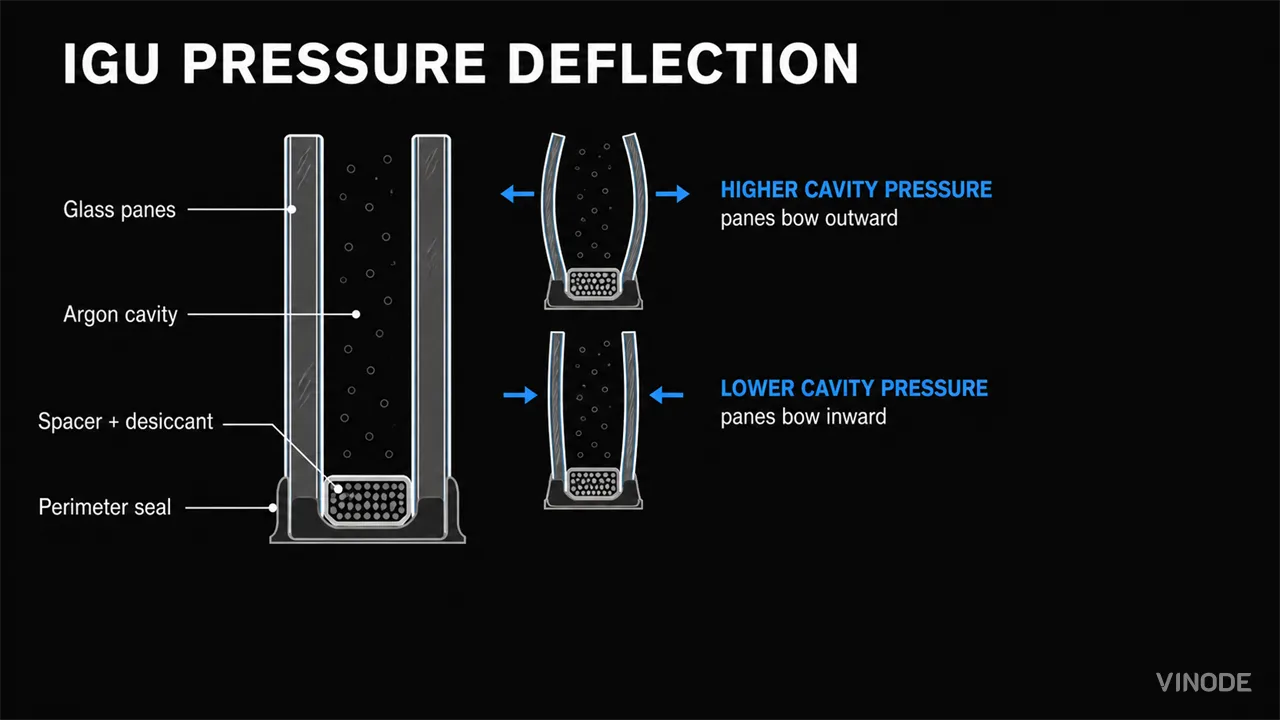
Start with what the window actually is. A curtain-wall window is an insulating glass unit: two or more panes with a sealed cavity of gas between them, usually argon. The important word is sealed. That cavity was filled and closed at one temperature, one barometric pressure and, implicitly, one altitude, and once it is closed it cannot equalise. Equalise here just means let the pressure inside come back into balance with the pressure outside, and a sealed unit has no path for the gas to do that.
The gas inside obeys the gas laws: seal a fixed amount of it and its pressure times volume, divided by temperature, holds constant. The atmosphere outside obeys nothing you control; it warms, cools and swings with the weather on its own schedule. When the two disagree, something has to give, and the only thing free to move is the glass. So the panes bow. When the cavity runs warmer than it was sealed, or the outside pressure falls, the gas pushes the panes outward. When the cavity runs colder, the panes are drawn inward. An altitude difference between the factory and the installed site does the same with no weather at all: a unit sealed low and installed higher sits with a standing outward bow from day one. The mechanism and its direction are laid out plainly in Construction Canada's account of insulating-glass pressure changes.
How far a pane bows, and how unevenly
The peer-reviewed modelling gives real magnitudes for named pane sizes under a named load, so start there. Take one clean equivalence from a 2022 analysis in the journal Materials: a drop of 5 kilopascals in outside atmospheric pressure bows a pane by about the same amount as a rise of 15.5 kelvin in the cavity gas (Respondek et al., Materials 2022, CC BY). Five kilopascals is a passing weather front; 15.5 kelvin is an afternoon of sun warming the glass. Neither is a storm. This is an ordinary, everyday load.
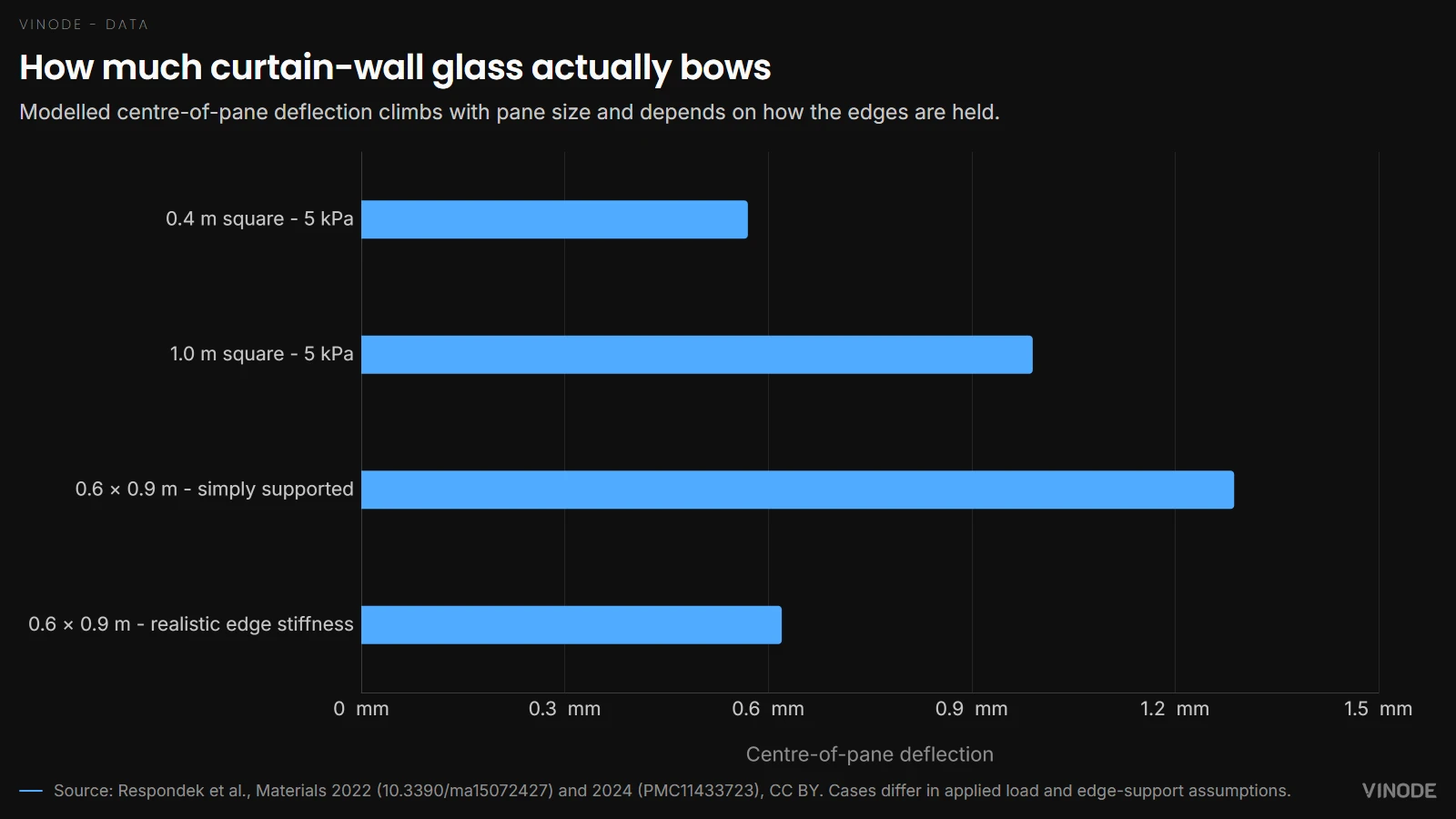
The modelled centre-of-pane deflection under that load runs from roughly half a millimetre to a little over one millimetre for ordinary panes, and it grows with pane size: about 0.57 mm for a square unit near 0.4 m across, rising to about 0.99 mm near 1.0 m. How the pane is held at its edges matters just as much. A later 2024 analysis by the same group modelled a 60 by 90 cm unit at 1.287 mm when its edges are simply supported, but only 0.620 mm once realistic edge stiffness is included (Respondek, Materials 2024, CC BY). These come from an analytical model rather than a tape measure on a real façade, so cite them as modelled figures.
Hold those two facts together, because their product is the whole point. Bow scales with pane size, and it scales with how each pane is framed. A real elevation is a grid of panes of different sizes, held in different ways, so adjacent panes bow by different amounts. The deflection across a façade is not uniform, and it was never going to be.
For ordinary curtain-wall panes under an everyday 5 kPa pressure load. Rises with pane size and roughly halves with realistic edge stiffness.
Source: Respondek et al., Materials 2022 & 2024 (CC BY) - as of
A bowed pane is a weak curved mirror
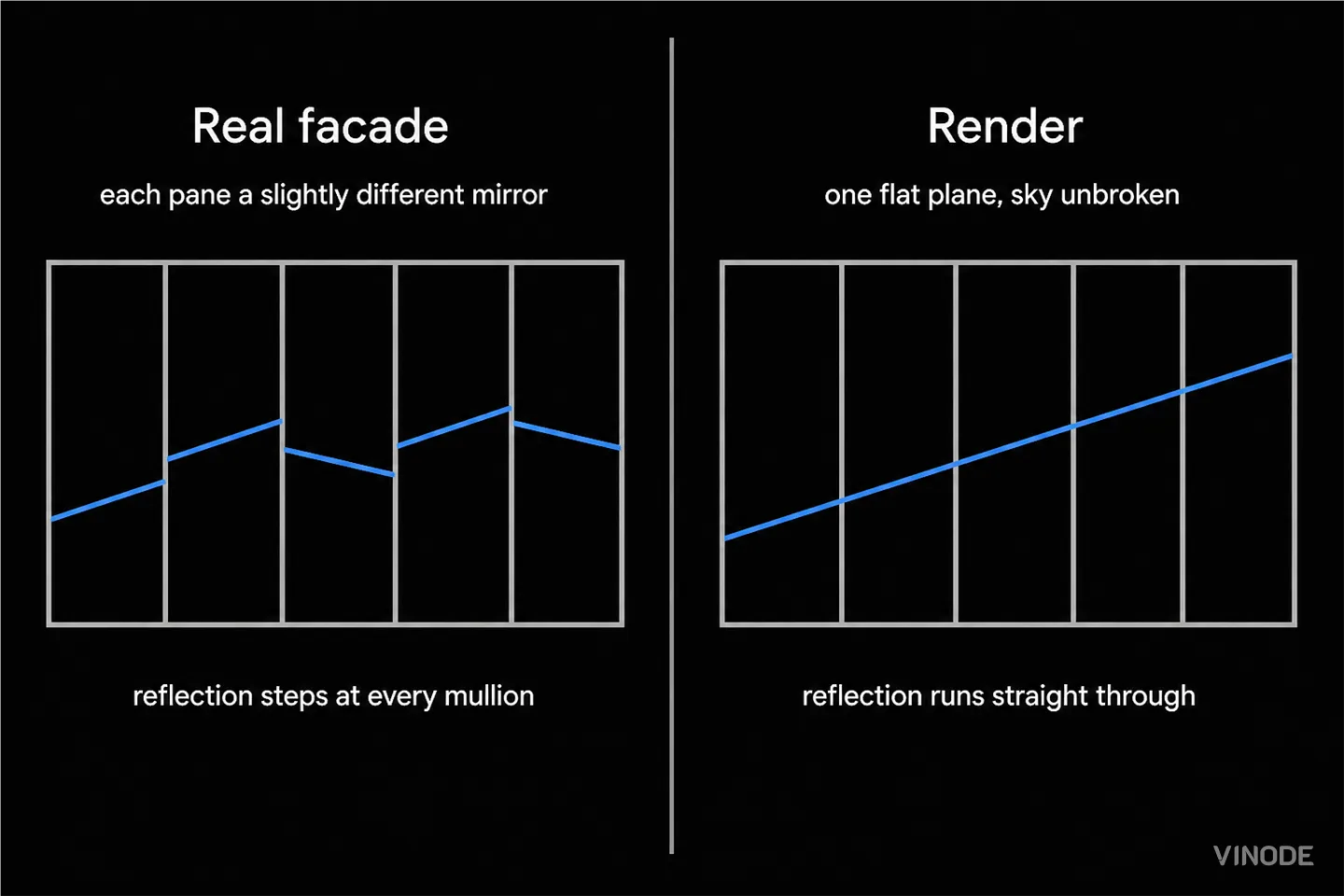
Now the optics, and this is the part you can check for yourself. A flat pane reflects the sky as one continuous sheet. Bow that pane by a fraction of a millimetre over a metre and it stops being flat and becomes a very shallow curved mirror. A curved mirror does not send the world straight back; it stretches or compresses the reflection a little, the way the back of a spoon does, only far gentler. Because every pane in the façade bows by a different amount, each one warps its slice of sky slightly differently, and the reflection steps and breaks at every unit boundary.
That is why a real glass tower, seen at a glancing angle with sky behind it, shows a reflection that is misaligned panel to panel, rippling where the panels meet. A render shows the same sky running smooth and unbroken across the whole elevation, because the render's glass is one flat plane repeated. And this misalignment is not our own inference. Construction Canada, describing exactly this sealed-unit deflection, treats the distortion of reflected images as an appearance defect that owners object to, even though it does not threaten the glass itself (Construction Canada). It follows straight from the optics that the more mirror-like the glass, the more a shallow curvature shows - a highly reflective low-e curtain wall is exactly where the effect is easiest to catch.
Climatic deflection is only one of several ways glass distorts what it reflects, and it helps to keep the others straight. Newton's rings are the coloured fringes that show up where two panes actually touch. Roller-wave and anisotropy both come from tempering: a faint rolling waviness in the surface, and the frozen-in stress patterns the process leaves behind. Solar concentration is a different problem again, a bowed façade focusing reflected sunlight into a hot spot on whatever stands across the street. All four are real, and all four are distinct. Only the everyday bowing of a sealed unit is the subject here.
Go and look. On a cold, clear morning, stand at an angle to any glass office building so the sky is reflected in the façade rather than the street, and follow a horizontal line of sky across the panels. On a real building it will not stay straight; it steps and shifts at each panel edge, because each panel is a slightly different mirror. The first time you catch it you will not be able to stop seeing it, and after that no rendered curtain wall will ever quite convince you again. The whole argument of this post is falsifiable against a building you can walk to.

Why no shader value can fix the flatness
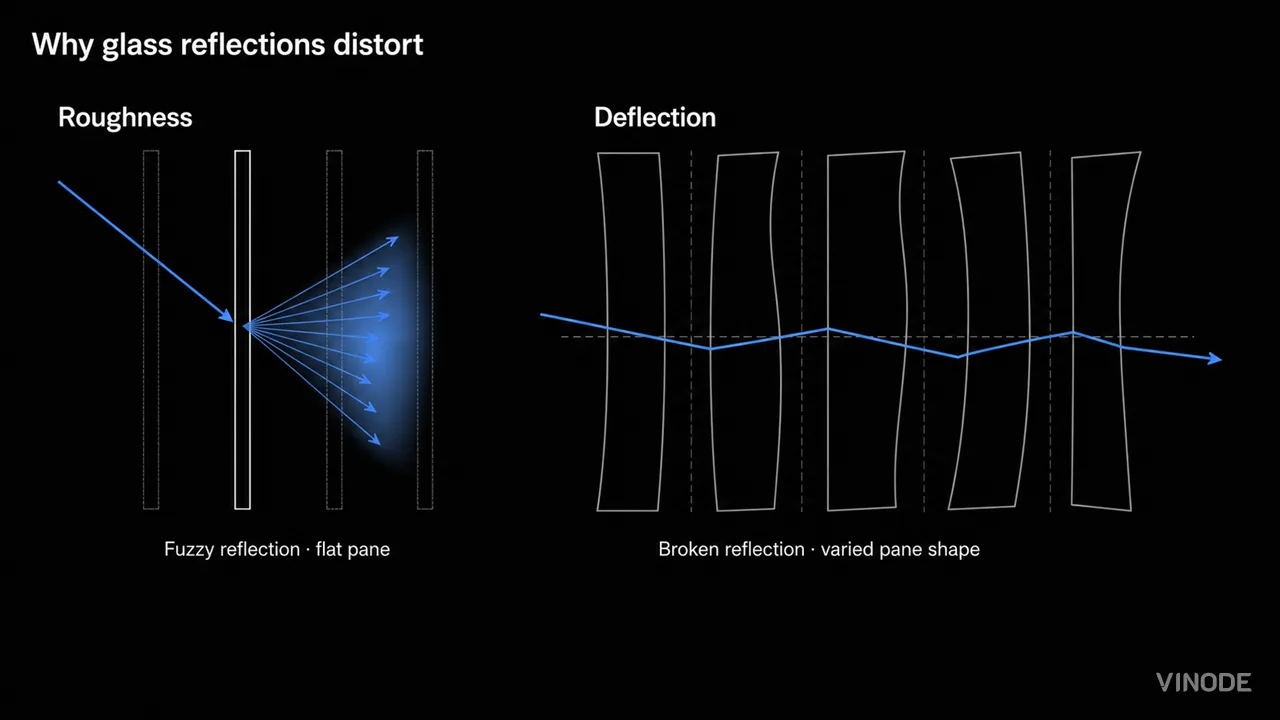
One distinction carries everything. Roughness scatters light within a single pane - turn it up and the reflection blurs, but it blurs uniformly across that one pane and stays put relative to its neighbours. Deflection does something different in kind: it changes the shape of the whole pane, and each pane's shape independently. No value of roughness, index of refraction or tint produces a discontinuity between adjacent panes, because that discontinuity is a per-pane geometric boundary, not a surface-scattering property. You are tuning the wrong layer, and the layer you are tuning cannot express the thing that is wrong.
The shaders are not primitive, though. A modern glass shader will do thin-film interference for the coating colour, stack multiple coating layers, handle spectral transmission, even take a per-pane normal map. It could also model the insulating unit as the four or more optical interfaces it really has, instead of one slab. Most scenes skip that to save render budget, and the tool would happily do it if you asked. What none of that touches is the flatness. The shader can be arbitrarily good and the pane is still flat, because the geometry came from CAD, where a window is a flat rectangle that nobody deflects.
Our own pipeline sits inside this problem too. It ingests geometry from the CAD and BIM tools architects actually use, Revit, ArchiCAD, AutoCAD, Vectorworks, and a window in one of those files is a flat rectangle. We do not deflect it, and we are not claiming we do. The flatness is inherited straight from the source model, and nothing downstream in the material graph bends it back. That is true of every render that begins from CAD geometry, not a quirk of ours.
The tint, at least, you can stop guessing
One surface parameter is worth a note, because artists habitually eyeball it: the colour of the glass. Low-emissivity coatings are spectrally selective, meaning they are engineered to reflect infrared while passing most visible light, and the interference in that thin coating stack leaves a faint colour cast, usually a cool blue or green. You do not have to guess the shade. Lawrence Berkeley National Laboratory maintains the International Glazing Database, which holds manufacturer spectrophotometer measurements from 300 to 2500 nanometres for real, named products, recording transmittance together with both front and back surface reflectance. If the exact colour of a specific product matters to a shot, it is a measured, public number rather than a taste call. That is the one surface parameter worth chasing to the last decimal. It still sits on top of the shape underneath it, and does nothing to that shape.
When the broken reflection matters, and what to check
Most of the time the flat glass goes unnoticed, and we would not spend an hour of render budget on it. The broken reflection only appears when the camera frames a curtain wall at a glancing angle with a bright sky behind it. Interior shots, dusk and night scenes, matte or fritted glass, distant establishing shots where a panel is a few pixels wide, all of those hide the effect completely. It is a defect of exactly one kind of image: the hero exterior, at or near eye level, glass filling the frame, sky doing the reflecting.
So change the order of operations for that one shot. The next time a curtain wall reads as fake and your hand goes to the roughness slider, ask a different question first: is the pane geometry flat? It almost always is, and if it is, you have found your problem. Whether the shot is worth deflecting the geometry for is a separate call, and outside the hero frame the answer is usually no. Knowing which layer the failure lives on is most of the value. Check the geometry before you reach for the roughness slider.
See a finished project
This piece was about why glass is hard to fake, not about our product. If you want to see what the pipeline ships anyway, a live project opens from a single link.

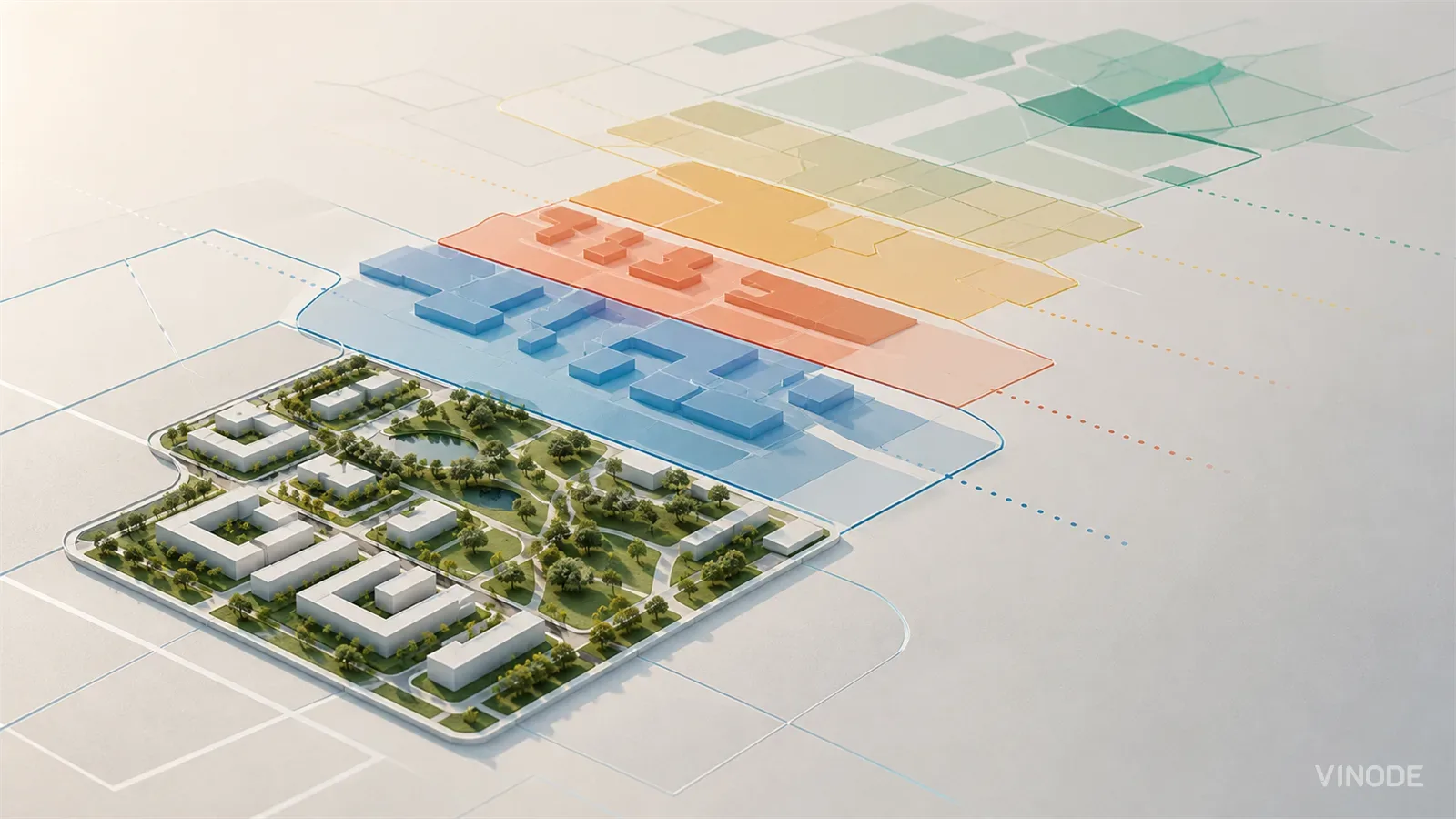
Masterplan 3D for Phased Estates: How to Show Phase One Without Overselling Later Phases
A phased estate contains several levels of certainty at once. The masterplan should make that difference visible, then absorb a later-zone redesign without discrediting the phase-one material buyers already saw.
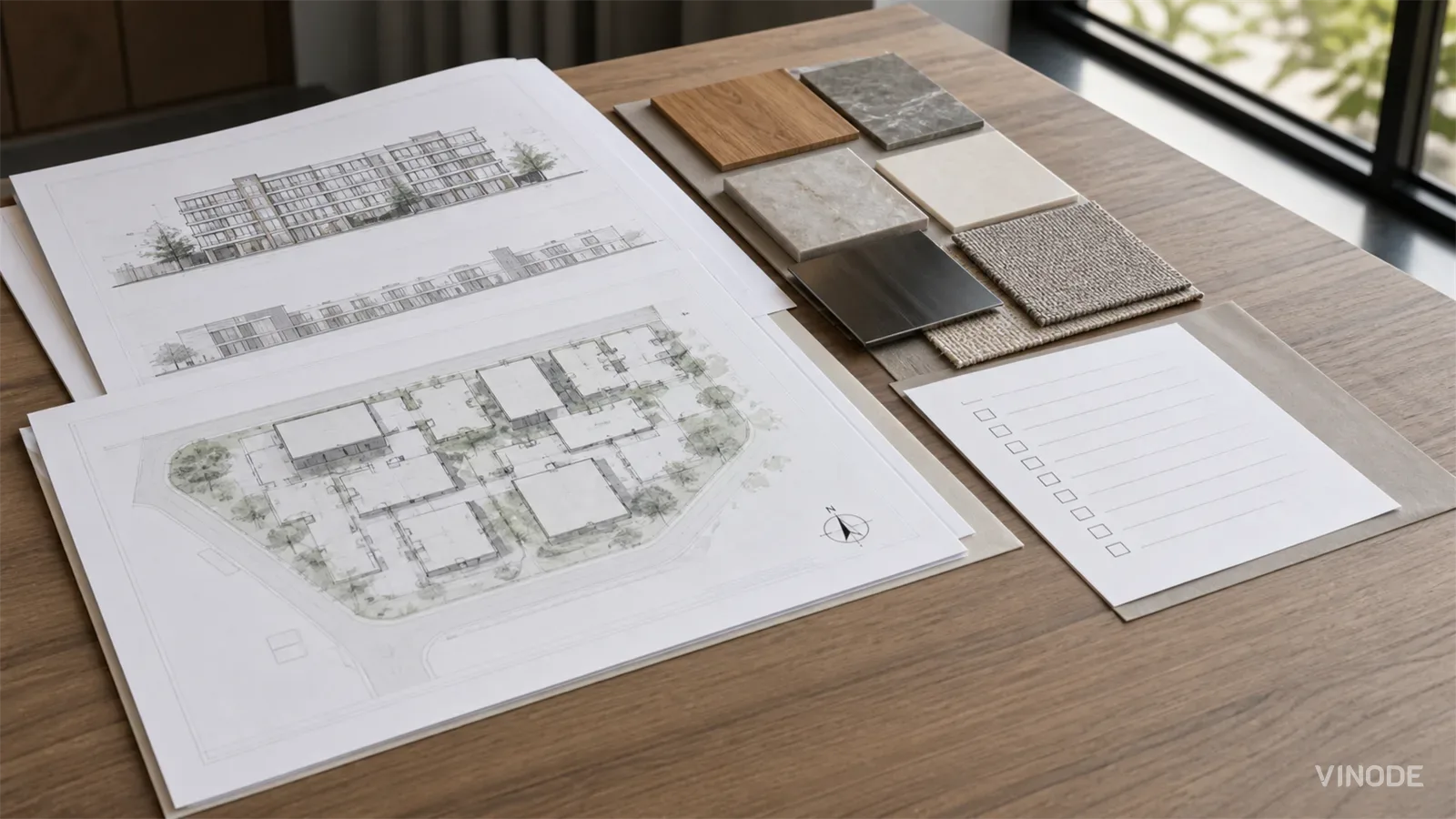
How to brief a 3D rendering studio before work starts
Send geometry, orientation, context, finishes, landscaping, shot intent, approvers and the open unknowns before rendering starts. Then revisions can focus on the image instead of missing facts.
Off-Plan Rendering: What Reaches the Buyer
A new marketing manager inherits 140 JPEGs, one MP4 and no model. Everything the 3D model knew about the units stayed on an artist's workstation, and three vendors are about to rebuild it by hand. What reaches the buyer depends on what leaves the studio.