
The true cost of ownership of an interactive property experience
Key Takeaways
- The launch quote is the smallest column of cost; the real total accrues over the two-to-three-year sell-down.
- The recurring bill is set by content change: whether editing price, status, and availability is self-serve or billable per request.
- Pre-rendered honestly costs more when the underlying model changes, because the 3D asset must be re-produced as real production work.
- Judge a vendor on its edit model and its exit terms: clean data export and ownership of the source models.
A developer's finance lead has two quotes on the desk for the same interactive sales experience. The numbers are close, so the decision feels like a coin toss between two vendors who both do good work. The instinct is to treat the quote the way you'd treat a rendering package: pay once, take delivery, done.
That instinct is what makes the wrong quote look like the right one. A rendering is finished when it ships. A sales experience never quite is, because the thing it represents keeps changing. A residential development sells down over two to three years, and for that entire stretch its unit list, its prices, and its availability move every single week. The quote captures the day you launch, but the real total is written over the thirty-six months after it, one small edit at a time, and almost none of that shows up on the statement of work you're comparing.
Two ways buyers misprice it
Most buyers get this wrong in one of two directions, and both fail the same way.
The first is the coin-toss above: the quote is the cost, so compare the two stickers and pick one. The second belongs to people who have been burned before. They know there's an ongoing bill, so they go hunting for it in the obvious place and start comparing monthly hosting figures across vendors.
Both are pricing what's cheap and predictable, serving bytes and storing assets. Neither is pricing the expensive, variable part: the labour and turnaround of keeping a live sell-down accurate. General-software TCO has long held that the purchase price is a minority of lifetime cost (the box below quantifies it), and a property experience skews that ratio even harder toward the back end. A property sales page is edited every week its campaign is live, which pushes its back-end share higher still.
General-software figure from IBM, which puts upfront acquisition at 20-40% and the rest after you buy. It's not a real-estate measurement, so read it as a directional benchmark rather than a number for this specific project.
There's a phrase that hides most of this cost: support and maintenance included. It reads like reassurance and it usually means something narrow. It means the server stays up. It rarely means that changing a price, marking a unit sold, or adding a translation comes free. If a vendor sheet says maintenance is covered, the only question that matters is which class of change is covered, and you have to ask it directly, because the sheet won't volunteer the answer.
The load-bearing cost: who holds the keyboard
This is the column the generic guides skip, because they're pitched at an agent with one listing rather than a developer with hundreds of units. It's also the column that decides your multi-year bill.
Picture the operational reality on a live project. Twelve apartments sell in a single week. Who moves them from reserved to sold on the public sales site, and does each of those edits cost you money? On a real development this is not a hypothetical load. Safa Al Fursan in Riyadh runs 528 units across 25 buildings. Multiply a weekly cadence of price changes, status flips, new photos, and promo flags across a list that size, over two or three years, and you have the real recurring cost of the experience. It never appears as a line item. It accrues as a hundred small requests, as response lag between the sale and the site catching up, and as a sales page that's quietly out of date on the weekend a competitor launches.
The discipline that survives contact with that reality is to sort every future change into two bins and price them separately.
Content edits are price, availability status (free, reserved, sold, promo), a new gallery photo, a translation, a tweak to a unit's attributes. These should be self-serve and carry near-zero marginal cost, because they're data rather than production. If a vendor bills you per change for these, that's the year-two cost bomb, and it's invisible at signing. On Vinode this class is self-serve by design: the Back Panel is a combined CRM and CMS where the client's own sales and marketing team edits unit data, pricing, status, galleries, and translations directly, in the browser, with no developer in the loop for everyday changes. Listings bind to live project data, so one edit propagates instead of being re-keyed across pages.
Model changes are the other bin, and they behave very differently. That's the next section.
If your sales team has to email the agency every time a unit sells, you didn't buy a platform. You rented a queue in front of one.
The honest counterweight: where pre-rendered costs more
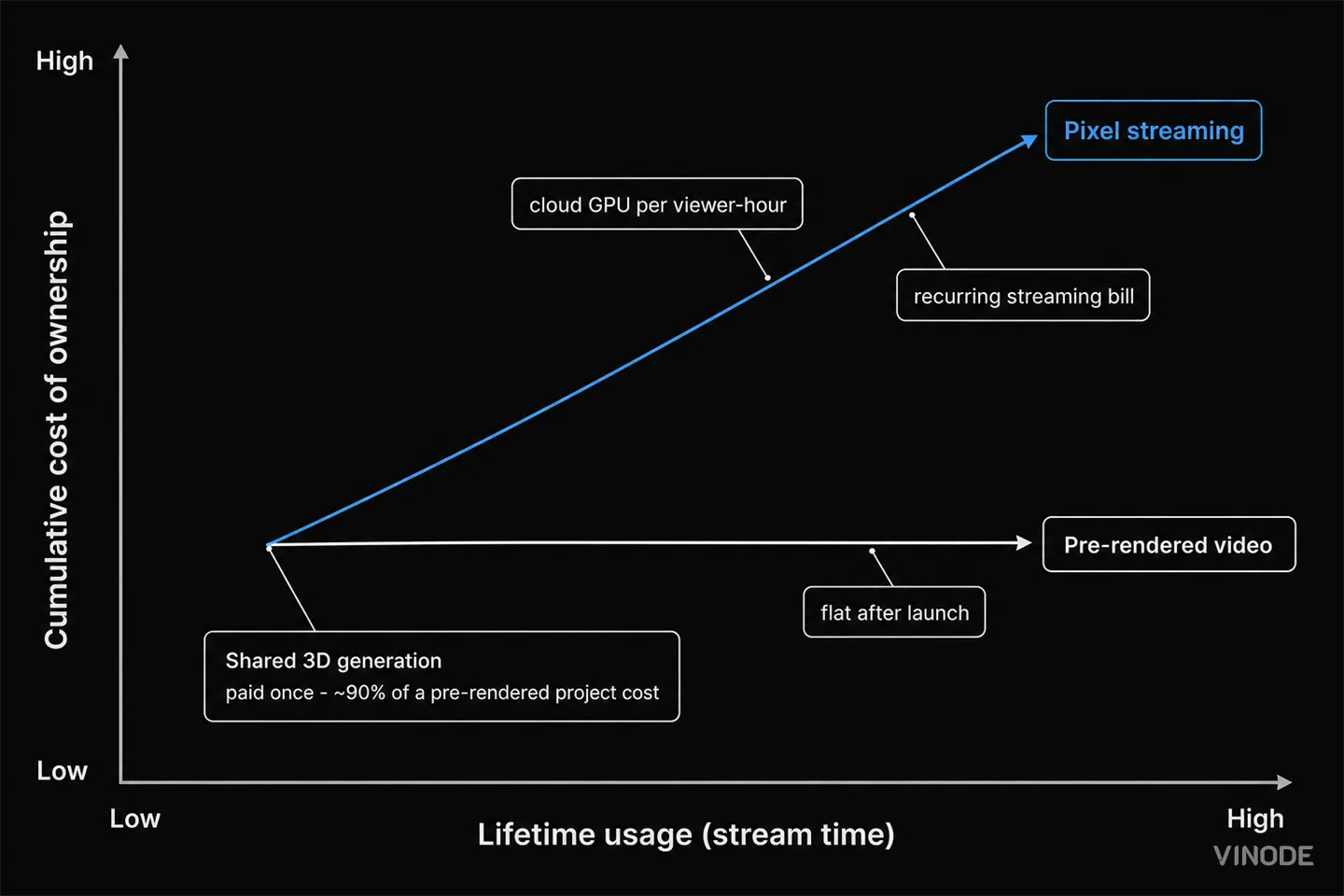
Here is the part a sales page won't tell you, and it's the strongest reason to trust the rest of this. Vinode's architecture is pre-rendered: the 3D is produced ahead of time and streamed as video, which is what keeps it cheap to serve and fast on a weak phone. That same choice makes it the expensive option for the second bin. When the model changes, a revised floor plan, a new tower, a phase two, the asset has to be re-produced. That's real production work, and it's legitimately re-billable on any vendor. A real-time engine would re-render that change on the fly; a pre-rendered pipeline pays for it in production time.
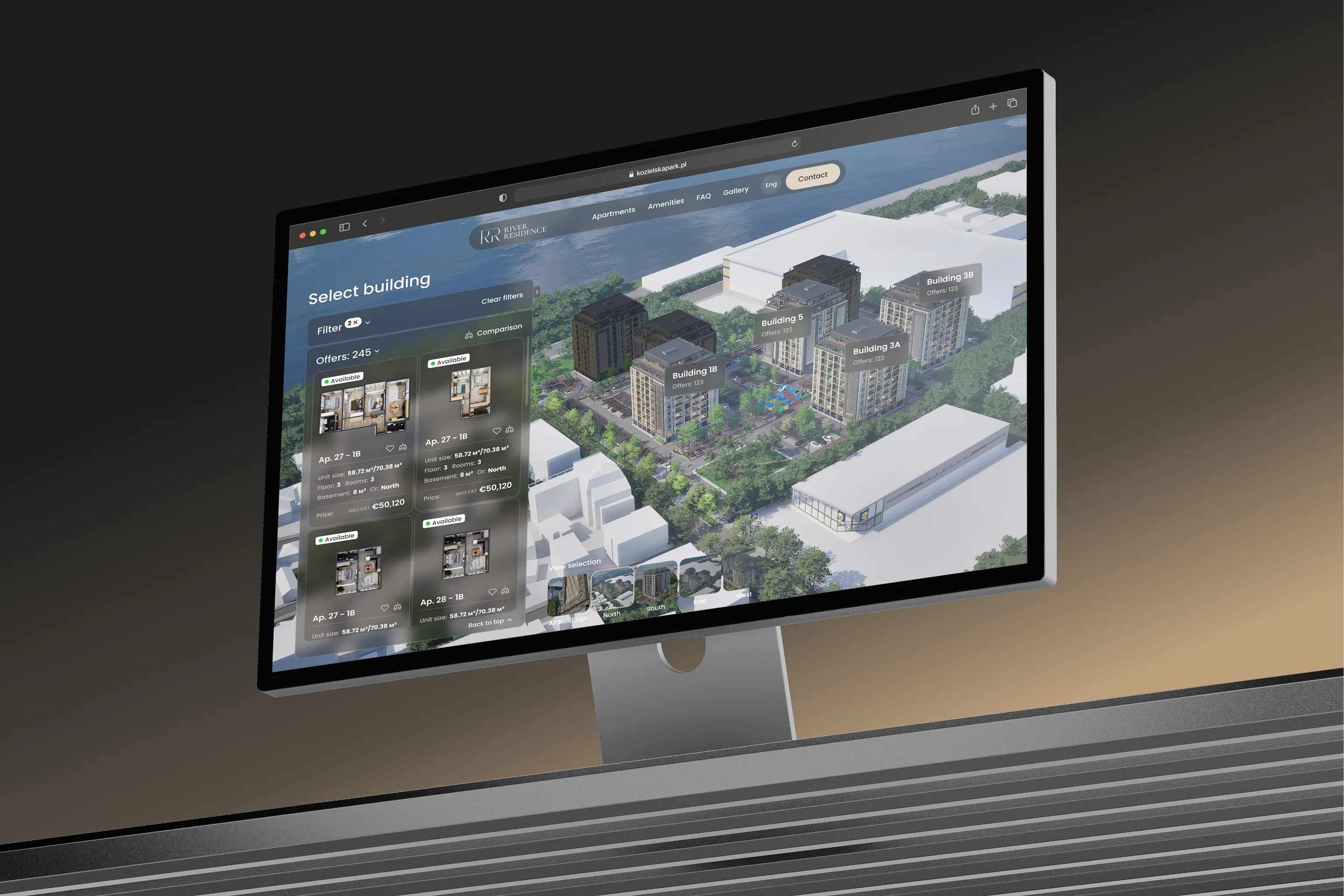
So the break-even is a question about your project. If the option set is finite and known, pre-rendering is the right trade. River Residence ships an interior style switcher and a live purchase configurator (parking, kitchen finishes, financing) over exactly that kind of bounded set, and it stays fast and cheap to run. If the model is open-ended and gets restructured often, the calculus shifts, and you should weigh a different approach.
One caveat on honesty: there is no public per-render figure, and I'm not going to invent one. Naming the gap is more useful than filling it with a made-up range. What you can do is ask the vendor to scope model changes explicitly, so the re-render cost is a known quantity rather than a bill that lands long after you've signed.
This is a framework for a development sold over years, not a single resale listing. And pre-rendering is not the universal answer: if your model is still in heavy design churn, or you expect to restructure the building itself repeatedly rather than just the data attached to it, the re-render column can outweigh the serving savings. Cost it honestly for your own project instead of assuming the trade that's right for a development at that scale is right for a six-unit boutique block mid-redesign.
Where each cost actually lands
The procurement question isn't only what does this cost, it's whose line item is it. Two examples that usually get mispriced.
Licensing. Building interactive 3D on Unreal Engine carries a per-seat cost. As of 2026-07-02, Epic charges a non-game seat licence of $1,850 per seat per year for companies over $1M in annual revenue using Unreal for commercial, non-game work such as architectural visualization (Epic Games - Unreal Engine pricing update). On a DIY, in-house build that seat is your recurring line item, one per artist, every year. On a delivered pre-rendered platform it sits on the vendor's side of the pipeline, folded into the engagement rather than showing up as an annual bill you administer. It's the same dollar of cost with a different owner, and the quote you're comparing may or may not be putting it on your side of the ledger.
Hosting. For a CDN-served experience, the serving bill tracks bytes delivered, and the per-GB rate falls as monthly volume rises (as of 2026-07-02, that tiering-down structure holds on major clouds, e.g. Google Cloud CDN pricing). Per-concurrent-viewer real-time streaming inverts that: a launch-day spike of a hundred simultaneous buyers becomes a cost spike, because each stream wants its own compute. The concurrency economics are worth understanding in full before you sign; we've worked through them in pixel streaming versus pre-rendered 3D. Storage and generic "maintenance" round out the picture, and for a streamed-video experience both are small enough to leave as a footnote rather than a section.
The CDN side stays cheap even at real volume. In our busiest single month, our project tours served 10,367 sessions with no per-viewer render cost: the serving bill tracks bytes delivered, not concurrent viewers. Anonymized aggregate, from our own GA4.
Source: Vinode measurement - as of
Put these questions in the RFP
Pin down the self-serve list
Ask for a written list of the changes your own team makes without the vendor: price, status, galleries, translations, unit attributes. Anything off that list is a billable request, and that gap is the cost that surfaces long after signing.
Get model changes scoped
That class of structural change is genuine production on any vendor. Ask for the scope and the rate in the contract, so the re-render is a known number instead of a bill you never scoped.
Cost the whole sell-down, exit included
The purchasing discipline that ties this together is simple to state and rarely done: stop comparing launch quotes, and cost the experience across the full sell-down, three to five years, with the exit priced in. The exit is where lock-in hides, and the only way to see it is to put the same short list to every vendor before signing, Vinode included. The two change-class questions above belong on that list. Two more expose the exit:
- Make them prove the data export. Your unit and lead data must come out cleanly if you leave. On Vinode the Back Panel does asynchronous data export with GDPR erasure; ask any vendor to demonstrate the equivalent live rather than claim it.
- Confirm you own the source models. The 3D originates from the developer's own CAD or BIM files, so make sure that ownership follows you out the door.
My honest opinion, after building these pipelines: the answers to those questions tell you more about your five-year cost than the quote total ever will. Make them the price of entry. Get every vendor to answer them on paper before you sign. Do that, and you stop pricing launch day and start pricing the three years of edits you're actually buying.
See the edit model before you commit to it
Walk through the Back Panel on a live development and price the whole sell-down, not just the launch.

The Unit-Specific PDF a Buyer Actually Asked For
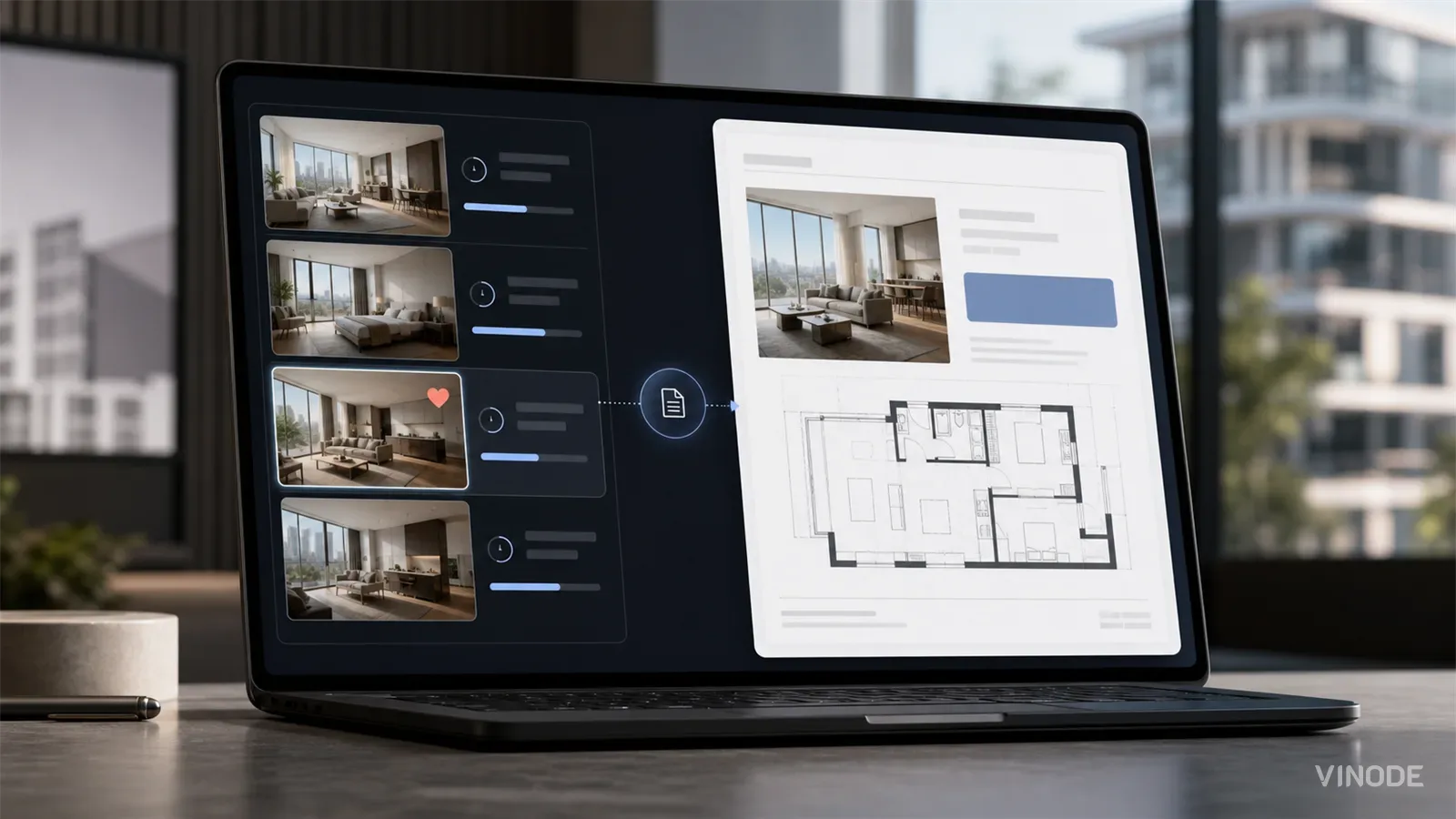
A buyer spends nineteen minutes on one two-bed, saves it, and gets the forty-one-page development brochure the next morning. Once a sales platform records the unit a buyer chose, the generic brochure becomes a decision to ignore that choice.

Expression of interest before release day: capture unit demand
640 names and no idea which side of the building they want. An expression of interest campaign pays off when the form is joined to the units each buyer explored, and each of these checks has a pass, a fail and a cost.

We measured when a pipeline crosses the presale line, not just whether it will
When GTHA opening-quarter absorption averaged 66%, the sold percentage was enough to forecast a presale crossing date. Then absorption fell to 17%. Three pipeline inputs produce the crossing date your lender asks for: stage-conversion rates, a cancellation haircut, and remaining inventory.