
Why signed-off discounts still leak developer margin
Key Takeaways
- Most development margin leaks through incentives that never touch the price field, so a cap on the headline discount misses where the money goes.
- Draw approval limits around the total concession value, counting furniture packages, fee waivers and upgrade credits, not the discount percentage alone.
- A slow or unclear approval loop is what pushes reps off-book, so design the gate for speed and pre-authorize routine concessions within guardrails.
- Generate the buyer's price from the unit record, so the brochure always quotes the current approved figure straight off the price list.
A three-bedroom on the top floor of a phase-two tower closed last quarter with every discount in order. The rep requested each reduction, a manager signed each one, and the numbers sat inside the approved band. When finance reconciled the deal against the underwriting model, the margin still landed below the figure the development had been financed on. No rule was broken and no signature was missing.
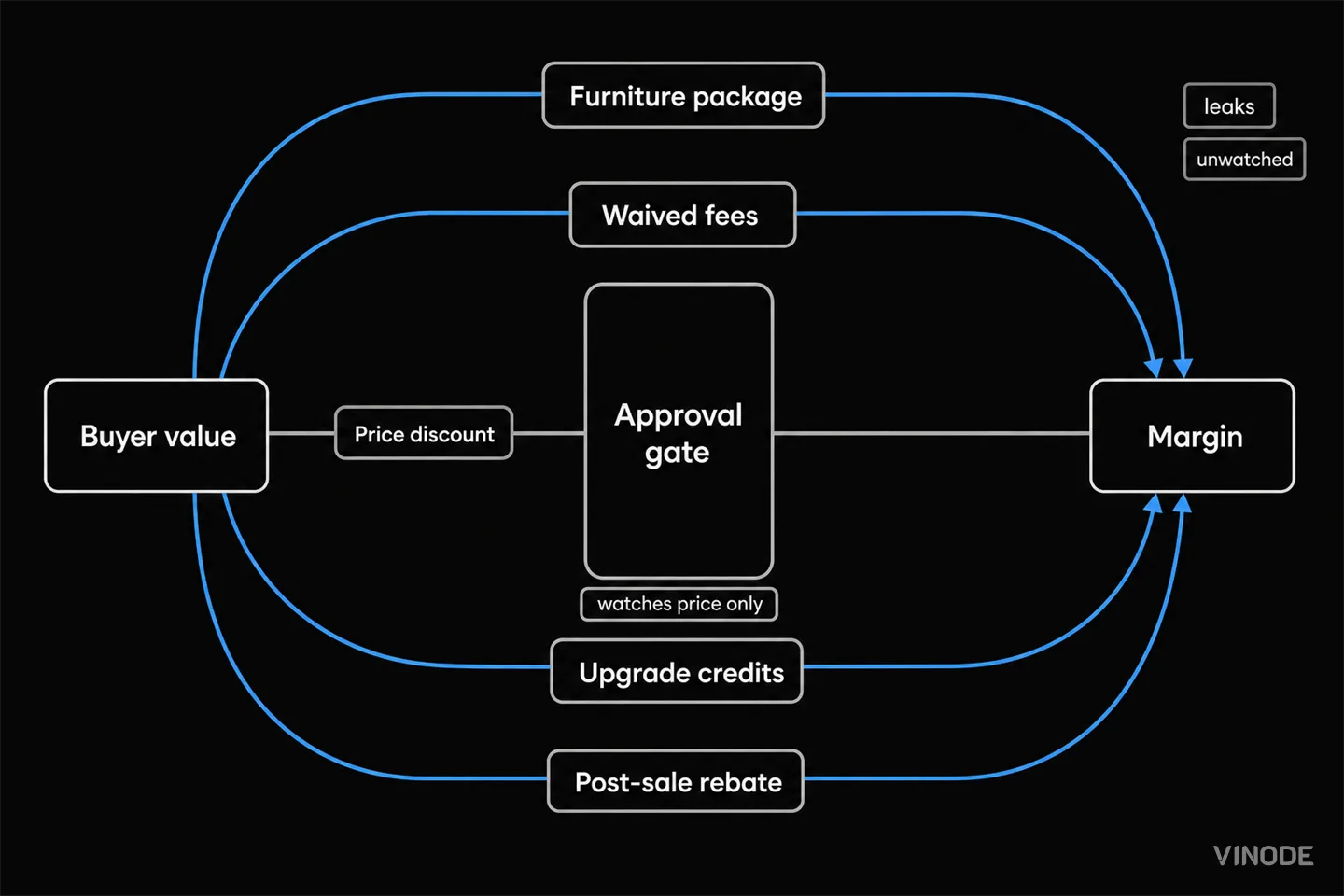
The concession that moved the margin never touched the price. It arrived as a furniture package thrown in at cost, a registration fee quietly waived, and a parking space credited at no charge. The price cell read exactly what the price list said, so the discount report read clean. The money left through a door the approval workflow was not watching.
This is the failure a discount-approval process built around the price field cannot see. Guard the headline number and reps route the concession into channels the system never records. This piece is about the authority layer above that number: who is allowed to give margin away, and by what mechanism. It assumes you already keep one price record every surface reads from. If you do not, that is the prior problem, and its home is one record for unit availability, not four in sync.
The leak a price cap can't see
Start by naming the channels the money actually leaves through. Furniture and appliance packages included at no cost. Registration or DLD fees the developer absorbs. Upgrade credits against a kitchen or a finish tier. Post-sale rebates paid once the contract is signed. Each one lowers what the buyer effectively pays, and none of them registers as a discount on the unit.
Developers keep those concessions off the headline on purpose. A published price holds the comparables for the rest of the phase, protects earlier buyers who paid list, and keeps a valuation intact. Cutting the number in the cell breaks parity for everyone still to sell, so the value travels somewhere the price list will not show it.
A single launch can carry hundreds of price points across several release phases. An unlogged concession on one unit disappears into a list nobody reads end to end.
So watch what a tighter cap actually does. Lower the self-approval band from a manager's threshold to a stricter one, and the reductions that used to run through the price move into the packages instead. Measured discounting looks healthier on the report. The total conceded per deal stays flat, or climbs. You have tightened the one channel the team already left and missed the packages that now carry most of the value.
Latency is the leak
The reason those channels exist decides what you fix. Reps route around the approval loop when it runs slow, or when nobody is sure who owns the decision. A deal that has to be reserved this week cannot wait on an approver who answers next Tuesday, so the rep finds a concession that needs no signature.
Every approval rung you add to a small, in-policy concession pushes more of that value into channels you cannot see. Before you tighten the cap, measure how long a clean, low-risk concession waits for sign-off, because that wait is usually what sends a rep looking for a concession with no signature attached.
By the time finance reconciles the phase, the missing margin is already spent. An unlogged concession leaves no trail back to whoever gave it, so the same gap opens on the next release.
Draw the matrix around the whole concession
The leak runs through those side channels, so the authority limit has to be drawn around the same territory. Add the furniture package, the waived fees, the upgrade credits, and any rebate into one number: the total concession value on the deal. Govern that figure. A concession worth as much as a headline cut should meet the same gate a headline cut would.
Where the sales band ends and the margin gate begins
Sales owns the deal
The commercial team can move price and concessions within a pre-set band. A routine, in-policy giveaway is already authorised by the matrix, so it closes without a fresh signature every time.
Finance owns the margin gate
Any concession that drops the deal below its margin floor escalates to whoever guards margin. Whether it clears the floor is the only question that sends it up.
When a deal must go to finance
Escalation keys off one thing: whether the deal still clears its margin floor. A below-margin studio and a below-margin penthouse reach the same gate, regardless of the unit's size or the rep's seniority.
Then pre-authorize the cases that carry no risk. Publish the guardrails and let a concession that lives inside them close without a request. The human gate is spent on the exceptions that threaten the number, and the everyday traffic stops queuing for a signature it never needed.
Make the concession visible, and bind the number to the buyer's document
An authority matrix only holds if the system can see what was given and shows the buyer the number that was approved. Two mechanisms in Vinode's Back Panel do that work.
First, a discount becomes a visible status the whole team can read. A unit's availability is one of free, reserved, sold, or promo, so a discounted unit carries the promo state where finance and every other rep can see it. Vinode pairs that with a discount-request workflow that has approval limits and an offer builder, the request-and-approve motion the matrix runs on.
Second, the number the buyer sees comes straight off the record. Price lives on the unit in the CMS, data-bound content renders that same figure on every surface, and the dynamic PDF brochure pulls the current price for the buyer's selected unit, so the document in the buyer's hand carries the same figure the price list shows.
If you sell a handful of units at one fixed price with no negotiation, skip the apparatus: a shared price list and a single approver cover it. The matrix earns its keep when several reps move prices across phases and concessions travel through more than one channel.
What this governs, and what it doesn't
Be precise about the edges. An honest model names what it cannot do, so here are three things Vinode's does not give you today.
There is no immutable price-change audit log. Attribution is documented for leads, tying a submission through to a deal and the unit it concerns, and versioned snapshots exist for the experience composer, but neither is a tamper-proof record of who changed a unit's price and when. If you need that history, ask for it by name and confirm it exists before you rely on it.
There is no hard double-reservation lock. reserved is an availability status and a pipeline stage. It models the intent that a unit is spoken for, though the platform does not stop two reps from holding the same unit at once. Treat it as a state your process has to keep honest.
There is no per-rep discount-versus-win-rate dashboard. The CRM carries monthly sales targets, not an analysis of which rep gives away the most to close. You can demand that measurement of any system, and you should, but do not assume the report already runs.
The rule for your own price list
Before you tighten a single cap, find out where your concessions actually live. Take a recent batch of closed deals, add up everything given on each one with furniture, waived fees, and credits counted in, and set that beside what your discount report shows. A wide gap means your control is aimed at the wrong field, and tightening the price cap will only widen it. Then time your loop: if an in-policy concession cannot clear approval fast enough to close the week it is needed, that latency is the next thing to fix, ahead of the cap. Run both measurements this week, pick whichever gap is larger, and start there.
See a live price list under governance
Walk a real project's CMS, promo status, and discount-request workflow against your own approval matrix.


The Unit-Specific PDF a Buyer Actually Asked For
A buyer spends nineteen minutes on one two-bed, saves it, and gets the forty-one-page development brochure the next morning. Once a sales platform records the unit a buyer chose, the generic brochure becomes a decision to ignore that choice.

Expression of interest before release day: capture unit demand
640 names and no idea which side of the building they want. An expression of interest campaign pays off when the form is joined to the units each buyer explored, and each of these checks has a pass, a fail and a cost.

We measured when a pipeline crosses the presale line, not just whether it will
When GTHA opening-quarter absorption averaged 66%, the sold percentage was enough to forecast a presale crossing date. Then absorption fell to 17%. Three pipeline inputs produce the crossing date your lender asks for: stage-conversion rates, a cancellation haircut, and remaining inventory.