
Who Should Steer a Property Tour: Free-Roam Camera or Guided Path
Key Takeaways
- Turning a first-time buyer loose with a free-roam camera repeats a usability failure first documented in 1996: people in unstructured 3D space get disoriented and give up.
- The real navigation decision is who authored the path, not whether the tour is interactive or passive.
- A guided path the buyer paces and directs removes that disorientation, but it trades away free camera control for inspecting one specific unit.
- Genuine free navigation earns its place with returning, high-intent buyers and presenter-led sales-office kiosks, not cold online first-timers.
The buyer who flew off into empty space
A developer in New York sends an off-plan tour to a buyer overseas. The buyer can't visit the site, so this link is the whole sales meeting. They open it, grab the camera, start to fly. Two minutes later they are floating somewhere above the parking, no building in sight, and they close the tab. Nobody reserved anything.
We have watched versions of this happen. The reflex is to blame the buyer, or the phone, or the 3D. The real problem is a design choice most tours make without thinking: they hand a first-time buyer a free camera in a big empty space and call it freedom. The navigation decision that actually matters is not interactive versus passive. It is who authored the path through the tour.
The fix keeps the buyer in control. On a path someone authored, they still drive. They set the pace, they choose where to go. They just can't wander off and lose the building.
The whole category sells camera freedom as the premium feature. For a cold first-time buyer, it is the exact thing that loses them.
We have known this since 1996
This is not new. Researchers documented it in 1996. In Wayfinding Strategies and Behaviors in Large Virtual Worlds, Darken and Sibert put subjects into large 3D spaces, some with environmental cues and some with none. The ones with no cues were, in the paper's words, "often disoriented and had extreme difficulty completing the task". Landmarks, paths and structure are what people use to find their way in the real world, and they carry straight into a virtual one. Take them away and a newcomer gets lost.
Newer work points the same way in real-estate terms. Nielsen Norman Group ran a usability study on virtual tours and found the interaction cost high enough that people gave up. Their participants reached for an old comparison: "several participants compared virtual tours to the 1993 video game MYST". That is a small qualitative study, sixteen users in 2020, not a conversion test, so we won't lean on it as proof. But unaided, a tour feels like work, and their users wished for someone to guide them through it.
How a Vinode tour is actually built
A tour is a graph of pre-rendered views, joined by transitions the designer built, so every step lands somewhere real. The buyer picks the unit, opens the floor plan, filters to two-beds, steps into a room, looks around a 360 view, goes back. Full control of pace and choice. What they never do is take a free camera off the rails and decide for themselves where a wall should be.
Two kinds of freedom
Authored path
The buyer controls pace and choice along views a designer built. Hard to get lost, because someone drew the route first.
Free-roam camera
The buyer flies the camera anywhere in the scene. Powerful for someone who already knows the layout. For a first-timer it is an empty room with the lights off.
What the guided path costs
We won't pretend structure is free. A path someone else authored is, by definition, not the path you would have taken. For the serious buyer who has already chosen a unit and wants to press their face against every corner of it, an authored route can feel like a leash. That freedom, the free camera on one specific apartment, is real value, and a guided path definitely gives some of it up to keep the newcomer from getting lost. Naming the trade is the honest part. Guided is better for the buyer who does not yet know where anything is. That is the whole claim, nothing wider.
Who free-roam is actually for
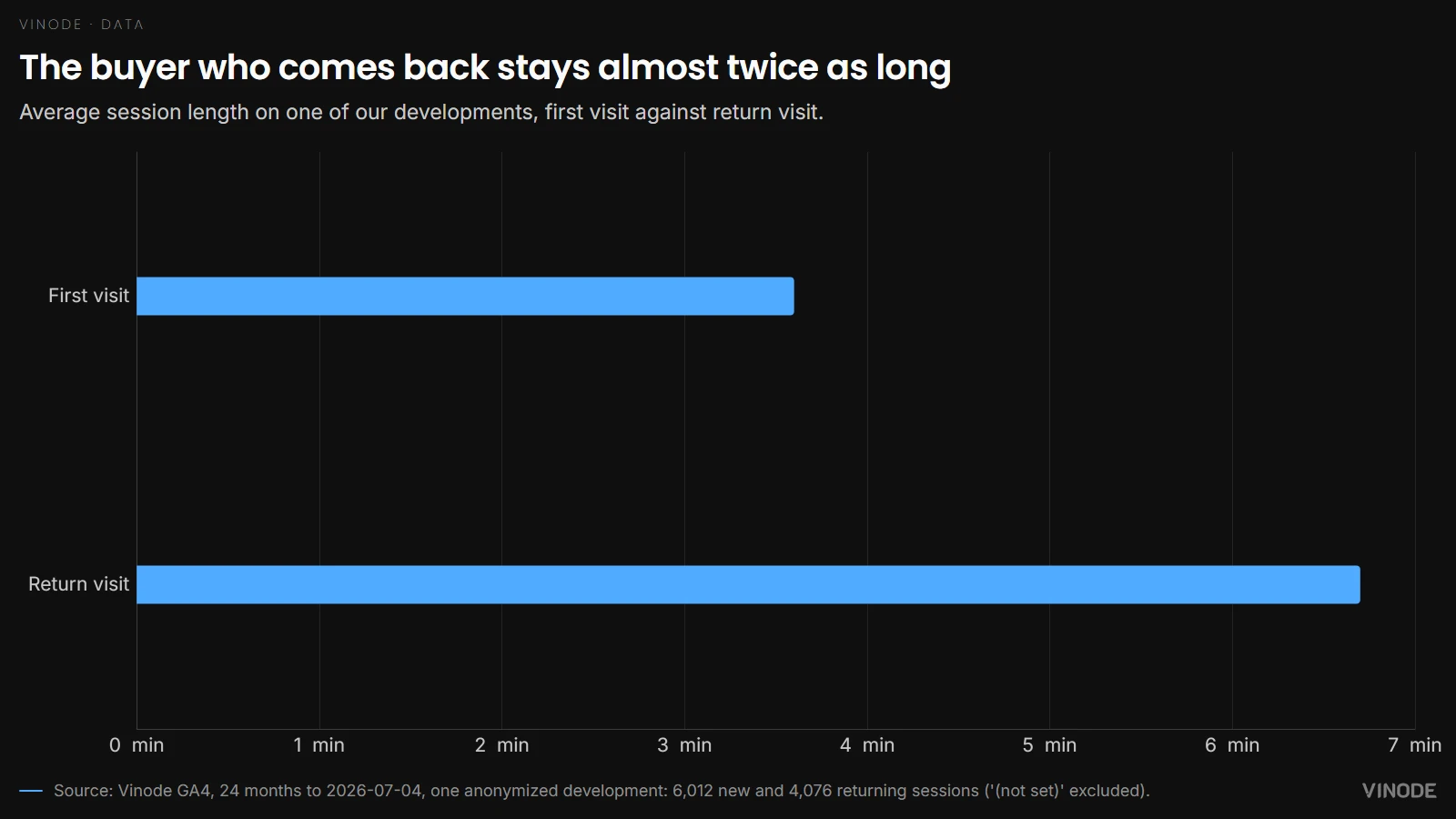
Free navigation earns its place, further down the funnel. Give it to the returning, high-intent buyer who has narrowed to one unit and wants to inspect it on their own terms. That buyer is visible in our own numbers. On one of our developments a return visit runs about 6.7 minutes against 3.6 for a first visit, and returning visits are 29% of identified sessions across our developments. By the second pass the buyer already carries the layout in their head, which is the one thing the first-timer does not have.
And give it to the sales office, where a salesperson drives. Our kiosk mode ships exactly this: real free navigation, no internet needed, run by a person standing next to the buyer who knows where everything is. That is the clean answer to who free-roam is for. Someone with a map already in their head, or someone with a guide beside them.
This might sound like it argues against our own earlier post, which says letting buyers explore on their own builds more confidence than being guided. It doesn't. That post is about self-paced control, deciding what to look at and when, and we give buyers that in full. It is not about a free camera in a sparse world. Those are two separate freedoms, and only one of them gets people lost.
The question to carry into your next tour
Stop treating a free camera as the goal, the thing that makes a tour feel high-end. It is a tool with one right user. Before you sign off on how your next tour moves, ask one thing: who is authoring the route through this tour, and is that the right person for the viewer who will open it? For the buyer you have never met, opening a link from another country, the answer is almost never to let them fly.
See a guided path on your own phone
Open a live Vinode project and watch how the path carries you from unit to room.

The Unit-Specific PDF a Buyer Actually Asked For
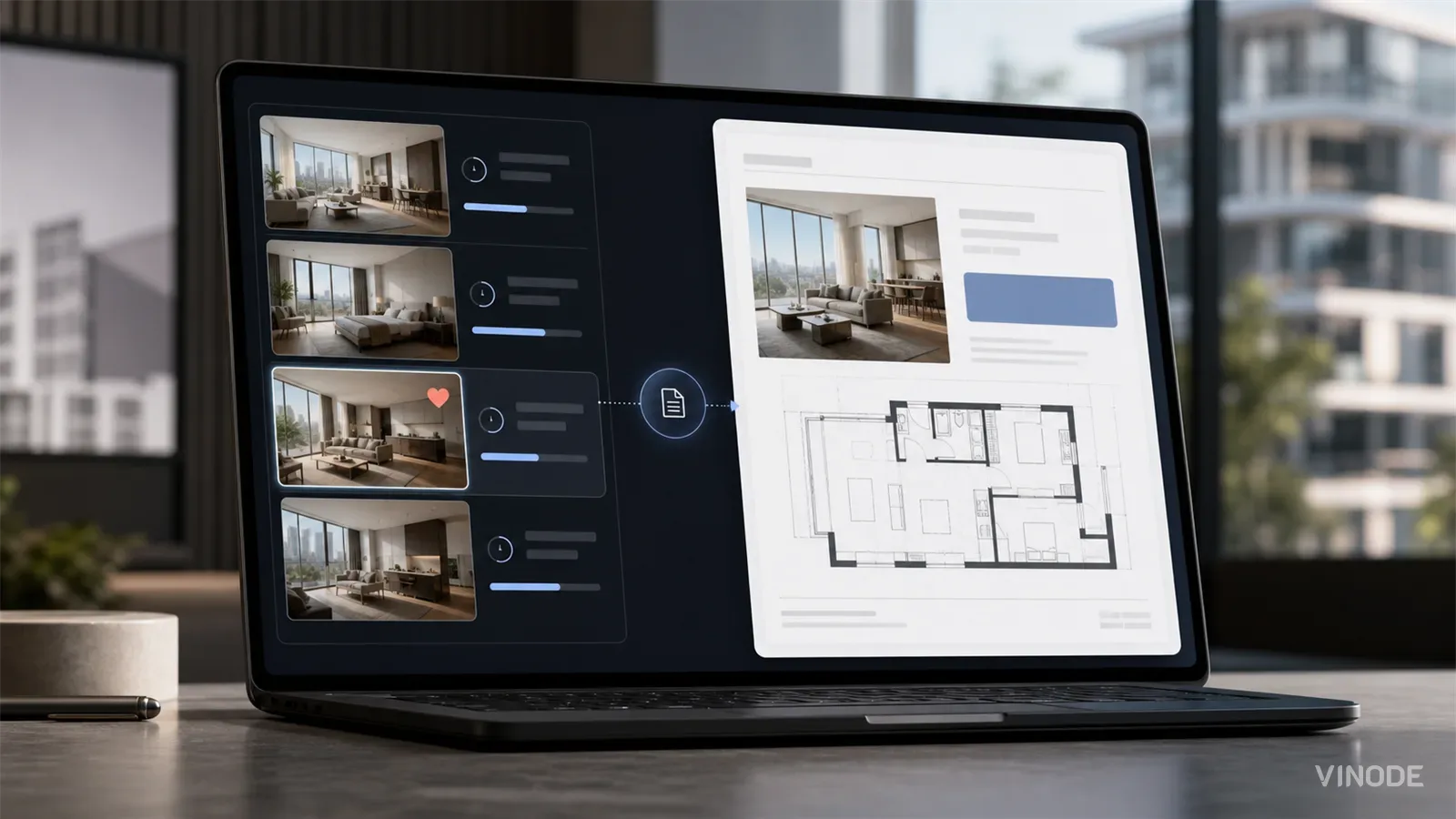
A buyer spends nineteen minutes on one two-bed, saves it, and gets the forty-one-page development brochure the next morning. Once a sales platform records the unit a buyer chose, the generic brochure becomes a decision to ignore that choice.
Expression of interest before release day: capture unit demand
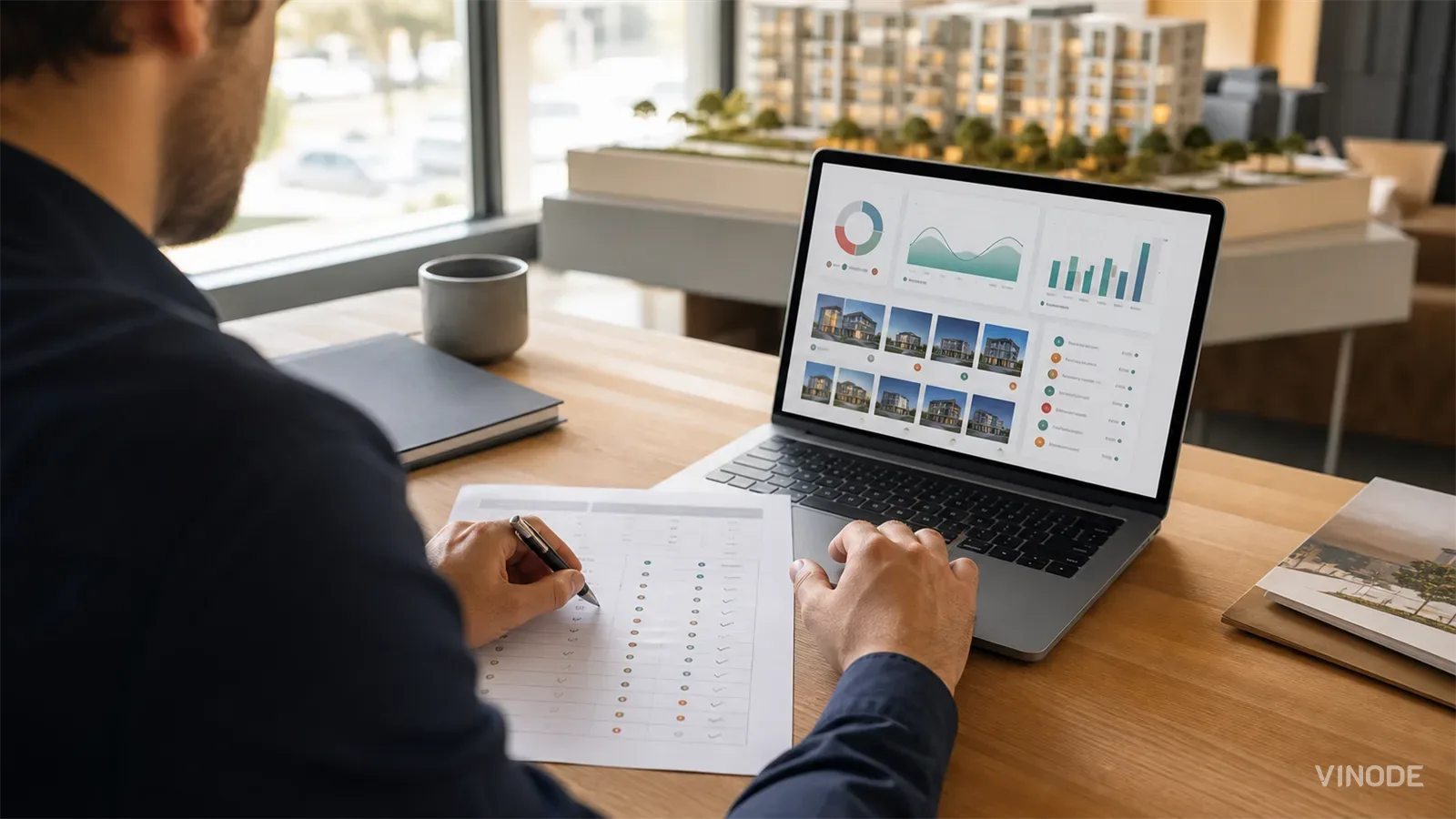
640 names and no idea which side of the building they want. An expression of interest campaign pays off when the form is joined to the units each buyer explored, and each of these checks has a pass, a fail and a cost.

We measured when a pipeline crosses the presale line, not just whether it will
When GTHA opening-quarter absorption averaged 66%, the sold percentage was enough to forecast a presale crossing date. Then absorption fell to 17%. Three pipeline inputs produce the crossing date your lender asks for: stage-conversion rates, a cancellation haircut, and remaining inventory.