
Pre-construction visualization: price the weeks, not the images

Key Takeaways
- Compare visualization with monthly carry and credible launch time gained, not with a studio's price per image.
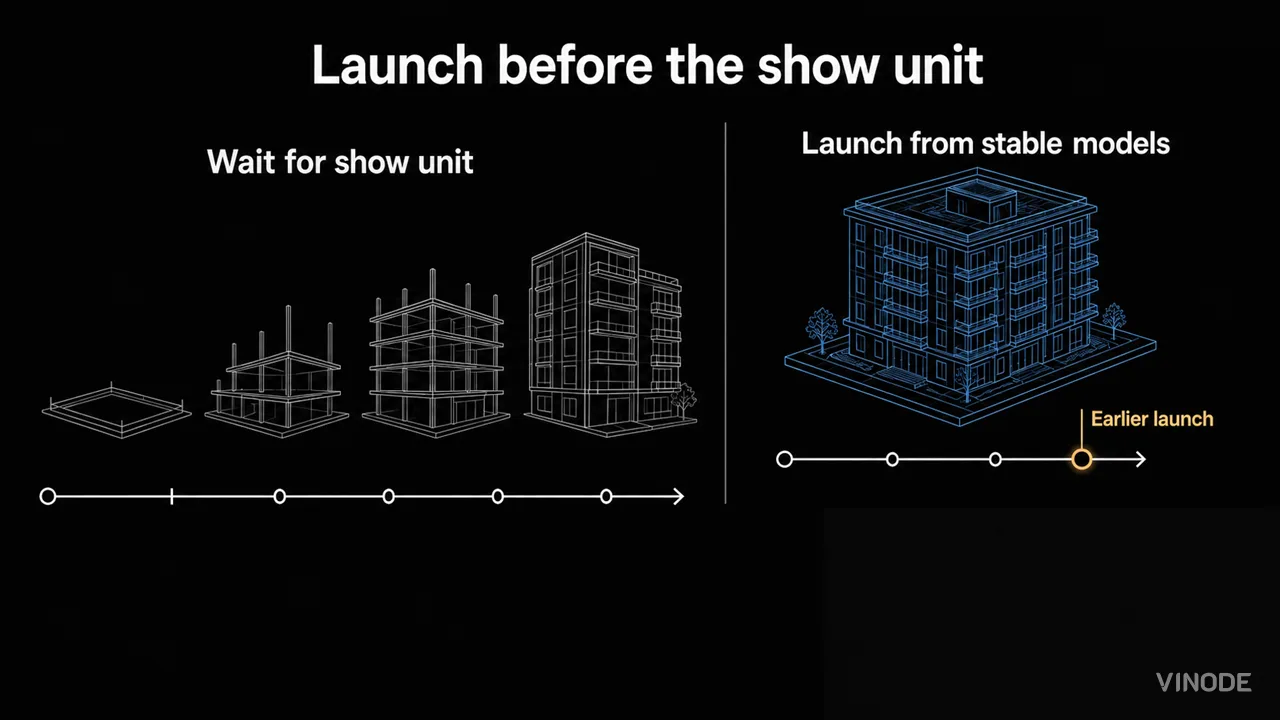
- Interactive visualization can start selling from stable project models before a physical show unit exists.
- Remote buyers make reach more valuable, but no controlled study proves visualization alone shortens the presale clock.
- Count only the costs and weeks that disappear when the threshold is met, then compare that value with the project quote.
Where is your development relative to its presale threshold today? If it is below the line, every week has a carrying cost and visualization belongs in the financing conversation. If it is above the line, the urgent version of this argument does not apply. Treat the work as a marketing investment instead. That first fork matters more than image count, animation length, or the difference between two studio quotes. Below threshold, the useful unit is time.
The calculation to take into the meeting
- Write down the monthly carry on the capital exposed before the construction draw.
- Estimate the launch time each scope can credibly recover.
- Compare that value with the full project quote, using the same dates and scope.
Below the presale threshold, price the weekly carry
A visualization brief usually arrives as procurement: a count of exterior images, interior views, floor plans, and animation seconds. That is tidy for buying production. It is poor for deciding whether to buy it. A cheaper image does not help if the cheaper scope leaves the sales launch waiting for a model unit. A costly image can be sensible if it is part of a system that lets the launch start while the building is still a set of approved plans and stable models.
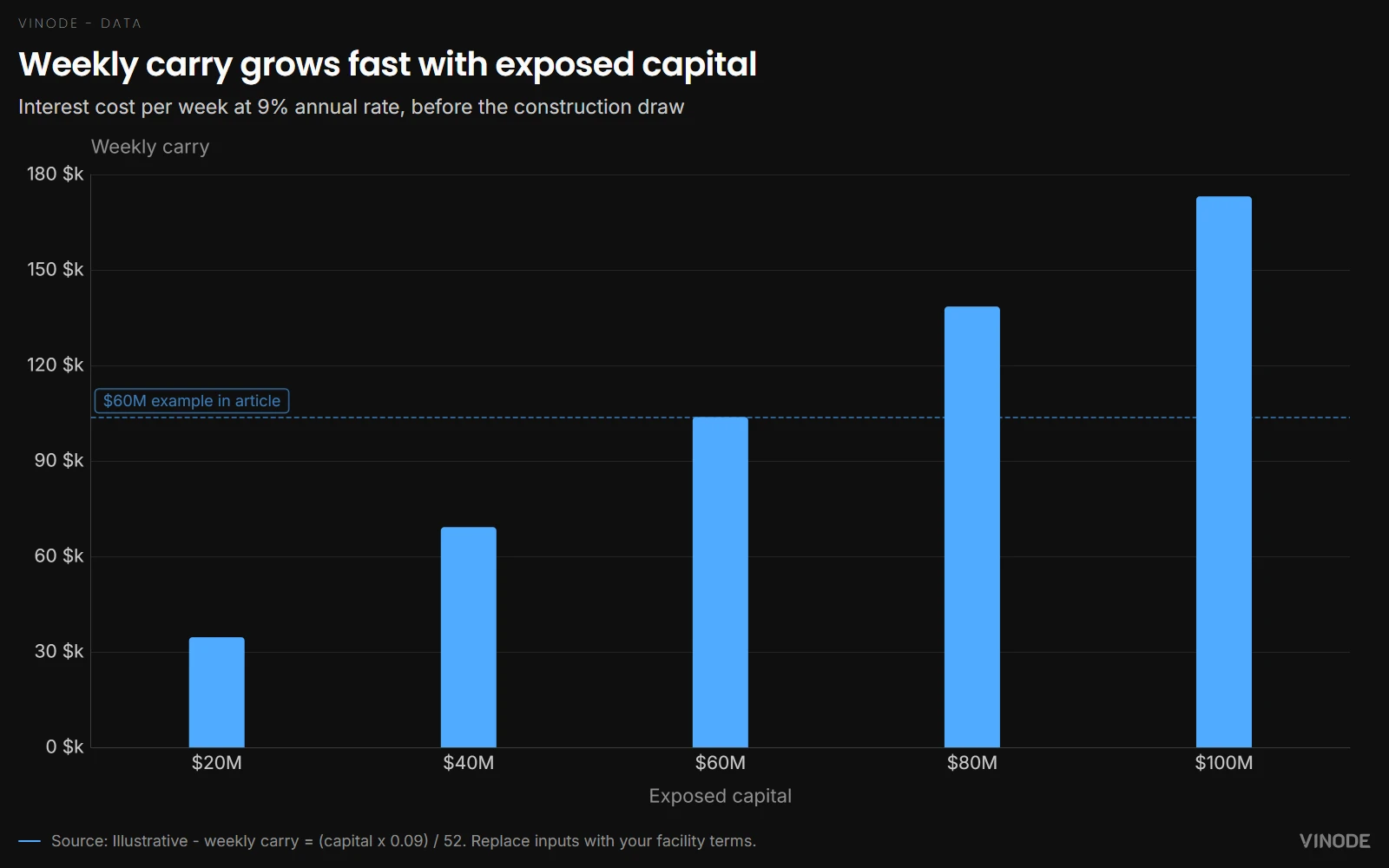
The governing calculation is simple. Take the capital that is carrying before your facility can draw. Multiply it by the effective annual rate, then divide by 12. That gives a monthly interest figure. Divide again by 4.33 for a working weekly figure. Then ask what date the proposed scope changes. If it changes no date, its value must come from marketing performance, not avoided carry.
The threshold itself differs by facility and market. One public example shows why it cannot be treated as a soft campaign target. Fannie Mae requires at least 50% of units in a new or newly converted US condo project, or its legal phase, to be conveyed or under contract to principal-residence or second-home buyers for a full project review (Fannie Mae Selling Guide, updated August 5, 2026). Your construction-loan covenant is separate and specific to your deal. Read that document, not a market average.
This is a US mortgage-eligibility rule, not a universal construction-loan threshold.
Source: Fannie Mae Selling Guide - as of
Suppose the figures in your board pack are $60 million carrying at 9% a year. The arithmetic gives $5.4 million a year, $450,000 a month, or about $104,000 a week. These illustrative inputs also appear in our guide to the presale threshold. Replace them with your numbers.
Now put the visualization quote beside that weekly figure. Compare dates. If the base scope is ready on October 1 and the richer scope is ready on September 10, the claimed gain is three weeks. If planning approval or legal copy blocks both launches until November, the gain is zero. Many persuasive proposals fail here. They price production speed while ignoring the other dates on the critical path.
That example assumes one exposed balance and one rate. A facility with a drawn balance and a fee on an undrawn commitment needs two lines. Let D be the drawn capital, r its annual rate, U the undrawn commitment, and f its annual fee. The weekly carry is (D x r + U x f) / 52. Include only charges that end or step down when the presale condition is met. If meeting the threshold unlocks a later draw while bridge debt keeps running through another approval, those weeks do not all belong to visualization.
Interest-rate hedges can complicate the effective rate, and I could lose a page to that side issue. But I digress - use the rate finance expects to bear during the exact weeks at issue, and show the assumption. The conversion matters because it replaces taste with a date finance can price. Image quality remains a procurement question, but only after finance knows whether earlier delivery has value.
Above the presale threshold, drop the carry argument
A project that has cleared its binding threshold lands on the short branch. Visualization may broaden the audience, keep unit information current, or reduce campaign work. Those are marketing and operating outcomes. Avoided threshold carry is no longer one of them.
This branch also includes all-equity projects with no presale gate controlling a draw. The condition connecting reservations to funding is absent. Forcing this frame would be theatre. Measure lead quality, reservation conversion, sales-team use, and the cost of keeping listings accurate. We think a disciplined no is better than a clever calculation attached to the wrong project.
Before the show unit exists, the date is the lever
Stay on the below-threshold branch. The next fork is whether a show unit is ready for buyers.
If it is not, interactive visualization can be built from stable architectural and 3D inputs before a finished apartment exists. We plan productized work and bespoke modeling on different production paths, but neither path is a launch promise. The proposal needs a dated dependency plan. Your team still has to supply approved plans, unit data, prices, legal copy, and brand decisions.
Map both routes on one calendar. Route A waits for a presentable apartment. Route B starts once the project facts needed for honest selling are stable. The gap is the maximum presale window digital work can open. It only has value when sales, legal, finance, and the lender are ready to use it.
Follow the date that still blocks launch
The show unit is the last blocker
Digital work can change the launch date. Price the credible gap against weekly carry.
Another approval is later
Digital work does not change the launch date yet. Fix the legal, pricing, planning, or data blocker first.
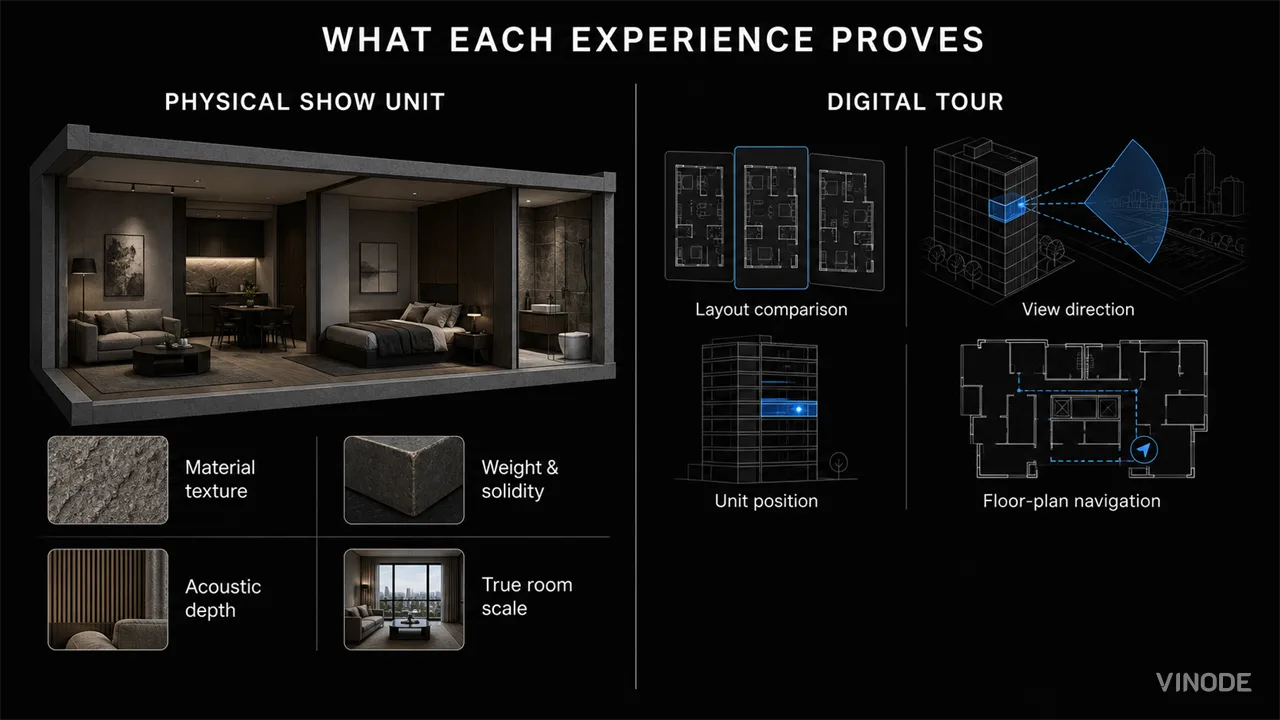
If the show unit already exists, timing is no longer the main constraint. Keep following the tree, but change the question from start date to reach. The built room proves things a screen cannot: material weight, acoustic feel, true bodily scale, and the quality of the finish. Digital proves different things: layout, view, orientation, position in the development, and how one unit compares with another.
That distinction prevents an expensive overclaim. Interactive visualization should not remove the show unit from a project plan merely because it can launch earlier. It gives the sales team an earlier and broader way to explain the product. Some buyers will still wait to touch the finishes. Some markets will expect a physical room at the point of commitment. If those buyers dominate your pool, the digital scope must earn its place through reach and sales use, not through a claim that it replaces the room.
No controlled study in our research ties interactive visualization to a fixed number of weeks off a presale threshold. Treat weeks gained as a project forecast with named dependencies. Do not present it as an industry benchmark.
Remote demand makes reach the next fork
The third fork is whether a useful part of the buyer pool is remote, overseas, mobility-limited, or unwilling to visit early.
If so, a show unit has a reach limit even after it opens. A buyer in another country cannot stand in it. Static images can attract that buyer and may support some commitments. A buyer comparing unit 14 with unit 37 needs more: the route through each layout, the floor, the view direction, current availability, and a document tied to the selected unit. An interactive experience can put those facts in one path.
We disagree with the common claim that remote buyers cannot commit from static images alone. Some do. Our research found studio-published percentages for remote commitments and faster sales, but no named primary study that isolates new-build presales or the threshold clock. The honest case rests on mechanism. Digital access expands what an absent buyer can inspect. Measure whether that changes reservations in your funnel. The deeper trust work sits in our guide to selling off-plan to remote and overseas buyers.

If the buyer pool is local and willing to visit, the reach case weakens. That does not kill the timing case. A local buyer still cannot visit a room that has not been built. But once the room opens, static renders, floor plans, and an effective sales advisor may be enough. A small scheme with one repeated layout can land here. So can a project with strong local demand that is already moving toward its threshold at the required pace.
Vendor material often hides this branch. A full interactive scope is not automatically right for every development. If local traffic is sufficient, the inventory is simple, and the digital work changes no date, buy less. The quote may be attractive and the result may be beautiful. Neither creates a financing case.
The lender sees reservations, not render quality
A lender does not release capital because an exterior image is photoreal. The relevant evidence is market absorption under the deal's conditions. Visualization matters through a chain: it supports an earlier or wider sales effort, that effort produces qualified buyers, and reservations move the threshold count. Break a link and the financing claim breaks.
Ask lending counsel what event enters the threshold count. A web lead, a reservation, and a signed contract are not interchangeable. If the lender does not accept a digital reservation as evidence, its financing value begins only when sales converts it into an accepted commitment. Price that conversion path, not the form submission.
Our measured project data gives context, with a strict limit. Developments using Vinode with 20 or more units have reached full reservation in 12.7 months on average. One dated project record independently lands near the same figure, but the full portfolio count and observation window are not yet attached to the ledger. There is no same-project comparison without Vinode. This describes pace. It does not prove that visualization caused it.
We consider approval without a checked sales path a governance error. Unit status, price, viewed unit, lead form, and follow-up need to connect. A buyer who explores unit 37 should not reach sales with no unit context. A reserved unit should not remain available online. Vinode's Back Panel manages unit data and leads for this purpose.
Measured across our projects through July 2026. There is no same-project control, and the full portfolio sample size is still pending.
Source: Vinode measurement - as of
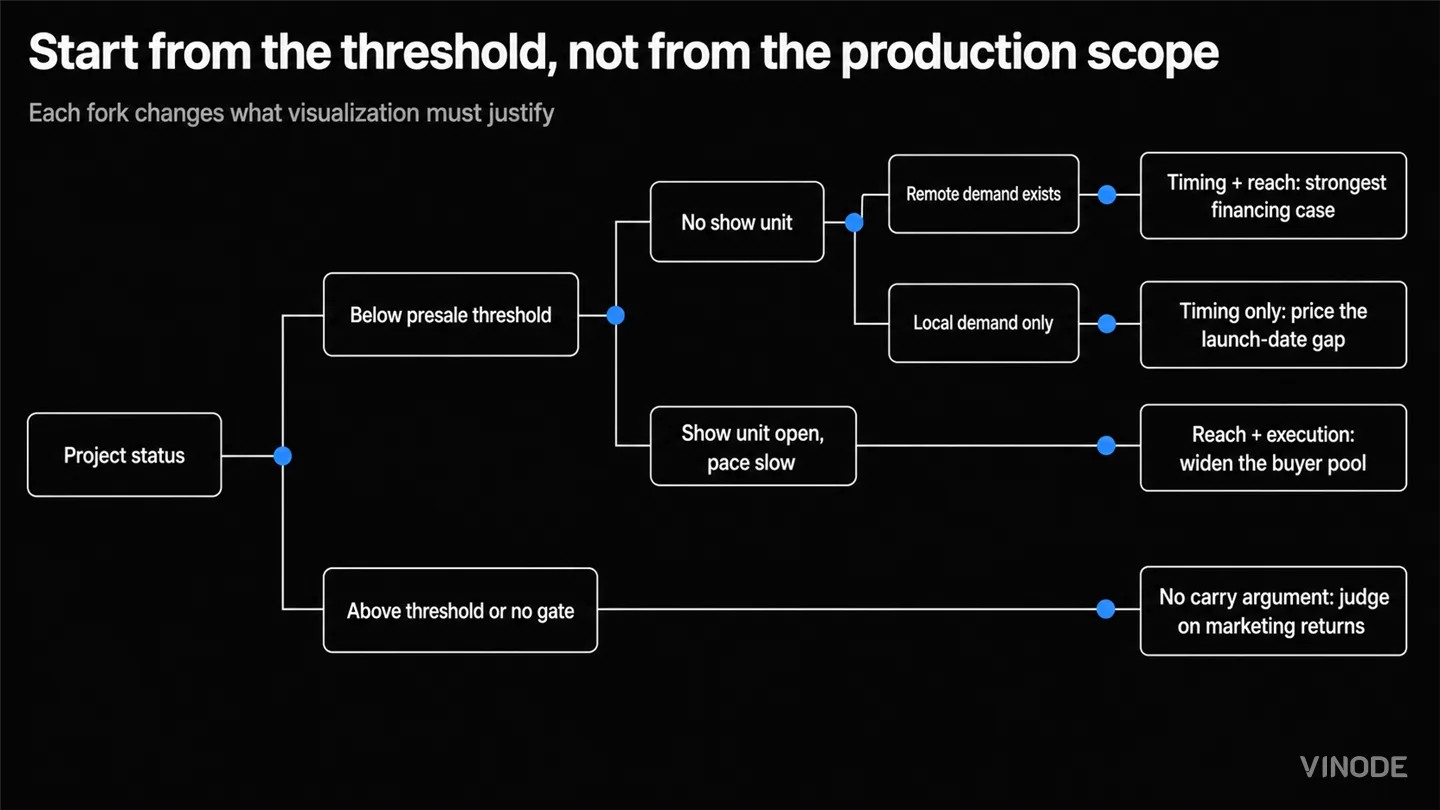
Decision tree: the four terminal states
Below threshold, no show unit, remote demand
Timing and reach both matter. This is the strongest branch for comparing the project quote with avoided carry.
Below threshold, no show unit, local demand
Timing matters. Reach may not. Use the launch-date gap and ignore unsupported remote-buyer claims.
Below threshold, show unit open, pace still slow
Reach and sales execution matter. Digital work must widen the usable buyer pool or improve the path to a qualified lead.
Above threshold or no financing gate
The carry frame does not apply. Judge the work on marketing and operating returns.
A worked example: below threshold, no show unit
Take the first terminal state. The scheme is below threshold. There is no show unit. Some buyers cannot visit. The board pack uses the illustrative $60 million and 9% inputs from earlier, so each week carries about $104,000 in interest.
The team asks each vendor for a dated dependency plan. One scope can go live three weeks before the physical route, but only if approved unit data arrives by a fixed date. Finance can test a maximum time value of about $312,000, then subtract delays shared by both routes, extra work, and the risk that the earlier launch does not move reservations. The remainder is the value to compare with the quote.
Do not assume the vendor carries that forecast risk. The contract should name the launch deliverable, client dependencies, review windows, change control, and what happens when either side misses a date. If it does not, the weeks gained remain the buyer's planning assumption, not a guarantee.
Actually, that risk makes the framing less clean than the headline. No spreadsheet can turn it into certainty before launch. Use scenarios. The zero-gain case changes no threshold date. The base case recovers defensible weeks. The upside case adds reservations through broader reach. Approve the work only if the base case makes sense. Do not approve a case that works only in the upside scenario.
If a visualization proposal cannot name the launch date it changes, it has not made a financing case.
Many pre-construction teams will recognize the strongest branch: below threshold, no finished show unit, and buyers who cannot visit. That is a working case, not a measured share of the market. It is where per-image procurement does the most damage.
The cost is the time spent comparing unlike scopes while the critical launch date stays unnamed. On the illustrative capital stack above, one lost week is about $104,000. Your figure may differ. Put it beside the quote.
Put monthly carry, credible weeks gained, and the full quote on one page. Name every dependency that can erase the gain. If the base case survives, visualization belongs in the financing plan. If it changes no date and reaches no buyer the current route misses, decline it or buy a smaller scope. The bad outcome is to keep negotiating images while nobody prices the calendar.
Put your project dates beside the scope
Tell us what is ready, what still blocks launch, and which units must sell. We will shape a custom quote around the real project.


AI Property Imagery in 2026: A Trust and Governance Playbook for Developers
A label tells buyers that AI touched an image. It cannot tell your team which design revision supports the image, who approved its claims, where it is live, or how to withdraw it.
The New-Build Sales Platform Checklist
Two agents reserve the same unit from two laptops, both reservations go through, and the listing stays available for eleven minutes. Test one live unit through inventory, availability, attribution and discount approval before you choose a platform.

AI Search Is Shrinking the Click: What Property Developers Should Measure Instead
AI answers can remove the visit before it happens. Keep tracking search traffic, but judge it by what follows: qualified arrivals, unit exploration, contextual enquiries and reservations.