
Why 3D looks 'game-like': photoreal is art direction, not resolution
Key Takeaways
- A game-like frame is the sum of directing choices about light, lens, and surface, so buying more pixels sharpens the flaws instead of removing them.
- A frame with a dominant light source and a believable, eye-level lens reads as real even at lower resolution.
- Unreal renders both games and film-quality architecture; the game look comes from rendering live under a frame budget, not from the engine.
- Fix the look at brief time by asking for a lighting hierarchy, an eye-level lens, material wear, and human context.
A marketing lead opens the first proof of a development the week before sign-off. The massing is right, the units are right, and the frame still looks like a video game. The reflex is immediate and almost always the same: the render must be too soft, the studio needs a bigger GPU, push it to 4K and it will finally look real. Then they open the file properties. It was already 4K. Resolution did everything resolution can do, and the frame still came across as fake. So what was the eye actually catching?
The answer is a short stack of decisions the viewer reads without being able to name them: how the scene is lit, how the camera moves, how the surfaces wear, and whether a single human being appears to live there. Every one of those is a choice a studio makes, which means every one is something the buyer can ask for before the work starts. Get them right on a lower-resolution frame and it holds up. Get them wrong at 4K, and the higher resolution just renders the problem in sharper detail.
Resolution is the wrong first lever
Start with a fair concession, because the rest of this only works if it holds up. Resolution is not nothing. A genuinely undersized render with tiled, low-detail textures does look cheap, and no amount of art direction rescues a frame the eye can already see is soft. Pixels are necessary.
They are just the wrong place to spend first. Push a flat-lit frame with a floating camera to 4K and you get a crisp picture of something fake. On the list of tells the eye actually reads, resolution sits near the bottom. The top of that list is where a marketing budget buys the most believability: the lighting, the camera, and the materials.
Lighting, materials, camera, people: the four decisions you read
Take resolution off the table and four decisions remain. Here is what the eye is reading in each.
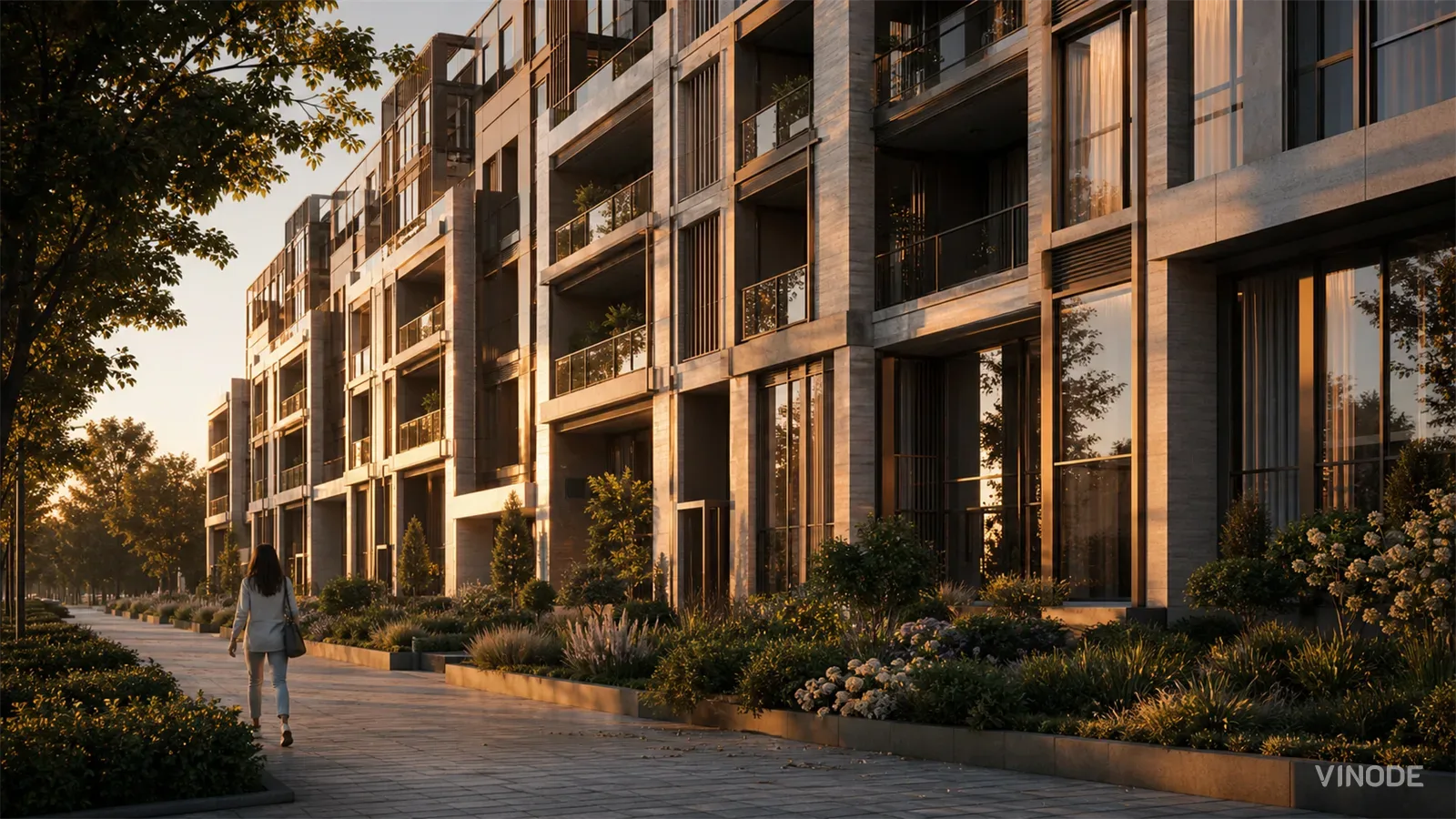
Lighting hierarchy. Real light has a dominant source, a direction, falloff, and shadow that means something. Much real-time and game lighting is tuned to be evenly bright so a player can read the whole space at a glance, and a frame lit that way carries the flat, level-like quality the eye picks up at once. A dominant key light, gradual falloff, and believable shadow behaviour do more for the sense of a real place than any jump in pixel count.
Material truth. Real surfaces carry wear, grime, edge variation, and age. When every material in a scene is flawless and uniform, the eye quietly files it as synthetic. The plastic look is a material decision, and the cure is roughness, subtle reflection, and a little imperfection.
Camera and lens logic. This is the loudest tell and the least discussed. Game cameras use wide, distorted fields of view, sit at heights no person stands at, and float through walls in fly-through moves no operator could shoot. A believable frame is shot the way a cinematographer works: eye level, a chosen focal length, restrained depth of field, a move a real dolly could make. More pixels do nothing for a camera that behaves like this.
Human context. An empty, immaculate space feels like a level waiting for a player to spawn into it. Add a person on the promenade, a car at the curb, a curtain caught mid-movement, and the same geometry starts to feel inhabited. That sense of simulated life is a craft in its own right.
There is physics under the first two. Physically based rendering computes how a surface answers light by real rules, energy conservation and a material's reflectance function, which is what keeps light and materials consistent across the scene (see Google's Filament rendering documentation). A real-time engine running on the viewer's phone has roughly sixteen milliseconds to compute an entire frame at 60fps, so it approximates that lighting with screen-space tricks and low sample counts. That approximation stays visible at any resolution, and more pixels only sharpen it.
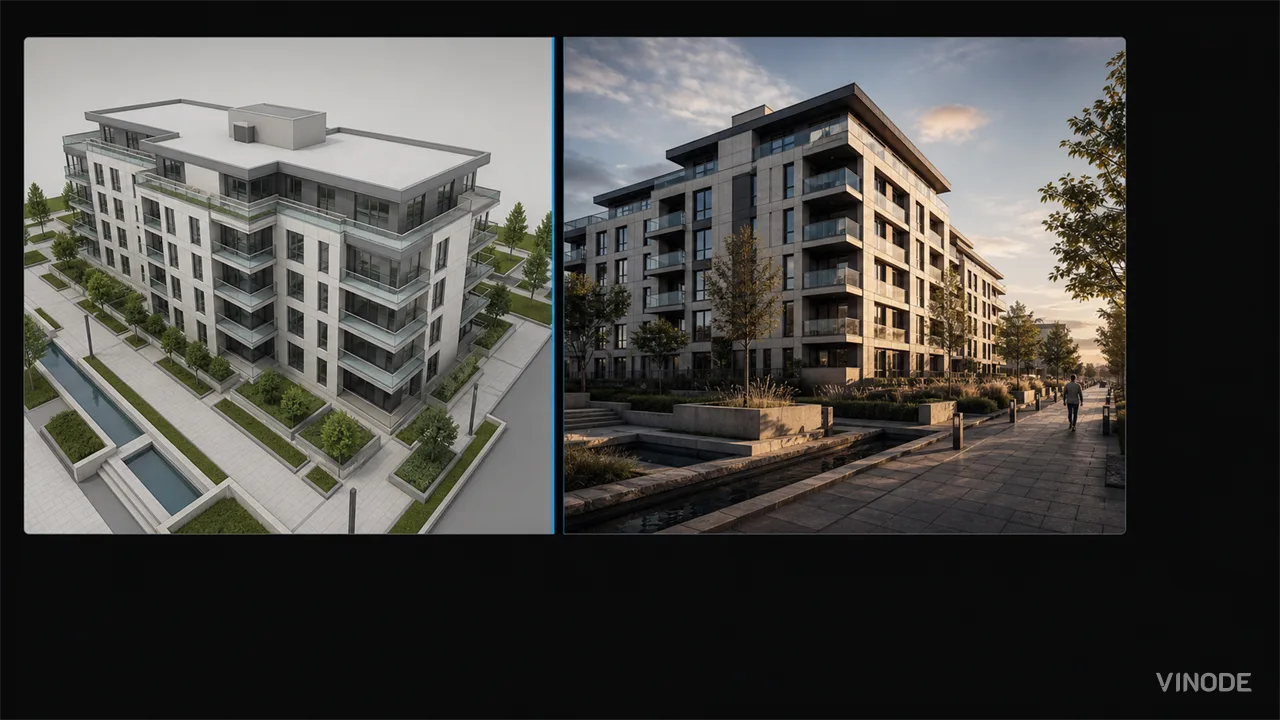
Unreal renders games and film-quality architecture, on different code paths
This is where the diagnosis turns useful, and slightly counterintuitive. Unreal Engine, the tool most people file under games, renders a large share of the photoreal architecture people have admired without ever knowing what produced it. The game look does not come from the engine's name. It comes from rendering live on the player's device inside that frame budget, and from the art choices the budget forces.
Unreal draws the line itself. Its offline Path Tracer is documented as a mode that trades the real-time compromises for physically correct lighting, and Epic is explicit that it runs on a different code path from the real-time renderer (see Epic's Path Tracer documentation).
It does not share the same ray-tracing code that has been developed to work well for real-time rendering.
Vinode renders the development this way, offline and once, ahead of any visitor loading the page. That is what lets the studio afford the deeper lighting and material work a live engine has to skip. On the Safa Fidar development in Riyadh the problem was specific, in the studio's own words: "A massive, long facade can read as a static, monotonous wall in digital renders." The fix was a matter of direction. Using Unreal Engine, the team added swaying trees along the promenades, dynamic daylight casting moving shadows across the architectural fins, and subtle ambient movement, so the building reads as a living community rather than a static wall.
What to demand in the render brief before you sign off
Most guidance on photoreal renders is written for the artist at the workstation. This is written for the person signing the brief, who never touches a render setting and does not need to. You do not have to specify a global-illumination method or a focal length. You do have to recognise that the four tells above are all decisions, and to ask for them in language a studio can act on.
Two habits matter more than any single instruction. Ask to see the work in progress before the polished final frame, starting with the lighting, because that is where believability is won or lost. And judge the work on a walkthrough, because consistency across every angle and every finish is where a cheap render falls apart. On the Safa Al Fursan development, holding that consistency was the whole job, and it is fundamentally a direction problem; the same discipline that keeps renders believable across every view applies to your brief.
Safa Al Fursan, Riyadh: at that scale, holding one look is a direction problem, not a resolution one.
What to put in the brief
Direct the light
Ask for the lighting pass before the polished frame, and judge it on the light hierarchy above, not on overall brightness.
Demand material wear
Name the surfaces that sell the place and ask for roughness, grime, and edge variation. Flawless reads as plastic.
Fix the camera to a human
Eye level, one chosen focal length, and restrained depth of field. No fly-throughs, no impossible heights.
Populate the frame
People, cars, and ambient motion in the hero views. An empty frame reads as a stage set no one lives in.
Where art direction stops: concept stages, offline pipelines, bad buildings
Three limits, because a checklist that claims to solve everything is its own kind of tell.
Photoreal is not always the goal. Early massing and concept stages are served better by stylised, diagrammatic images that communicate intent without pretending to be a photograph. Demanding full photoreal there wastes budget and time. This post is about the deliverable that is meant to look real; the sketch that is meant to look like a sketch plays by different rules.
Rendering offline makes the good look affordable. It does not make it automatic. Take the frame budget away and you can afford fuller lighting and materials, but a render with no lighting hierarchy and an impossible camera looks just as gamey offline as it does live. Direction is the lever; the pipeline only pays for it. The runtime and per-viewer cost side of that choice is a separate question.
And art direction sells a good building. It does not manufacture desire for a bad one, and a believable frame of a feature that will never be built is a worse problem than an ugly render, which this checklist does not solve.
A render that looks real but shows a balcony, a view, or a finish that will not be delivered is an advertising liability. Keep the render true to what buyers will actually get, and gate every proof through a render review and sign-off checklist before it goes public.
Scoring the next proof on the four decisions, not the pixel count
When the next proof lands, resist the reflex to check the resolution. The tells that give a render away are the four decisions this piece has been about. Score those instead, and a single walkthrough tells you more than any pixel dimension can.
See the direction doing the work
Open a live Vinode project on your own phone and judge the four decisions for yourself.


Masterplan 3D for Phased Estates: How to Show Phase One Without Overselling Later Phases
A phased estate contains several levels of certainty at once. The masterplan should make that difference visible, then absorb a later-zone redesign without discrediting the phase-one material buyers already saw.
How to brief a 3D rendering studio before work starts
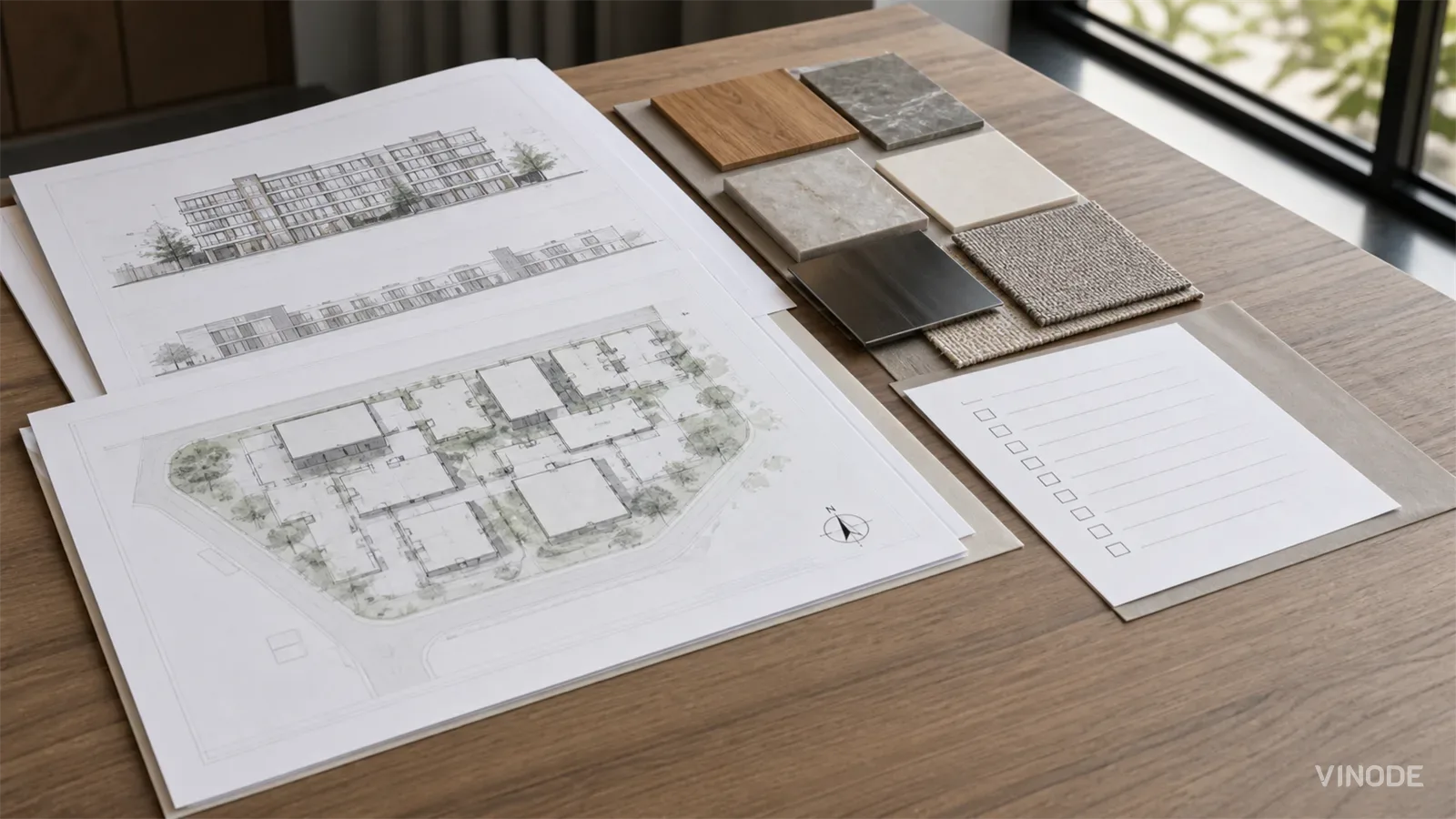
Send geometry, orientation, context, finishes, landscaping, shot intent, approvers and the open unknowns before rendering starts. Then revisions can focus on the image instead of missing facts.

Why rendered glass façades read as fake: the optics of IGU deflection
Archviz glass reads as fake for a reason no roughness slider reaches. Real curtain-wall panes are slightly bowed, each one differently, so adjacent panes reflect the sky at slightly different angles. A render's panes stay flat because the CAD geometry is flat, and that flatness is what the eye catches.