
The launch-day traffic spike: why you're bracing the wrong asset

Key Takeaways
- The pre-rendered 3D is the safest asset under load, since it is built once and served as a cached file that costs almost nothing per extra visitor.
- The reservation write behind the form is what breaks on launch morning, because each submission hits an origin database per request.
- Split the page into a presentation layer and a transactional tail, then aim your capacity and load tests at the write endpoint.
- Reserve any waiting room for the reservation write you cannot pre-bake, not the cached presentation the edge already absorbs.
The release is scheduled for 10:00. Twelve hundred people have registered interest, the agency has been teasing the drop for three weeks, and the whole allocation is expected to move before lunch. The developer's marketing lead keeps looking at one thing on the launch page and quietly dreading it: the interactive 3D tour. It's the biggest, most expensive asset on the site, and the instinct writes itself. When a few thousand phones open that page in the same ten minutes, that tour is what buckles. So the planning turns to renting more server, or putting a virtual waiting room in front of the whole site to hold the crowd back.
The dread is misplaced. On a launch page built the right way, the interactive 3D is the safest thing under load. What actually gives way is the thin, unglamorous transactional tail: the write path sitting behind the register-interest form. Launch spikes are real where demand runs hot. In Dubai, off-plan made up 69% of residential transactions in Q1 2025 (Economy Middle East), and a well-marketed release there genuinely can clear in an afternoon. But surviving that morning has almost nothing to do with the morning itself. It was decided weeks earlier, in how the page is delivered.
Why the 3D tour barely notices the crowd
Here is the part that feels wrong until you sit with it. In Vinode's model the 3D was rendered once, ahead of time, primarily in Unreal. It ships as pre-baked video plus a light interactive layer, served from a global edge network. The buyer's phone isn't running a real-time engine, and no server is rendering a fresh scene for each viewer. That work already happened, exactly once, before launch day. So the three-thousand-and-first visitor to open the tour costs essentially what the first one did. Serving one more copy of a finished file is almost free.
Contrast that with the alternative the fear quietly assumes. A page that renders 3D live on each device, or a real-time cloud stream that spins up a GPU per viewer, does genuine compute for every concurrent person. There, the crowd is the cost. A spike means one of two things: a fleet of GPUs pre-warmed and idling, or latecomers queued behind the ones already busy. Either way, cloud GPUs are billed by the hour (Google Cloud GPU pricing). We pull that cost-and-concurrency thread apart in pixel streaming vs pre-rendered 3D, and the device-reach side of it in why pre-rendered 3D beats real-time. The point for launch day is compact: an asset's visible weight tells you nothing about what it costs to serve.
Vinode's own testing puts pre-rendered playback near 2 seconds, against 6 for in-browser WebGL and 12 for in-browser Unity. There's no scene to compute at load time, so a congested launch-morning network is about the only variable left.
Cached tour and live form fail differently
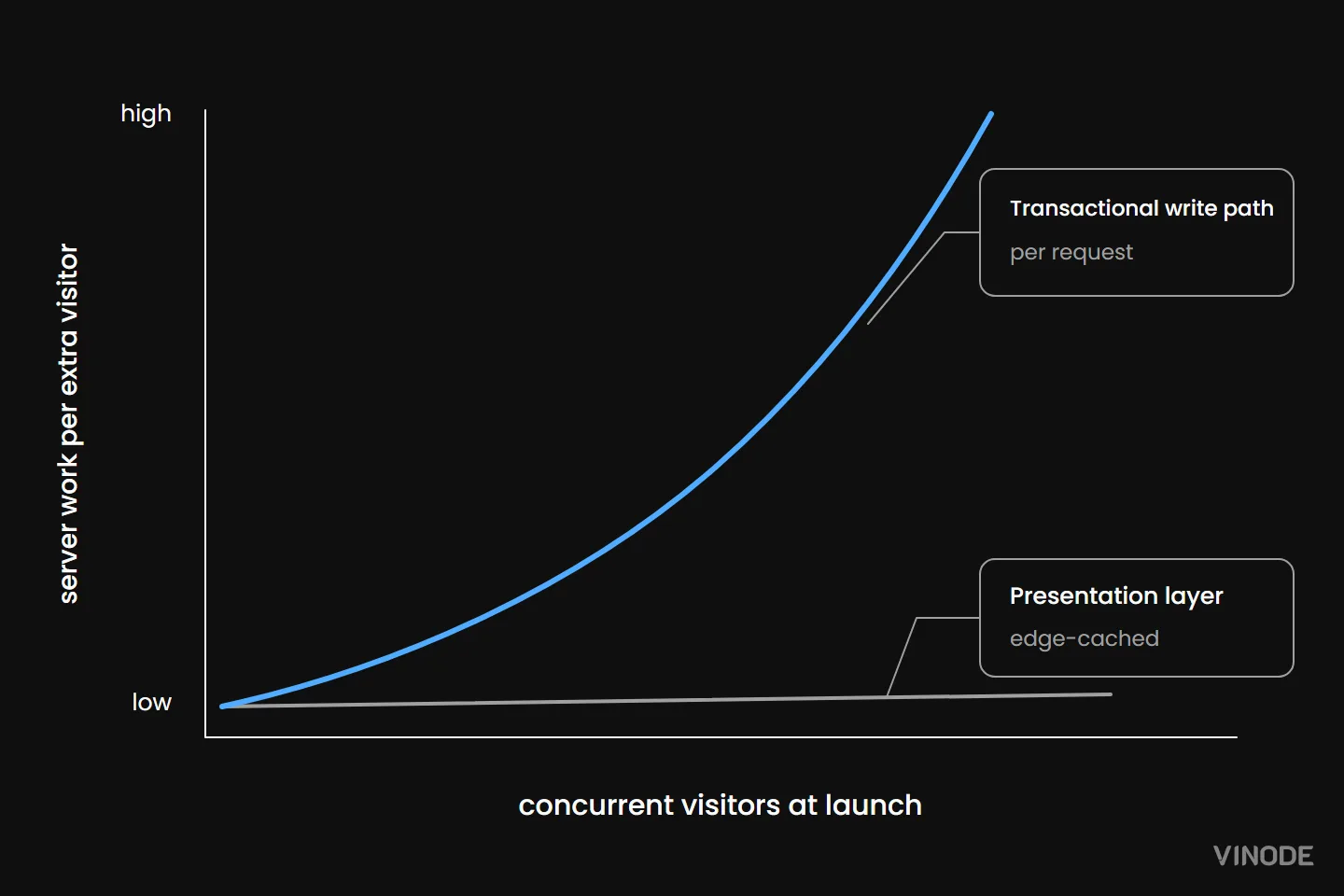
Before you spend a cent on capacity, split the launch page in two: a presentation layer and a thin transactional tail. They fail for completely different reasons, and lumping them together is what sends people shopping for the wrong fix. The split below draws the line; what earns your attention is why each side breaks.
The presentation layer, once it's cached at the edge as static files, is a delivery problem, and delivery scales flat. A content delivery network stores popular content on many distributed servers, which reduces load on the origin and helps it weather heavy traffic (Wikipedia: Content delivery network). Most visitors are served from a nearby edge and never reach the origin at all. The dynamic part behaves the opposite way. A form endpoint, a database write, a live availability query: each of these runs per request against an origin, and a database under a pile of simultaneous requests is the classic place a busy site falls over. That same mechanism explains a quieter complaint, the site that only crawls during marketing campaigns. It's the identical origin bottleneck, recurring on every traffic bump instead of arriving once at launch.
Split the page before you size the servers
Presentation layer (most of the page)
The 3D tour, floor plans, imagery, and HTML. Built once and cached, so every extra visitor hits a static file and the origin never sees them. On this layer, concurrency is already handled before the campaign goes live.
Transactional tail
The reservation write, and the live check of what's still available. Each request runs per visitor against an origin, and each one is real work for the server. This is the part a spike can actually break, and the only part worth sizing carefully.
Settle the presentation layer before launch week
This is the opinion the whole post rests on: launch-day survival for the presentation layer is decided by how the page is built, not by anything you arrange on the morning. If the heavy assets are pre-rendered and served as static files from the edge, concurrency on that layer is already handled by the time the first buyer opens the page. No amount of morning-of headroom buys you what the delivery model either gave you or didn't.
The honest evidence here is the scale of what already ships. Safa Al Fursan, a Safa Investment development in Riyadh, is the heaviest build in our portfolio: 67,000 m², 25 buildings, 528 units, all filterable one-thumb on a phone. A page carrying that much can only feel instant on an ordinary device because the render already happened and the device is just playing it back. That's an architectural property. There is no "we held N simultaneous visitors" number behind it, and inventing one would undercut the real point. The weight lives in production, paid once, and it never reaches the visitor as runtime cost. For the performance side of the same argument, we dug into it in do 3D property tours hurt Core Web Vitals.
What edge caching cannot protect: the reservation write
Edge caching has a limit worth saying plainly, because a post that only sells the upside isn't worth trusting. Edge caching protects the presentation layer but leaves the genuinely dynamic write path exposed. A reservation, a payment, a unit moved from available to reserved: those are live transactions against a source of truth, and no CDN makes them spike-proof. On the worst version of launch morning the 3D tour is serenely fine while a reservation write queues under contention, or the availability panel still shows a unit as free that sold ninety seconds ago.
Keeping availability accurate under that load is a data problem, and the honest claim here is a modest one. In Vinode, one unit record carries price and status, and listings are bound to that live data so every surface reads from the same record instead of a hand-copied number. That is a single-source-of-truth guarantee, which we cover in unit availability as a single source of truth. What it does not cover is write contention or double-booking under a burst of simultaneous reservations. If overselling under load is a real risk for your release, that write path is exactly where you need real capacity, and possibly a queue.
Edge caching stops at the write. So budget the reservation endpoint as its own system, not a line item on the page's capacity: give it a target sized to peak concurrency, and if you deploy a waiting room, meter this endpoint rather than the tour. It's the only place on the page that does live work per visitor, so it's the one place your capacity plan should live.
When a virtual waiting room earns its place
A virtual waiting room is a legitimate tool, and it's worth being fair about it. It redirects arrivals to a static holding page and admits them to the site in batches, at a rate the origin can survive. For a genuinely dynamic bottleneck you can't pre-bake (high-contention inventory, seat allocation, a payment step that must not oversell), it's the right instrument.
The mistake is reaching for it first. A waiting room is an admission that your page can't take the crowd, so you meter the crowd. If the heavy thing you're protecting is presentation that could simply be cached, you've metered a crowd to defend a layer that could have absorbed all of them at once. Scope the queue, if you use one, to the write path where contention is real, and keep it off the cached presentation, which needs no protection.
What to load-test before launch day
None of the architecture above removes the one piece of real preparation. It just narrows it. Estimate peak concurrency from what you can actually predict (expected registrations compressed into the first minutes after the drop) plus honest headroom. Then test against that number. So what should you actually test? Three things, and none of them is a generic go-live checklist:
- Load-test the real launch page. Hit the page buyers will actually reach, with its real assets and its real edge configuration. A stripped-down staging copy tells you nothing about the thing that ships.
- The write endpoint on its own. Hit the form submit and reservation path separately, and hard. That's the part that breaks, so that's the part your load test should be trying to break.
- Know which surfaces are cached and which are dynamic. For every element on the page, you should be able to say whether it's served from the edge or computed per request. The dynamic list is your whole risk surface, and it ought to be short.
Settle the page split weeks before launch day
The launch page's fate is an architecture choice, so settle it while the launch is still weeks out. Split the page into its two load profiles, cache the presentation layer so the tour becomes a static file you can stop worrying about, and aim your remaining capacity, plus any queue you decide you need, at the small write path. Do that and the origin capacity or waiting room some teams buy "to be safe" is mostly insurance against a problem they no longer have. The delivery model already carried the morning.
See how a Vinode page loads under real conditions
Open a live project on your own phone, then let's talk about the launch you're planning.


Masterplan 3D for Phased Estates: How to Show Phase One Without Overselling Later Phases
A phased estate contains several levels of certainty at once. The masterplan should make that difference visible, then absorb a later-zone redesign without discrediting the phase-one material buyers already saw.

Why rendered glass façades read as fake: the optics of IGU deflection
Archviz glass reads as fake for a reason no roughness slider reaches. Real curtain-wall panes are slightly bowed, each one differently, so adjacent panes reflect the sky at slightly different angles. A render's panes stay flat because the CAD geometry is flat, and that flatness is what the eye catches.

Off-Plan Rendering: What Reaches the Buyer
A new marketing manager inherits 140 JPEGs, one MP4 and no model. Everything the 3D model knew about the units stayed on an artist's workstation, and three vendors are about to rebuild it by hand. What reaches the buyer depends on what leaves the studio.