
Where Off-Plan Buyers Actually Start: The Online-First, Agent-Closed Funnel

Image co-authored with help of AI for illustrative purposes
Key Takeaways
- Online discovery and the sales agent do two different jobs, so funding one to replace the other weakens the funnel at both ends.
- Show units, prices, and availability before the lead form, and buyers arrive at the call already narrowed to specific apartments.
- The online step qualifies buyers but never closes the sale, which stays the person's job.
- In the one measured case, conversion rose during self-qualifying and when buyers booked a meeting, while the closing step did not improve, so keep a person on it.
The budget meeting where this goes wrong
A developer has room for one more move this quarter. Option A hires another sales agent to work the phones and walk buyers through the gallery. Option B puts a lead-capture form in front of the floor plans, so anyone who wants to see a unit hands over an email first and the pipeline fills faster. Both options quietly assume the same thing: that the website and the sales team are two versions of the same tool, buying the same outcome, competing for the same money.
They are not. Sit in that room and you will usually hear one of two arguments. The optimiser wants to gate the floor plans, because buyers research online, so the site should capture and convert as early as it can. The traditionalist wants the extra agent, because serious off-plan buyers still sign through a person, so the website is a brochure and the real work happens on the call. Each is half right, and each starves the half it does not believe in.
One statistic that is the shape of the argument
The cleanest way to see the split is a single figure from the National Association of Realtors' 2025 Profile of Home Buyers and Sellers: searching online is the most common first step for buyers, at 46% most recently, while 88% still purchase through an agent or broker (NAR, 2025).
One caveat travels with that number and you should keep it attached: it describes general US residential buyers, not off-plan specifically and not the international markets where a lot of off-plan sells. So do not read it as proof that online replaces the agent. Read it as the geometry of the funnel. The screen is the first touch and the qualifying step; the human is the close.
NAR's 2025 Profile of Home Buyers and Sellers. General US residential, not off-plan-specific.
Source: NAR 2025 Profile of Home Buyers and Sellers - as of
Two jobs the money can buy
Gating and over-staffing backfire for the same underlying reason, and it surfaces as a failure at each end of the funnel. Gate the floor plans and you stop buyers from narrowing themselves before anyone picks up the phone, so the agent inherits colder leads. Lean entirely on agents and you make people phone in for answers a good page would have given them, so most never phone at all. The buyers who self-qualify on an interactive floor plan reach the call already knowing which unit they want.
What each half is actually for
The online experience
Lets a buyer self-qualify before she speaks to anyone: filter units, walk interiors, favourite, compare a shortlist. Its output is a buyer who knows what she wants.
The sales agent
Closes: handles objections, holds the reservation, and is the person a large decision still wants to talk to. Its input is a qualified, warm lead.
A website you have to 'convert harder' by gating it is usually a website that was not explaining enough to convert on its own.
Show the floor plans, or hide them behind a form
Here is the decision most posts on this topic dodge. Either you let a buyer see the units, prices and availability, or you make a form the toll gate to reach them. Showing them upfront wins, for a reason that sounds backwards. A buyer who has already picked out three specific apartments is worth more to your sales team than an anonymous email from someone who saw nothing.
The trade is real, so name it plainly. Gating harvests more early leads by raw count, because curiosity alone fills a form. Showing upfront harvests fewer but better ones, because the buyer spends the effort to self-select first. You are trading lead volume for lead quality on purpose. The appetite for that self-service is not new: NAR's 2021 Generational Trends study found 58% of buyers said they wanted virtual tours (NAR, 2021), yet genuinely interactive walkthroughs stayed rare for years after. When your page answers the question the buyer arrived with, the form can ask for less and still convert.
What qualifying actually moved
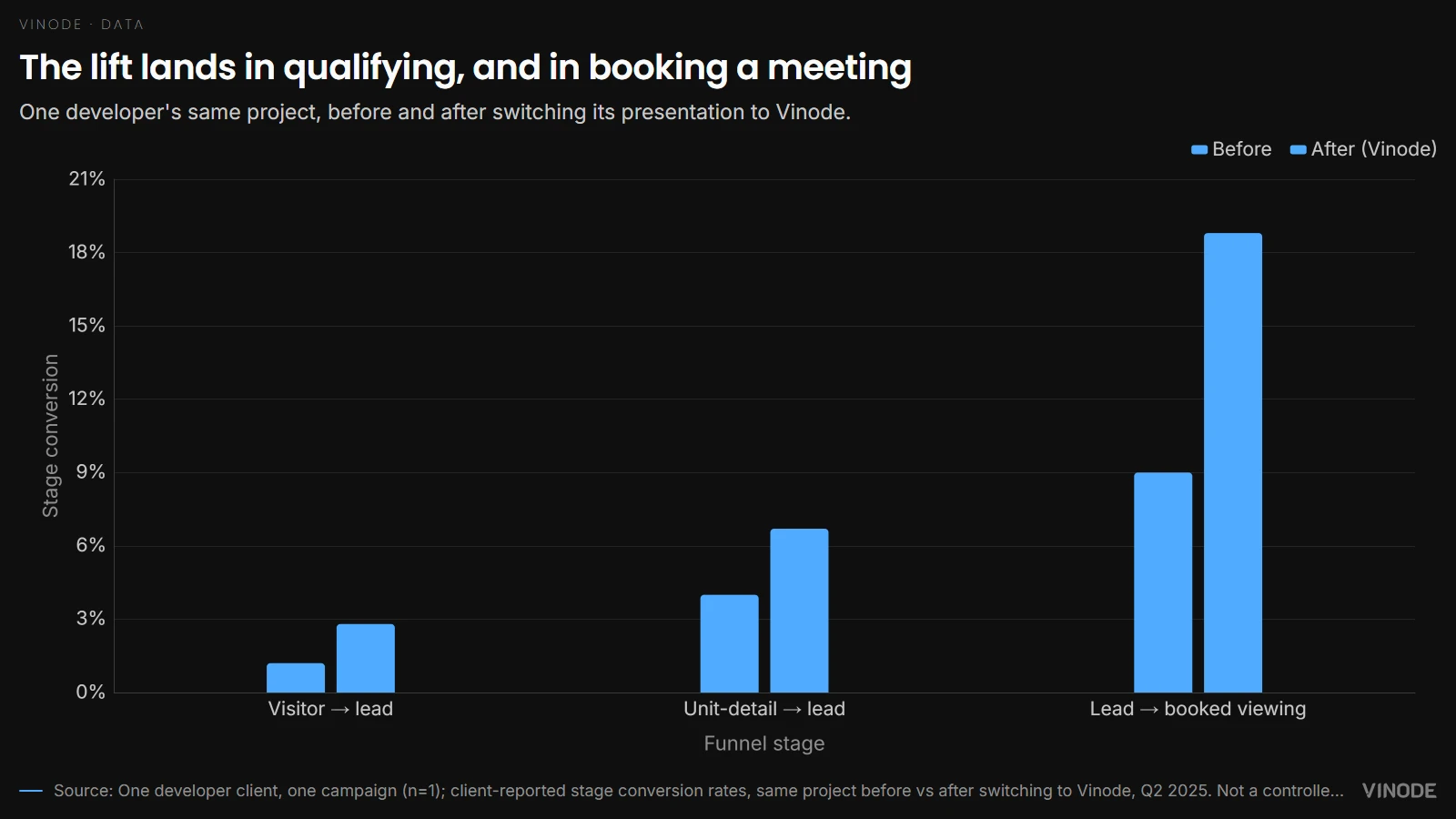
We have one developer's before-and-after that shows where the gains land, and it is not a tidy vendor headline. This is a single development, one campaign, client-reported, comparing the same project at the same price point before and after switching its presentation to Vinode. It is n=1, not a controlled trial, and the absolutes matter more than the percentages.
Visitor-to-lead conversion rose from 1.2% to 2.8%, a 133% lift. Among buyers who reached a unit's detail page, lead conversion rose from 4.0% to 6.7%, up 68%; that stage isolates the presentation effect best, because intent was already equal on both sides. The step from screen to salesperson improved most of all: leads that booked a viewing or consultation went from 9.0% to 18.8%, up 109%. Read the shape of it. The lift concentrates early, in the qualifying, and again when a buyer books time with a rep. End to end, the same project converted a larger share of visitors into sales, from 0.01% to 0.06%, but that figure compounds tiny numbers, and it hides something honest: the final offer-to-close stage actually fell about 11%.
That pattern shows up again in where buyers spend their attention. Portals win reach, and a generic search usually starts on one. But attention there runs thin: per Similarweb, an average visit to Zillow lasts about six minutes across roughly twelve page loads (Similarweb, as of June 2026), spread across everyone's inventory at once. On one of our own developments, visitors opened more than 70 individual apartments inside a single building, none of it behind a form. That is a buyer drilling down toward one specific unit. A portal is usually where a buyer first finds you. The drilling down, one apartment opened after another, happens somewhere you own.
From 1.2% to 2.8% on the same development. One developer client, one campaign, n=1, client-reported before/after. The offer-to-close stage fell about 11%.
Source: Vinode measurement - as of
When there is no sales gallery to walk into
For a lot of off-plan inventory, 'starts online' is not a preference; it is the only first meeting on offer. A buyer in Riyadh weighing Safa Al Fursan, a buyer looking at Más Colonia in Uruguay, a buyer considering Tropical Mirage on the coast of the Dominican Republic: none of them is flying in to tour a show apartment that has not been built. Here the brochure-site model fails outright, because the site is the sales gallery. There is no physical fallback standing behind it.
This is where the delivery detail earns its keep. The experience runs in any browser with no app, loads in about two seconds on an ordinary phone, and works offline as a kiosk, so the buyer who cannot visit still gets the walkthrough an on-site buyer would have had. (The cost mechanics of streaming that 3D to every viewer are their own study; the short version is that pre-rendering is what makes 'open it on any phone, anywhere' affordable.) For the full remote-buyer playbook, selling off-plan to overseas buyers goes deeper.
The hand-off, and the seam we do not cross
The useful part of that seam is what crosses it. When the product hands a warm lead to a rep, the buyer's visit history rides along, so the first call opens on the units she actually weighed instead of a blank 'so what are you looking for' opener (what a buyer did before they enquired shows the trail a rep sees). This post is a sibling to the speed-to-lead argument; the point here is not how fast you follow up, it is what the online step hands over when you do.
Vinode captures unit-level intent and hands a warm lead to a person. It does not take the deposit or close the sale online. If a tool in this category claims it closes the deal for you, that is the claim to distrust.
Stop scoring the website on raw lead volume
All of this points at a measurement change. Judge the online step by how many forms it fills and gating always looks like the winner, because it manufactures form-fills out of plain curiosity. Judge it instead by whether the leads it sends arrive qualified and reach a booked viewing, and the picture inverts. The metric that deserves the weight is qualified-lead-to-viewing, and which landing page produced it. Track conversion to a booked meeting by landing page and first-touch source, and you learn which parts of the site actually qualify buyers.
Which job are you paying each to do?
Back to the budget meeting. The real question underneath it is which job you are paying each of them to do. Fund the online step to qualify: show the units, the prices and the interiors before the form, and let buyers narrow themselves to a shortlist on their own. Keep the person for the close, warm lead in hand. Then measure the site on qualified viewings rather than raw leads.
One honest exception. If you sell a handful of bespoke units and a single agent already walks every buyer through by hand, there is no discovery step at scale to fund, and this argument is theoretical for you. The split funnel matters when there are more interested buyers than an agent can personally shepherd, which describes most launches of any real size. For everyone else, the fastest win is duller than hiring or gating. Let the site do the qualifying, and keep your people for the part a buyer still wants a human for.
See what a buyer explores before they enquire
Walk a live Vinode project the way an off-plan buyer would, then look at what the sales team sees on the other side.

The Unit-Specific PDF a Buyer Actually Asked For
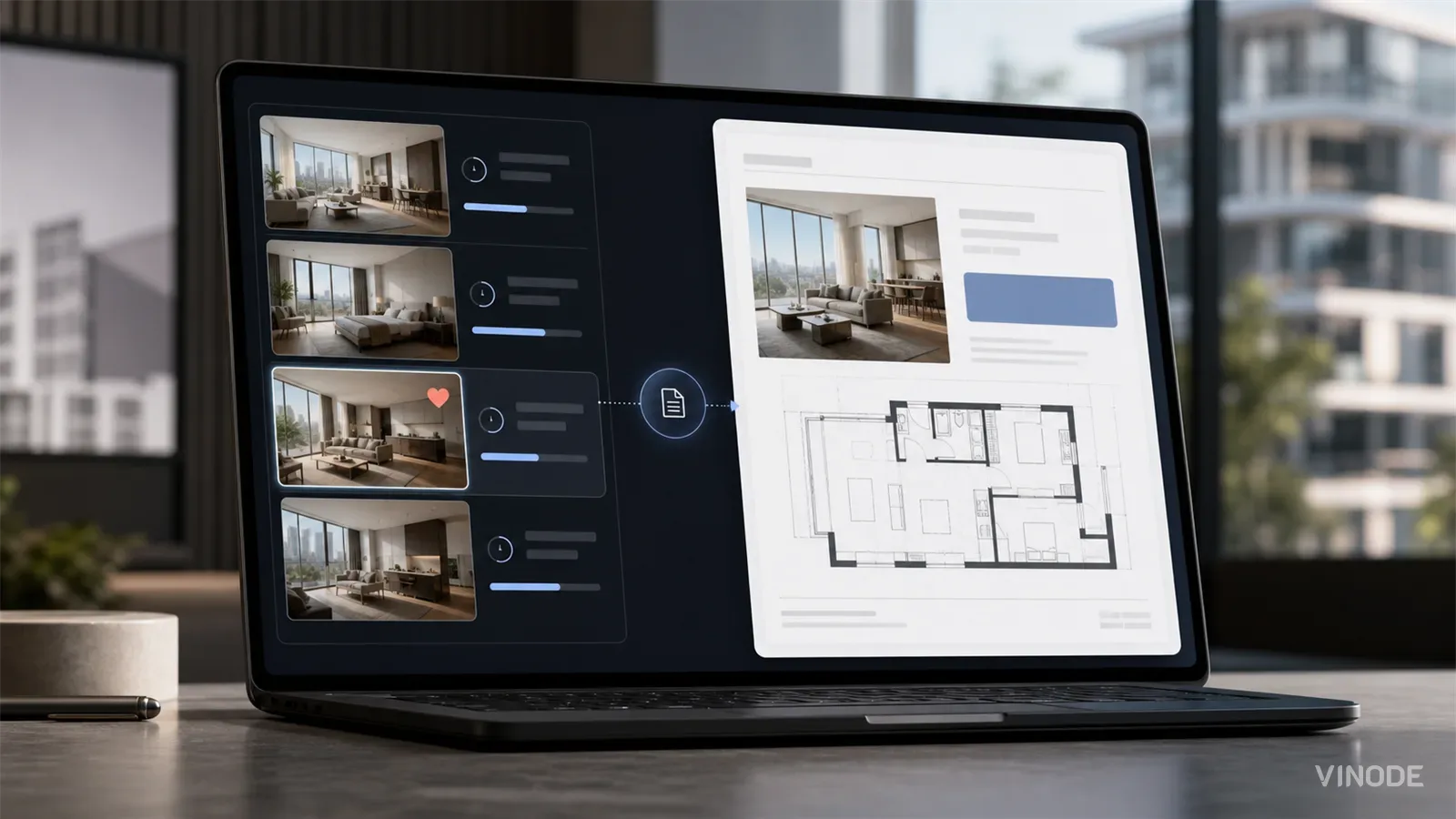
A buyer spends nineteen minutes on one two-bed, saves it, and gets the forty-one-page development brochure the next morning. Once a sales platform records the unit a buyer chose, the generic brochure becomes a decision to ignore that choice.

Expression of interest before release day: capture unit demand
640 names and no idea which side of the building they want. An expression of interest campaign pays off when the form is joined to the units each buyer explored, and each of these checks has a pass, a fail and a cost.

We measured when a pipeline crosses the presale line, not just whether it will
When GTHA opening-quarter absorption averaged 66%, the sold percentage was enough to forecast a presale crossing date. Then absorption fell to 17%. Three pipeline inputs produce the crossing date your lender asks for: stage-conversion rates, a cancellation haircut, and remaining inventory.